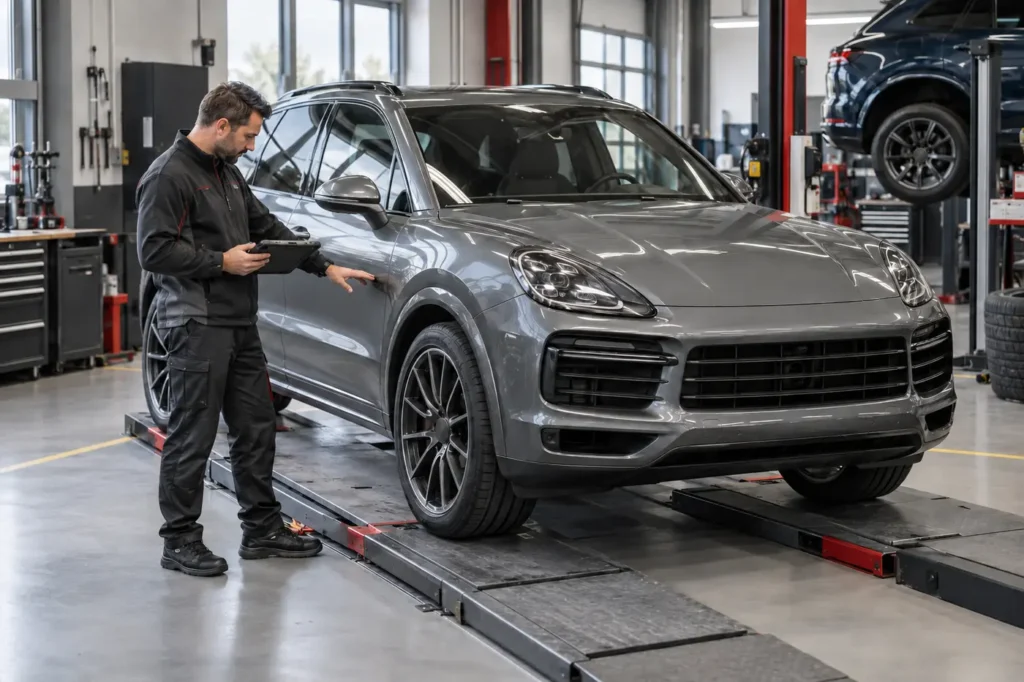
A Porsche Cayenne air suspension fault means the chassis control system has detected an abnormal condition, but the warning alone does not identify the failed part. A leaking air spring, damaged line, weak compressor, valve-block fault, ride-height sensor problem, low system voltage or control issue can produce similar messages. The useful clues are which corner changes height, how quickly it happens, when the compressor runs and which fault codes and live values return during testing.
The same diagnostic principle applies to air-equipped Panamera and Macan models, but their hardware differs by generation, model year, market and option. Confirm the vehicle’s VIN equipment and installed hardware before interpreting a symptom or ordering parts. Steel-spring wear is a separate concern involving joints, bushes and dampers rather than an air circuit.
What the warning means
Porsche air suspension replaces conventional coil springs with pressurised air springs or air struts. Depending on the model, the system also includes a compressor or air-supply unit, reservoir, valve unit, pressure and ride-height inputs, air lines and an electronic control unit. It keeps the body level as the load changes and, where equipped, allows different ride heights.
The warning in the instrument cluster reports a system-level problem. It does not prove that the compressor has failed, and it does not prove that an air strut is leaking. A workshop should identify the vehicle’s equipment, preserve the stored faults and test the system before replacing an expensive assembly.
PASM is not another name for air suspension
Porsche Active Suspension Management, or PASM, electronically controls damping. It can be fitted with steel springs or combined with air suspension. A Porsche advertised with PASM does not automatically have air springs.
| System | What it controls | What owners should know |
|---|---|---|
| Steel springs | Vehicle support through conventional coil springs | There is no air circuit to leak, although dampers, mounts, arms and joints still wear. |
| PASM | Electronic damper control | It may be paired with steel springs or air suspension, depending on the model and equipment. |
| Adaptive air suspension | Ride height, self-levelling and spring support, usually with PASM damping | Diagnosis can involve pneumatic, electrical and mechanical checks. |
| PDCC | Active roll stabilisation | This is a separate chassis system. Its faults should not be labelled as air-spring faults without evidence. |
| Porsche Active Ride | Hydraulically active suspension control on certain current models | It is not the same system as conventional adaptive air suspension and requires its own diagnostic procedure. |
Symptoms and clues
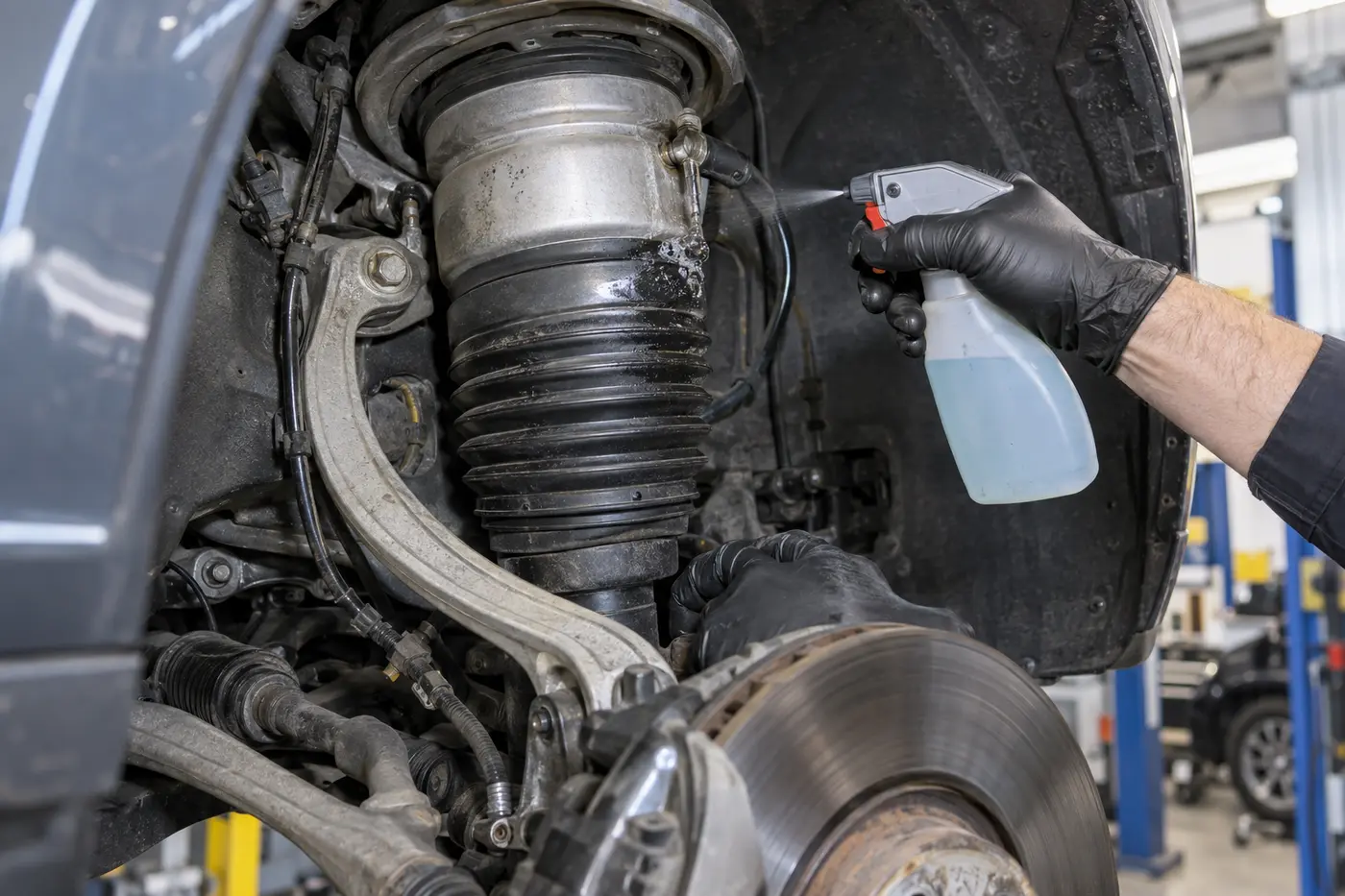
A symptom narrows the test plan. It rarely names the failed component on its own. Record the conditions when it occurs instead of repeatedly changing the ride height in an attempt to clear it.
| Observation | What it suggests | What it does not prove |
|---|---|---|
| One corner is lower after comparable overnight parking | A local loss of height, sensor reading error or valve-control issue at that corner | That the air strut must be replaced without a retention and control test |
| Both corners on one axle are low | A shared supply, valve, control or load-related issue may be involved | That two air springs failed at the same moment |
| The compressor runs often or for a long time | The system is trying to restore pressure, possibly because of leakage or weak compressor output | That the compressor is the root cause rather than a casualty of an existing leak |
| The vehicle will not rise, or rises slowly | Insufficient supply pressure, restricted delivery, a valve problem, leakage or an invalid sensor input | Which component is responsible |
| A chassis warning appears while height looks normal | An intermittent sensor, linkage, wiring, voltage, pressure or control fault is possible | That the warning is harmless |
| Ride is harsh or bouncy but height is stable | PASM damping, tyres, dampers, mounts, bushes or joints may need attention | That an air leak exists |
Mechanical wear lookalikes
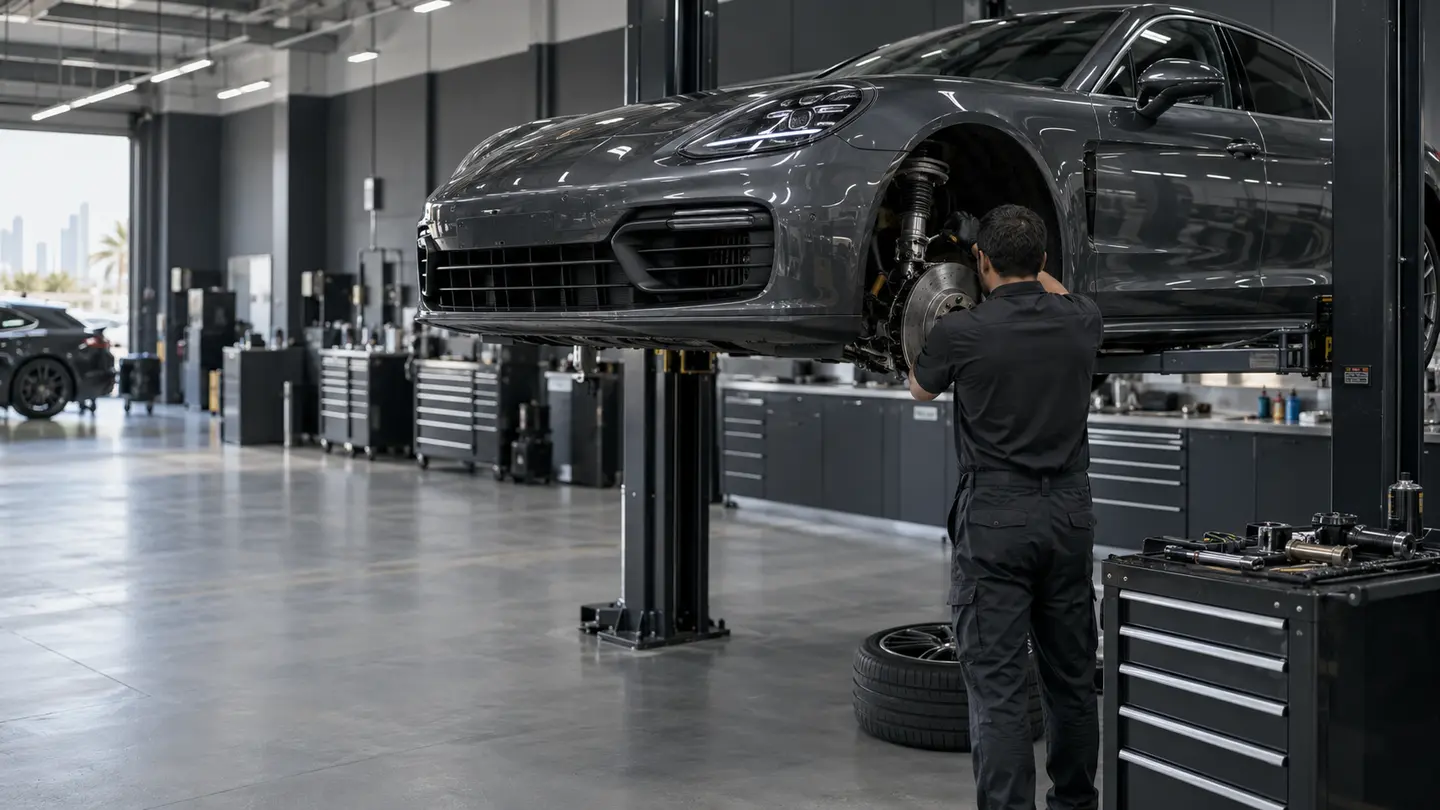
Not every suspension complaint comes from the air circuit. Excessive bounce can indicate weak damping. Knocks and creaks may involve mounts, bushes, ball joints, anti-roll-bar links or loose hardware. These steel-spring and mechanical wear concerns need their own inspection and should not be diagnosed as air leaks from the symptom alone.
Steering drift and uneven tyre wear may be caused by tyre pressure, tyre damage, wheel alignment, ride-height error or worn joints. Alignment readings can expose the effect of incorrect ride height, but alignment alone does not identify why an air-suspension vehicle is sitting low. The height fault should be corrected first when it affects the geometry.
Air suspension by model
Cayenne generations
Air suspension has been available across the E1, E2 and combustion E3 Cayenne generations, but it was not fitted to every vehicle. The newer Cayenne Electric has its own platform and specification. Specification varies by market, trim and option selection. A VIN equipment check and a physical inspection are more reliable than assuming from a badge or model year.
First-generation Cayenne 955 and 957
Porsche describes air suspension and PASM on the first-generation Cayenne E1. The 9PA vehicles, commonly identified as 955 or facelift 957, can have self-levelling air suspension and adjustable ride height. On an older vehicle, age can affect more than the rubber air spring. Line connections, seals, the compressor, valve unit, sensor links, wiring and previous repairs all deserve inspection.
A Cayenne that settles at one corner while parked gives useful evidence of local height loss, but the low corner still needs to be separated from a sensor or valve-control issue. If a tired compressor is replaced without finding a leak that made it run excessively, the new unit may be asked to compensate for the same unresolved fault.
Second-generation Cayenne 958
Porsche’s E2 generation history dates its launch to 2010, while a 2011 Cayenne Turbo specification documents air suspension with PASM on that variant. On equipped E2 vehicles, pneumatic height control and electronic damping must be assessed separately. A VIN check matters more than applying the same specification to every 2011–2018 car. Diagnostic work should distinguish a loss of air support from a PASM damper or electrical fault. A harsh ride with no loss of height points the investigation in a different direction from a corner that sinks over several hours.
Third-generation combustion Cayenne E3
Porsche described optional three-chamber adaptive air suspension at the E3 Cayenne launch. For the extensively revised combustion Cayenne introduced in 2023 for the 2024 model year in some markets, Porsche describes optional two-chamber air suspension with two-valve damping, alongside steel springs with PASM on relevant versions. Market launch dates and standard equipment differ. Verify the VIN and fitted parts. Similar dashboard wording does not make the test values or parts interchangeable.
On a newer Cayenne, retained fault memory, control-unit live data, pressure behaviour and ride-height values are especially important. Calibration should follow the applicable Porsche procedure after a confirmed repair. It should not be used to hide a mechanical height loss.
Panamera systems
First-generation Panamera 970 and second-generation 971 specifications vary. Porsche documents three-chamber air suspension on the 2018 Panamera GTS, which does not establish it for every 971. In Porsche’s third-generation Panamera launch specification, two-chamber, two-valve air suspension with PASM is standard and Porsche Active Ride is optional on E-Hybrid versions. Confirm the specific model year, region and options before applying that description to an imported car.
Common owner observations include one end sitting low, slow levelling, frequent compressor operation, a stored chassis warning or a ride-quality change. The body shape can make small differences look dramatic, so compare measurements on level ground and under similar loading. A visual impression is not a substitute for measured corner heights and fault data.
If the Panamera has Porsche Active Ride, a one-chamber air spring works with an electrically driven hydraulic pump at each active damper. Its presence does not make ordinary air-suspension troubleshooting sufficient. The active hydraulic control changes the diagnosis and repair procedure.
Macan systems
Porsche Macan air suspension problems should start with an equipment check. Availability differs across the 95B-generation combustion Macan range. For example, Porsche lists sport air suspension as standard on the updated Macan GTS announced in 2021. That example should not be applied to every GTS model year or regional specification. Other Macans use steel springs, with or without PASM. Confirming the fitted hardware prevents a damper, mount or control-arm problem from being misdescribed as an air-suspension leak.
On an air-equipped Macan, a low corner, slow height change, prolonged compressor run or chassis warning should be investigated with the same evidence-led sequence used on Cayenne and Panamera. Part numbers and normal live values remain model-specific.
The electric Macan introduced in 2024 has its own platform and suspension specifications. Porsche’s US launch information lists adaptive air suspension as standard on the rear-drive Macan and Macan 4S. Equipment in other markets and later model years needs a VIN check. Do not carry over a combustion Macan diagnosis or parts list solely because the model name is shared.
When to stop driving
Arrange recovery rather than continuing to drive if the body has dropped enough for a tyre to rub, the vehicle is unstable, suspension hardware is loose or broken, the underside repeatedly strikes the road, or a red instruction tells you to stop. A severe height difference can alter wheel geometry and braking stability as well as damage a tyre or other suspension parts.
If the vehicle remains level, steers and brakes normally and shows only an amber warning, avoid unnecessary journeys and have it checked promptly. The exact wording in the owner’s manual and the vehicle’s behaviour should guide the decision. Do not crawl beneath a lowered air-suspension vehicle unless it is supported using the correct workshop procedure.
What owners can record
- Photograph the warning before switching the vehicle off.
- Note the selected ride height, drive mode, outside temperature, load and time since parking.
- On level ground, photograph all four wheel arches from comparable angles.
- Record whether the whole vehicle, one axle or one corner changes height.
- Listen from outside for compressor operation without placing yourself beneath the vehicle.
- Check whether the symptom appeared after a battery problem, wheel alignment, suspension work or impact.
- Keep the fault present for diagnosis where safe. Repeatedly clearing codes or cycling the ride height can remove useful context and overwork the compressor.
These observations help reproduce the complaint. They do not replace pressure tests, electrical measurements or a physical inspection.
How workshops diagnose faults
- Identify the suspension specification. Confirm the model, generation, market equipment and relevant option data from the VIN and the hardware on the vehicle.
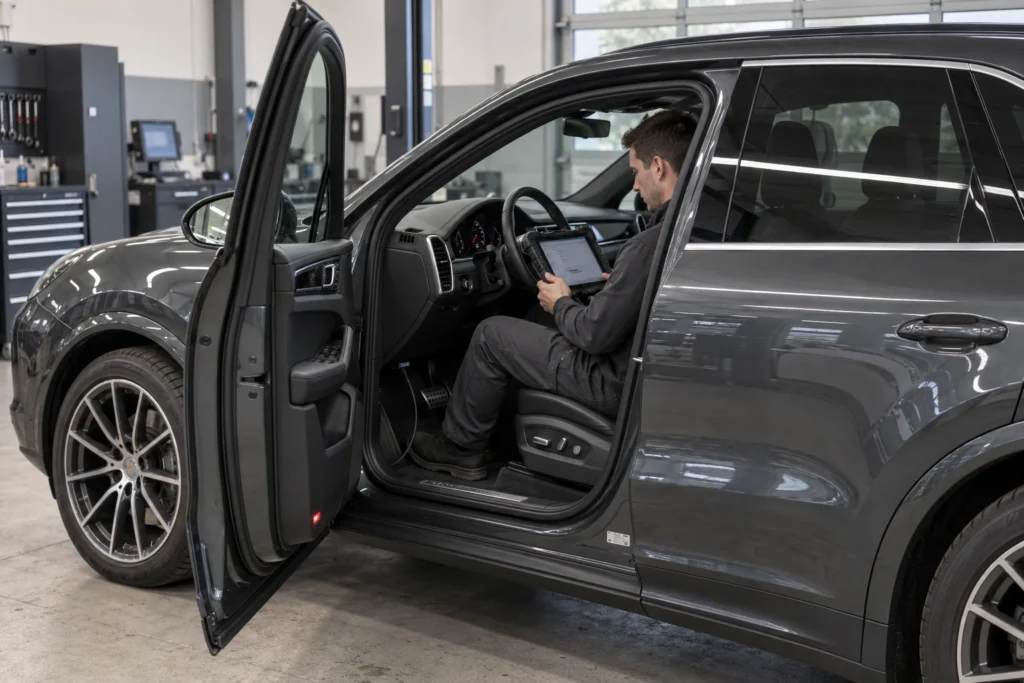
- Preserve the evidence. Read all relevant control units before clearing anything. Record fault status, freeze-frame information where available and live ride-height or pressure values.
- Measure the stance. Place the vehicle on level ground under controlled loading and compare all four corners with the specified measuring points.
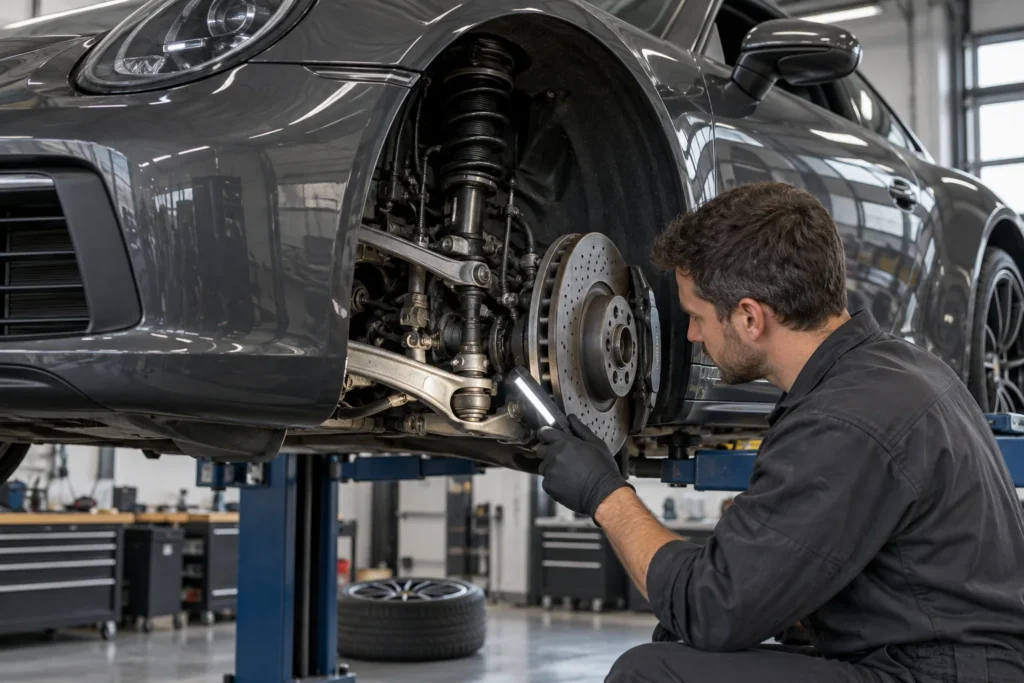
- Inspect both pneumatic and mechanical parts. Check air springs or struts, lines, fittings, valve unit, compressor mounting, sensor arms, wiring, dampers, bushes, joints, tyres and signs of earlier repair.
- Test the suspected path. Depending on the evidence, this may include pressure build-up and retention, leak detection, compressor output and current supply, valve activation, sensor plausibility and voltage checks.
- Repair and verify. Follow the applicable depressurisation and filling procedure, calibrate when required, align the vehicle if ride height or geometry has been disturbed, then repeat the original parking or road-test conditions.
Repair decisions
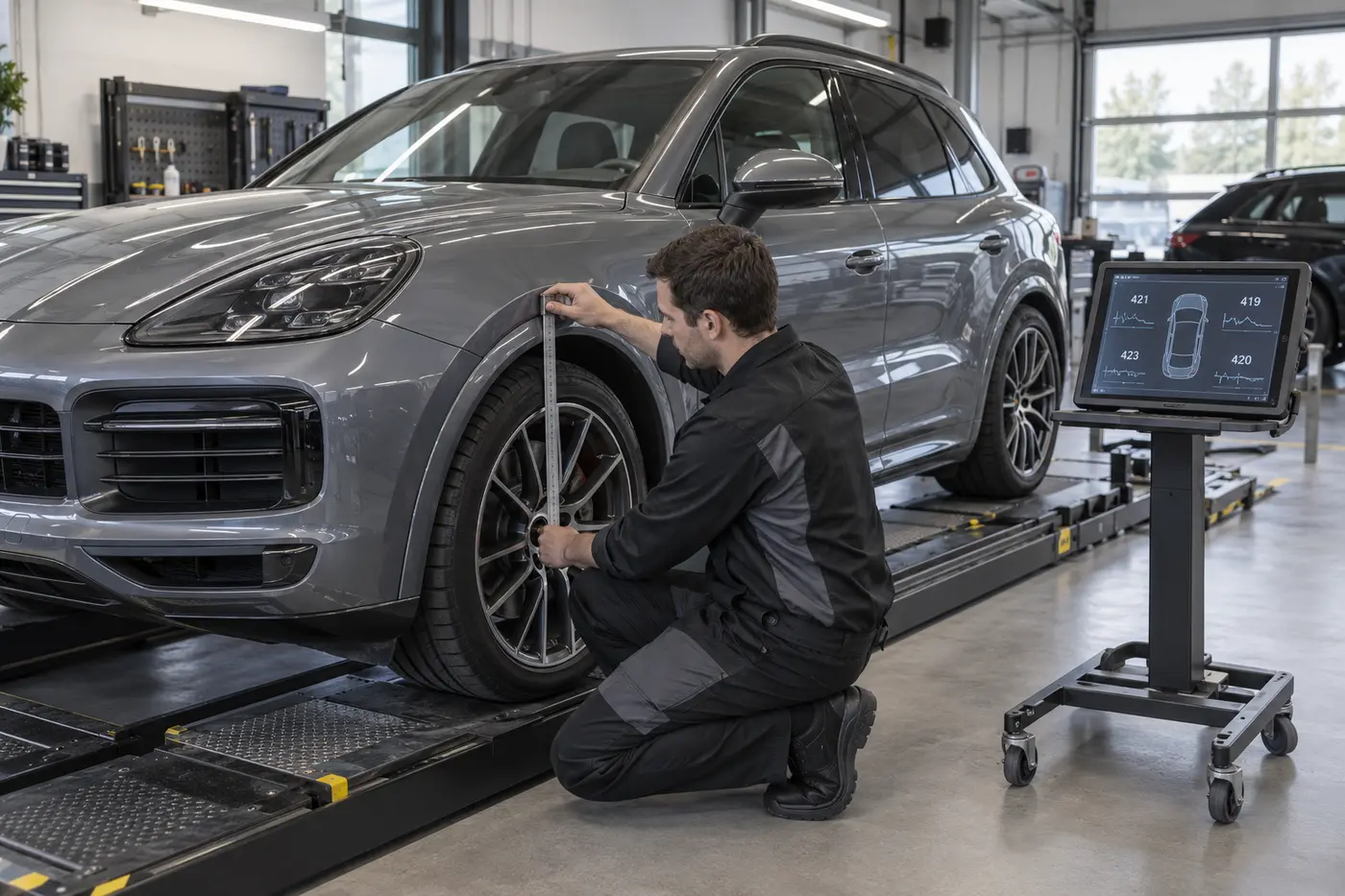
The correct repair scope depends on the failed function and the condition of connected parts. Replacing the most visible component can waste money if it is reacting to another fault.
| Confirmed finding | Likely repair direction | Verification after repair |
|---|---|---|
| Leak at an accessible line or approved connection | Repair or replace the affected line or fitting using the correct procedure | Pressure retention and repeat height check |
| Air spring or air strut will not retain pressure | Replace the confirmed leaking unit and inspect the opposite side comparatively | System fill, calibration where required and an overnight stance check |
| Compressor output is below specification | Correct its electrical or supply fault and replace the unit if testing confirms internal weakness | Pressure build time, current behaviour and leak-free system operation |
| Valve unit does not control the tested circuit | Address the valve or its wiring after ruling out line and strut leakage | Commanded corner response and pressure retention |
| Ride-height signal is implausible | Inspect linkage, mounting, wiring and sensor before calibration or replacement | Live-value plausibility through suspension movement |
| Ride height is stable but damping is poor | Investigate PASM damper, mount, tyre and mechanical suspension condition | Fault-memory check and controlled road test |
Paired replacement can be sensible when the repair procedure, product warranty or comparative wear supports it, but replacing all four corners by default is not evidence-led. Ask the estimate to name the confirmed failure, the test result, the proposed parts and whether calibration and alignment are included.
When to seek an inspection
A warning that returns, a corner that changes height, repeated compressor operation or an uncertain previous repair deserves a structured inspection. Our suspension team in Al Quoz 4 can identify the fitted system, scan the chassis control units, measure the vehicle and test the suspected pneumatic or mechanical path before a repair is quoted.
Need a suspension diagnosis?
Tell us the model, warning message and which corner or axle changes height. We can advise on the next inspection step without guessing at parts.
Checks before buying
First verify whether the car has steel springs, PASM with steel springs, conventional adaptive air suspension or, on an applicable newer model, Porsche Active Ride. Then inspect it after a cold or overnight park if the seller permits. Compare all four corners on level ground, watch the complete start-up and height-change sequence, and listen for prolonged compressor operation.
Review invoices for part brands, replaced corners, compressor work, calibration and alignment. A scan should be completed before stored chassis faults are cleared. If a warning is present or the stance changes, use the result to request diagnosis rather than treating the cost of one guessed component as the entire risk. A pre-purchase inspection can combine the suspension checks with an assessment of the rest of the vehicle.
Common questions
What does a Porsche Cayenne air suspension fault mean?
It means the control system has detected an abnormal condition affecting the suspension or its inputs. The message does not identify one failed part. Fault memory, live values, corner-height measurements and pressure or electrical tests are needed to separate a leak, compressor, valve, sensor, voltage or control problem.
Can you drive with a Porsche air-suspension warning?
Do not drive if the vehicle is severely low, unstable, rubbing a tyre, striking the road, has loose or broken hardware, or displays a red stop instruction. If it remains level and behaves normally with an amber warning, avoid unnecessary trips and arrange prompt diagnosis.
Why does one corner drop overnight?
A repeatable drop at one corner suggests that corner’s pressure is not being retained or its height is being reported or controlled incorrectly. The air spring, strut, line, connection, valve path, sensor and control commands should be checked before a part is chosen.
Is PASM the same as air suspension?
No. PASM is Porsche’s electronically controlled damping system. It can work with conventional steel springs or with adaptive air suspension, depending on the vehicle’s specification.
Is the compressor always the cause?
No. A leak can make a healthy compressor run too often until it overheats or wears. Compressor output should be tested, but the rest of the system must also retain pressure or the underlying problem will remain.
Does air-suspension repair require calibration?
Some repairs and component removals require ride-height calibration using specified measuring points and a suitable diagnostic tool. The requirement depends on the model and repair procedure. Calibration cannot correct a component that is still leaking or mechanically damaged.
Do all Cayenne, Panamera and Macan models have air suspension?
No. Availability varies by generation, trim, market and options. PASM on its own is not proof of air suspension. Verify the VIN equipment record and the installed hardware.