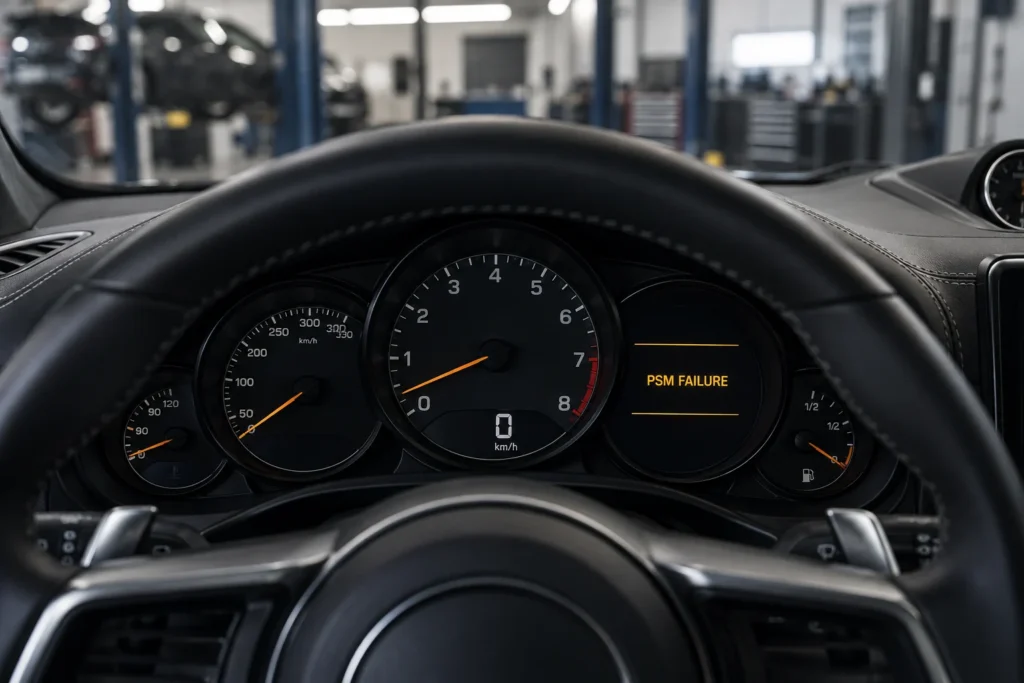

A Porsche battery warning light does not automatically mean the battery needs replacing. The message may concern low stored charge, a fault in the low-voltage charging system, or a different electrical system entirely. Read the exact wording, note whether the engine is running or the vehicle is in ready mode, and follow the instruction shown for your model.
If the display tells you to stop, or the warning accompanies smoke, a burning smell, overheating, or a change in steering or braking assistance, stop somewhere safe and arrange assistance. Do not continue a journey just because the vehicle still moves. A general guide cannot determine how much electrical reserve remains or whether a particular car is safe to drive.
This guide helps Porsche owners separate the warning from the diagnosis, prepare useful information for a workshop, and understand a battery or charging-system estimate. It covers owner decisions, not high-voltage repair or a universal jump-start procedure.
Read the exact warning
Two owners can describe a “battery light” while reporting different problems. A photograph taken after parking safely is more useful than remembering the icon alone. Include the whole message, any color or instruction, and whether it disappears or stays on.
| What you actually see | What needs distinguishing | Sensible next step |
|---|---|---|
| A battery or electrical-system warning that remains while driving | Charging or electrical-supply fault versus stored battery charge | Follow the displayed instruction and seek diagnosis. Do not assume a longer drive will recharge it. |
| A low-charge message after parking | A discharged battery versus a battery that can no longer hold sufficient usable charge | Arrange an appropriate charge and battery assessment, with investigation if the problem repeats. |
| A key-battery message | The remote-control battery versus the vehicle battery | Consult the key section of the correct owner’s manual. |
| A hybrid or electric-drive warning | Traction-battery, drive-system, or low-voltage fault | Use the exact model’s warning instructions. Do not touch high-voltage components. |
| A lamp visible only during the normal startup check | Normal display behavior versus a warning that remains afterward | Compare with the vehicle’s manual rather than a generic dashboard chart. |
Porsche’s digital driver’s manual is the starting point for model-specific warning wording, charging connections, and recovery instructions. Select the correct vehicle. This guide does not substitute a warning explanation from one generation for another.
A low-charge message only after long parking calls for a different investigation from a charging-system warning while driving. Note the parking duration and any fitted accessories if it repeats. Battery condition and parked electrical consumption may then need checking.
When the warning appears on the road
The first decision is where to stop safely, not which replacement part to buy. Avoid trying to diagnose a moving vehicle, taking a phone photograph while driving, or repeatedly switching systems on and off to see what changes.
- Read and follow the vehicle’s instruction as road conditions allow. If it directs you to stop, leave the traffic flow and stop in a safe location.
- Note accompanying symptoms once stationary. Dimming lights, several new warnings, abnormal temperature, or an unusual smell are useful details to report.
- Contact assistance or the workshop before deciding to drive farther. Explain the exact warning rather than asking whether all battery lights are safe to ignore.
- If there is smoke, fire, or another immediate danger, move people away from the vehicle and contact emergency services. Do not open or work on a suspect battery.
Do not repeatedly restart the car to test whether the warning clears. A successful restart is not proof that the charging system is healthy, and a vehicle that stops may not restart. Equally, turning off safety-critical lighting or visibility equipment is not a sensible way to extend a journey.
The same caution applies after a jump-start. Getting an engine running only answers one question: it could start with assistance at that moment. It does not establish why the charge was low or whether the car will maintain its electrical supply.
Why the model and electrical system matter
Match the electrical system to the model
Many combustion-engine vehicles use an engine-driven alternator to support the low-voltage system and charge the battery. A hybrid or electric vehicle can use a different arrangement, including a DC-DC converter supplying the low-voltage system. An alternator diagnosis should therefore start by confirming that the component and architecture actually apply to the car.
A useful booking description includes the model, model year, powertrain, and any recent battery work. “Cayenne E-Hybrid with an electrical-system message” is a different starting point from “older 911 with a warning that stays on after starting.” Neither description, by itself, identifies a failed part.
AGM battery specification
AGM means absorbent glass mat. It is a type of lead-acid battery, distinct from a conventional flooded design. VARTA’s AGM explanation describes this construction and the need to check vehicle compatibility.
Do not select a replacement using physical size alone. The installed specification, approved technology, capacity, starting rating where applicable, mounting, connections, and any battery-management requirements need to match the vehicle. A lithium battery is not interchangeable with an AGM battery just because both are described as low voltage.
Traction and low-voltage systems
The range or charge percentage shown for an electrified Porsche does not provide a complete assessment of its low-voltage supply. Conversely, a low-voltage battery concern does not prove the traction battery has failed. Treat those as separate diagnostic questions until the vehicle’s fault information connects them.
Leave orange cables, high-voltage housings, traction batteries, and isolation procedures to appropriately qualified personnel. Do not use a combustion-car jump-start diagram for an unfamiliar hybrid or EV.
What a proper diagnosis should establish
Ask for a diagnosis that separates battery condition, charging performance and wiring integrity. The purpose is to find out whether the battery is the cause, a consequence, or one of several faults.
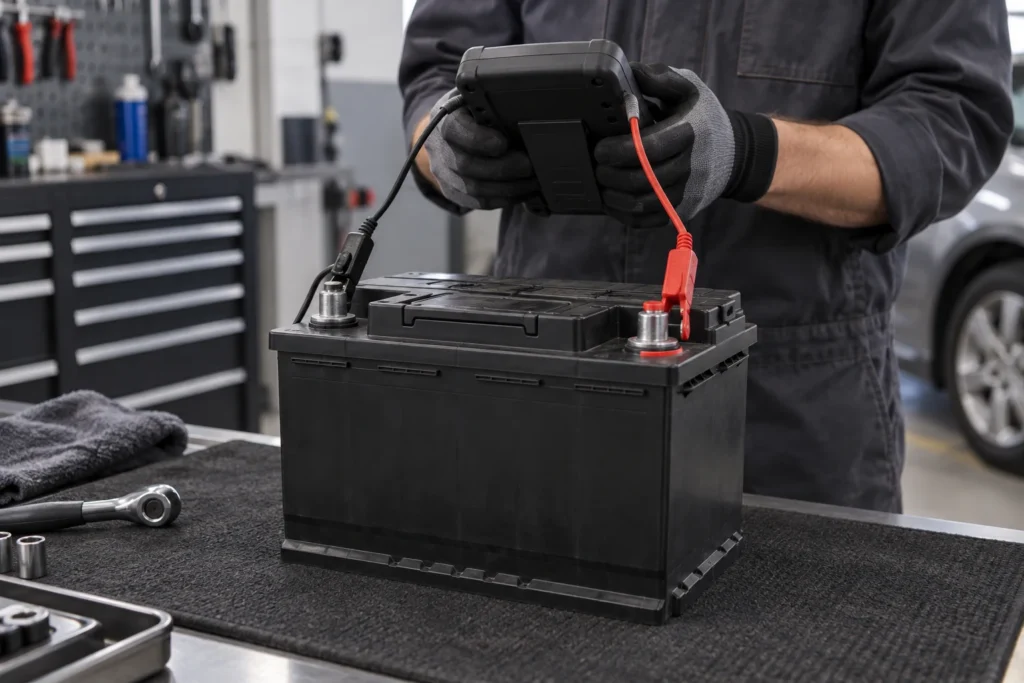
Battery condition before a replacement decision
A workshop should identify the fitted battery and use a suitable test method. State of charge describes how charged it is now. State of health concerns its ability to perform compared with what is required. A discharged battery may need an appropriate charge and retest before a useful conclusion can be reached.
A voltage reading is a measurement, not a full diagnosis. VARTA’s battery-testing guidance distinguishes state of charge from an assessment of battery health. Temperature, recent charging, operating state, chemistry, and the test method affect interpretation. This is why a universal “healthy Porsche voltage” table would be misleading.
Ask what was tested, under which conditions, and what the result means. “Battery bad” without the relevant specification or test result is less informative than a recorded test and a clear explanation of why replacement is justified.
Charging performance while the fault is present
For an applicable alternator-equipped car, the workshop may need to evaluate the alternator, its drive, control, and electrical connections under the appropriate operating conditions. On another architecture, the relevant supply component and test procedure will differ.
The useful result is not simply a number measured once. Ask whether the observed output matches the vehicle’s commanded behavior, whether the fault was reproduced, and whether associated wiring or drive problems were excluded. An intermittent warning can require a different test plan from a permanent no-charge condition.
Connections and voltage loss
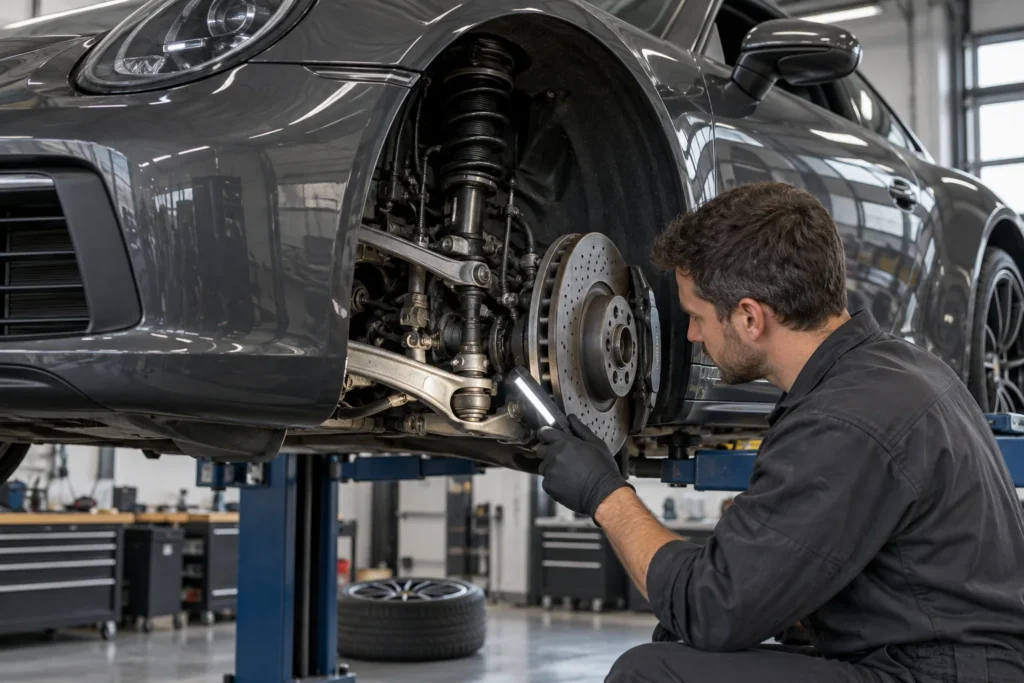
A poor connection can prevent electrical power from reaching a component even when the battery itself tests acceptably. A technician may inspect relevant terminals, grounds, cables, and connectors, then use voltage-drop testing under suitable conditions to investigate resistance.
Visible corrosion is worth documenting, but appearance alone cannot settle every connection problem. Do not dismantle terminals or probe unfamiliar connectors as an owner experiment. Access and disconnection can have model-specific consequences, and accidental shorts can cause injury or damage.
Stored faults and their timing
Several control units may record warnings during an electrical-supply event. That does not mean every named system has independently failed. Preserve the fault information before clearing it, then establish which faults return after the underlying supply issue is addressed.
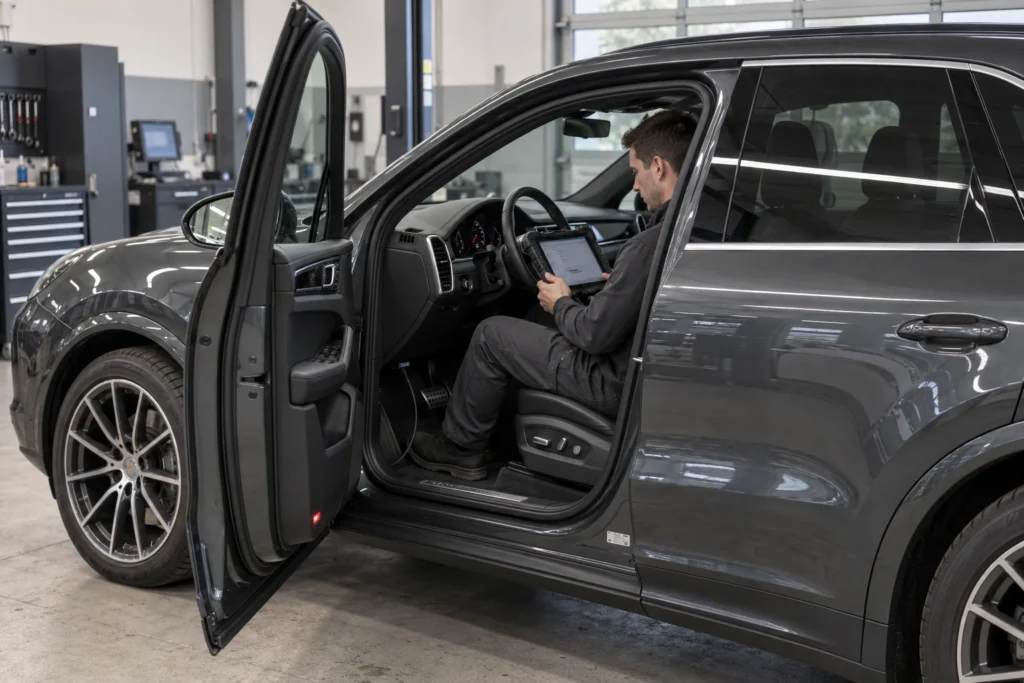
Where an electrical concern accompanies other warning messages, Porsche computer diagnostics can form part of a wider investigation. A scan is evidence to interpret alongside testing, not an automatic shopping list of modules to replace.
Charging, repair, or replacement
The appropriate outcome depends on the findings. Charging can be useful when the battery is suitable for recovery and the cause of low charge is understood. It cannot repair a damaged battery, restore a failed charging component, or eliminate an ongoing electrical drain.
Replacing the battery makes sense when testing and the vehicle specification justify it. Repairing a cable, connection, charging component, or identified drain may be the required primary work. Sometimes the battery has been affected by the original fault and both repairs are necessary.
For Porsche battery replacement, request confirmation of the exact replacement specification and whether the model requires battery registration, adaptation, or other documented setup. Do not assume every Porsche has the same requirement, or that an arbitrary reset is enough.
If a proposed battery differs from the original specification, ask why the alternative is suitable and which vehicle or product documentation supports that decision. “It fits” and “it has a longer warranty” do not answer the compatibility question.
What should be included in an AED estimate
An accurate estimate depends on the model and confirmed fault. This guide does not publish an invented Dubai-wide price range. A battery-only supply price and a completed electrical diagnosis are different services and should not be compared as though they include the same work.
Ask the workshop to itemize:
- Diagnostic checks and whether further investigation needs separate approval.
- Battery brand, part number, technology, and specification if replacement is justified.
- Labor, access work, and required vehicle setup.
- Any separately diagnosed cable, charging-system, or accessory fault.
- Post-repair checks, disposal arrangements, and written warranty terms actually offered.
- Whether VAT and any collection or recovery charges are included in the quoted total.
For an intermittent warning, agree on the next diagnostic step and its approval limit. A proposed replacement should follow findings that explain the warning, rather than a single stored code or a one-time voltage reading.
After the warning is repaired
Keep the test findings and invoice. If the warning returns, note the exact message and whether it appeared during driving, charging or startup. Those details help distinguish a repeat fault from a new one. A battery age rule by itself is no substitute for model requirements and condition testing.
Questions to settle before collecting the car
Was the cause identified, or was only the symptom addressed? Ask whether the work explains both the warning and the circumstances in which it appeared. A new battery should not be the only evidence supplied for a charging-system complaint.
Were relevant tests repeated after the repair? Request confirmation that the repaired system was checked under appropriate conditions and that persistent fault messages were investigated. An intermittent problem may require observation beyond a short collection check.
What should I do if it happens again? Get a clear instruction about the warning, especially if the original message required stopping. Record the circumstances and contact the workshop rather than repeatedly resetting the vehicle.
The most useful message to send is short: your Porsche model and year, exact warning wording, when it appears, whether it starts or enters ready mode, and any accompanying symptoms. Those details help the workshop plan the next test instead of guessing at the next part.