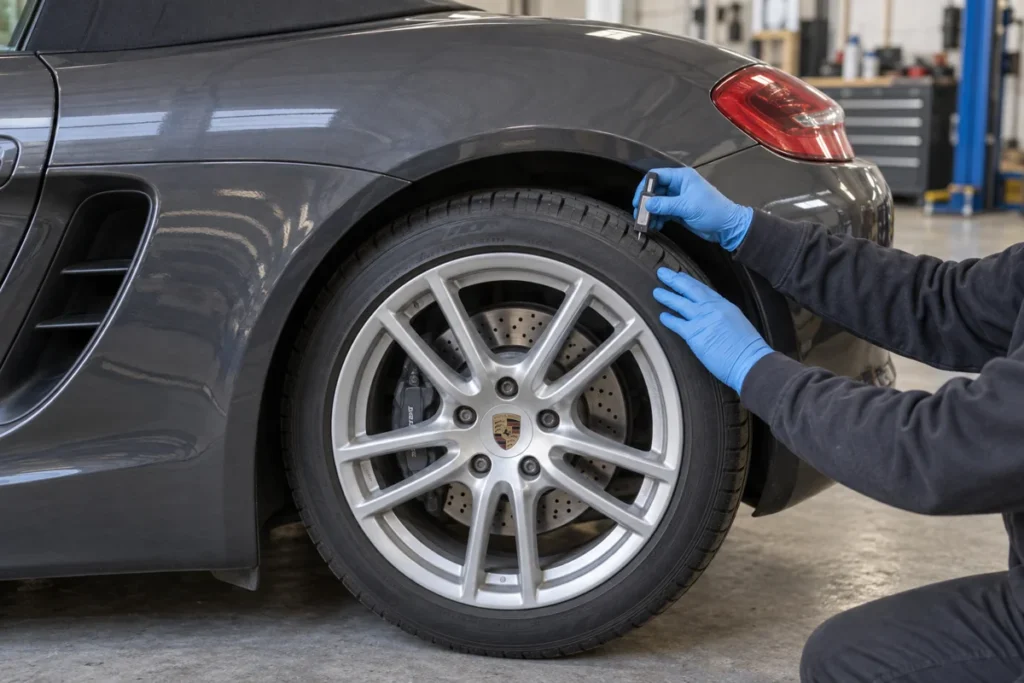

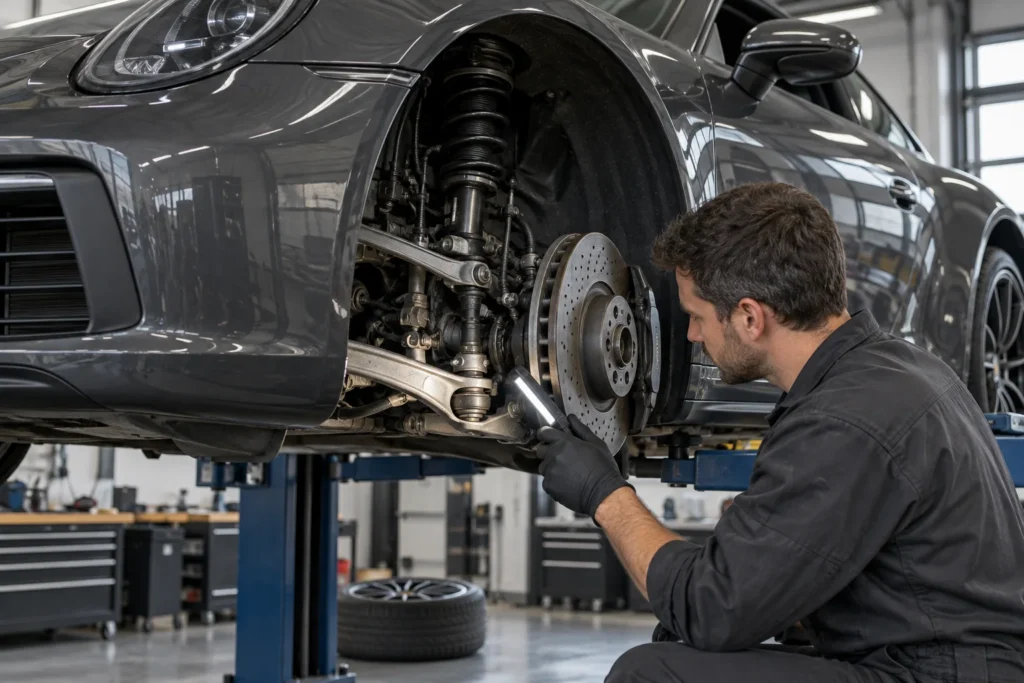
A new knock over a speed bump, steering that feels less settled or an unevenly worn tyre can make a familiar Porsche feel different. Suspension wear is one possibility, but tyre pressure, wheel damage, brakes and other nearby parts can produce similar symptoms. The right repair starts by separating those possibilities.
This guide covers mechanical bushes, ball joints, links, springs, mounts and dampers. It explains their different jobs, what owners can observe safely and how a workshop decides whether a part needs replacement. A car dropping overnight or displaying an air-suspension warning follows a separate diagnostic path.
When to stop driving
Stop somewhere safe and arrange recovery if steering becomes unpredictable, a wheel appears loose, a tyre rubs the body or the car becomes unstable. Visible broken suspension parts, severe tyre damage or a warning instructing you to stop also change the decision. Do not continue at motorway speed to see whether the symptom settles.
A hard kerb or pothole impact deserves particular attention when followed by a loud knock, altered steering or vibration. Damage may involve the wheel, tyre and suspension together. A car that still moves is not necessarily fit for the journey you intended to make.
For a mild noise with stable handling, avoid unnecessary driving and arrange an inspection soon. That is different from declaring the car safe for continued use. Describe the symptom when booking so the workshop can advise whether it should arrive by recovery. Never crawl beneath a vehicle supported only by a jack.
Follow the pattern of the symptom
The circumstances of a noise are more useful than a guess about the part. A knock while one wheel crosses a small bump differs from a hum that builds with road speed. Note the conditions during ordinary driving, without deliberately swerving, braking sharply or hitting bumps to reproduce it.
| What you notice | Parts or conditions worth considering | What helps the inspection |
|---|---|---|
| A light knock on uneven surfaces | Anti-roll-bar links, bushes, joints, mounts or loose nearby items | Whether it occurs on one-wheel bumps or larger movements |
| A thud when braking or changing direction | Bush or joint movement, mounts, brake hardware | Whether the steering or wheel position also feels different |
| Steering pull or wandering | Tyres, pressure, geometry, steering or suspension movement | Recent tyre work, impacts and the road conditions |
| Vibration within a speed range | Tyre or wheel condition, balance, hub or chassis issues | Whether it occurs steadily or mainly during braking |
| Repeated body movement after a bump | Damping, tyres, springs or the fitted chassis setting | How the response has changed from the car’s usual behaviour |
Noise travels through the body, so the corner that sounds loudest from the seat is not always the source. A loose boot item, underbody panel or exhaust mounting can also imitate a suspension rattle. A useful inspection starts broadly enough to avoid overlooking a simple cause.
What bushes actually do
A suspension bush helps locate a component while allowing its designed movement. Rubber or other compliant material also helps manage vibration and noise. It is normal for many bushes to flex. The question is whether that movement remains appropriate for the design or has become excessive through damage or separation.
A worn bush may allow an arm to shift differently under braking, cornering or a bump. The driver might notice a thud, less precise steering or a change in tyre wear. Those observations help the technician choose where to look, but the final assessment comes from the bush and surrounding assembly.
Surface cracking and structural separation are different findings. A photograph of aged rubber does not tell the whole story. The inspection should consider its position, loading, attachment and movement, including whether the inner and outer parts still function together as intended.
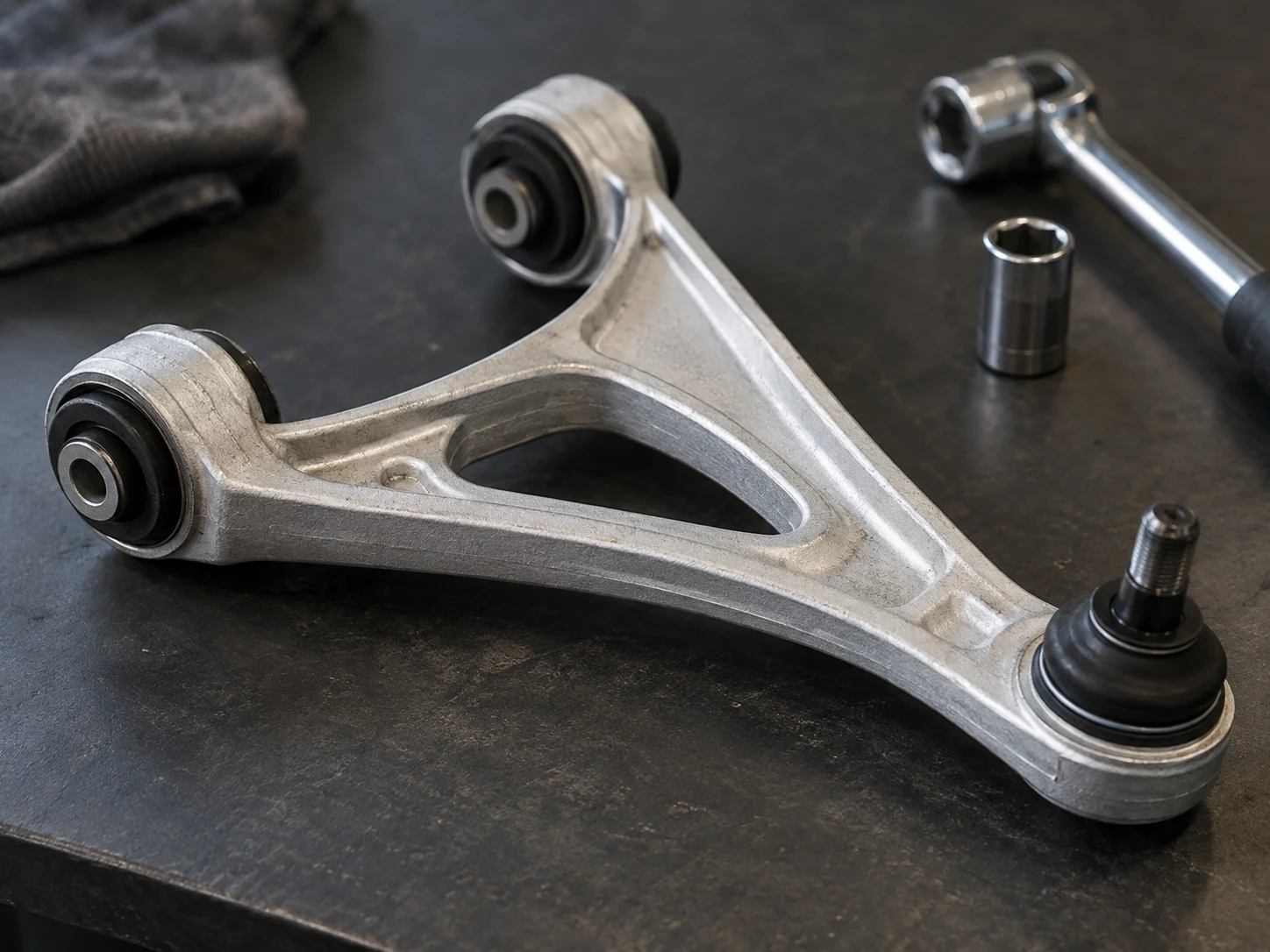
Some bushes can be serviced separately, while other repairs involve a complete arm. Availability, the condition of the arm and the approved repair method affect that choice. Ask whether the proposed replacement is required by the component design or simply offered as a convenient assembly.
Ball joints and links have different roles
A ball joint allows articulation while connecting suspension components. Its protective boot helps keep the joint’s working surfaces protected. Damage, contamination or movement beyond the relevant criteria can make it a repair priority, particularly where the joint is important to controlling wheel position.
Anti-roll-bar links connect the bar to the suspension. Their joints and mountings can contribute to knocking, especially as the suspension moves over uneven ground. A noisy link and a worn main suspension joint are not interchangeable diagnoses, even if both noises seem to come from one wheel arch.
Inspection methods depend on the suspension layout and how a joint is loaded. The same hand movement or pry-bar action cannot be used as a universal pass-or-fail test. MOOG’s ball-joint inspection guidance distinguishes joint designs and measurement directions. The relevant Porsche procedure determines how the actual car is assessed.
Lifting, supporting and loading joints are workshop tasks. Owners should not try to recreate an internet inspection method using an emergency jack. Stored spring energy, moving assemblies and incorrect support can make apparently simple checks hazardous.
Dampers control movement rather than carry every load
Springs and dampers work together but serve different purposes. A spring supports load and allows suspension travel. A damper controls the movement that follows. A mount connects the assembly and can itself become a source of noise or unwanted movement.
Poor damping may show up as less settled body control, repeated movement or a change in how the tyre follows an uneven surface. Tyres and chassis settings influence those sensations too. A firm sports suspension should not be condemned simply because it feels different from a softer SUV.
Leakage needs a careful description. A light film is different from fluid actively running down the unit. The KYB damper inspection guidance also considers damaged rods, mounting problems and changes in vehicle control. A dry-looking unit can still require assessment if its behaviour has deteriorated.
Fluid elsewhere in a wheel arch may come from another source. The workshop should identify the origin before ordering a damper. Likewise, a broken spring, damaged bump stop or deteriorated mount may need attention even when the damper itself is serviceable.
PASM does not mean air suspension
Porsche Active Suspension Management, or PASM, concerns controlled damping on equipped cars. Seeing PASM in a specification does not establish that the vehicle has air springs. The fitted spring system, damper controls and any ride-height equipment need to be identified separately.
For example, Porsche’s 2024 911 chassis information describes PASM dampers, springs and anti-roll bars, with separate front-axle lift equipment on applicable configurations. Front-axle lift is not evidence of four-corner air suspension. Do not apply an SUV air-system diagnosis to a 911 simply because both have an adjustable chassis feature.
An electronically controlled damper adds electrical connections and control functions to the mechanical assessment. A chassis fault message can direct an electrical investigation, but it does not identify a worn bush. Equally, a clean scan cannot rule out mechanical play in a joint.
For sinking ride height, frequent compressor operation or an air-system warning, use the Porsche air-suspension guide. Keeping those faults separate prevents a mechanical-wear article from becoming a second version of the air-suspension diagnosis.
Tyres can imitate suspension wear
Tyres are the first point of contact with the road. Incorrect pressure, uneven tread, damage or a change in construction can alter noise, comfort and steering feel. Check these before assuming the change must come from an expensive chassis component.
Use the cold-pressure instructions for the exact vehicle, tyre fitment and load. Do not copy a pressure from another model or release air merely because a reading rises after driving. The handbook and vehicle label provide the relevant starting point for routine owner checks.
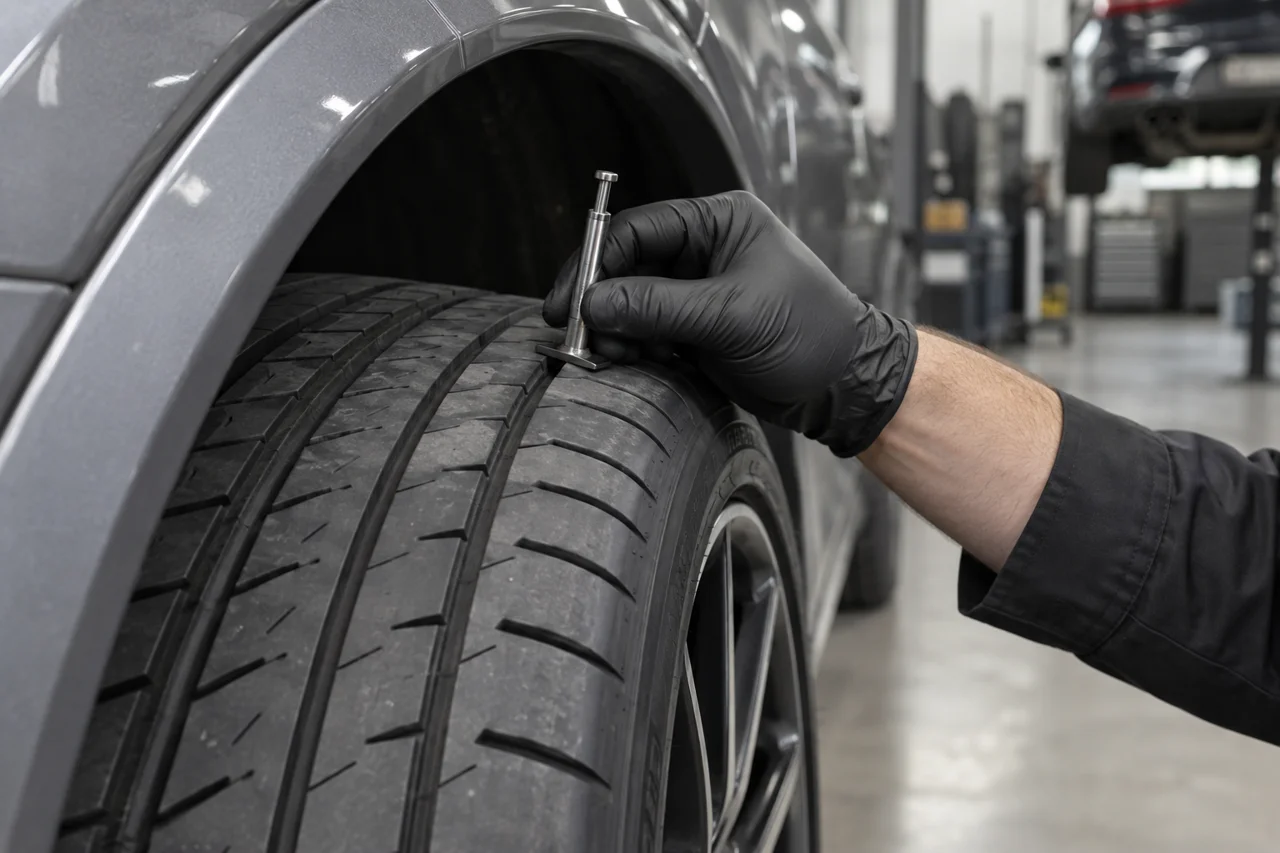
Look at both inner and outer tread where you can do so safely with the car parked. The visible outer shoulder can look acceptable while another area needs attention. A bulge, exposed cord, severe cut or rapid loss of pressure calls for prompt professional help, not a suspension road test.
Tyre wear patterns suggest directions for investigation rather than identifying one component. Pressure, alignment, wheel condition and damping can interact. Replacing the tyre may address a safety issue, while the cause of its abnormal wear still needs attention to protect the replacement.
Wheel, hub and brake lookalikes
A vibration at a certain speed may relate to the rotating wheel-and-tyre assembly. A bent rim, damaged tyre or imbalance deserves consideration before bushes are replaced. After an impact, the inspection may also need to include the hub and bearing.
A hum or growl that changes with road speed is different from a short knock over a bump. Braking-related noise or vibration adds another set of possible causes. Describe when it appears rather than naming a wheel bearing or brake disc from the sound alone.
Wheel fastening and recent wheel work also belong in the history. If a wheel feels loose or the symptom began immediately after fitting, stop and have it checked. Do not keep driving while experimenting with pressures or chassis modes to make the vibration disappear.
Road surface can contribute to steering pull and tyre noise. That is one reason a technician may compare the complaint in controlled conditions after an initial safety inspection. An owner should not release the steering wheel on a public road to perform a pulling test.
Why driveway shortcuts are unreliable
Pressing down on a body corner cannot isolate the damper from the spring, tyre, vehicle weight and damping setting. A noticeable change in body movement is worth reporting, but counting bounces is not a universal replacement rule for Porsche dampers.
The same applies to comparing corner heights. Uneven ground, tyre differences, loading and the designed vehicle setup can influence measurements. Where ride-height data or sensors are relevant, their readings must be interpreted through the applicable procedure. Four identical numbers are not a general requirement for every chassis.
Prying a bush until it visibly moves is also not enough. Some movement is part of its function, and the direction and load used during inspection matter. Excessive force or the wrong contact point can damage a serviceable part and create an apparent fault.
There is no fixed mileage at which all bushes, ball joints or dampers expire. Condition, use, impact history and the vehicle’s maintenance requirements matter. A distance-based sales recommendation should still explain the actual component condition and why replacement is appropriate now.
A useful workshop inspection
The workshop should identify the chassis specification and discuss the complaint before choosing tests. A safety inspection comes before any attempt to reproduce unstable handling. Recent tyres, alignment, suspension work, wheel changes and impacts all help establish where the investigation begins.
Tyres and wheels are assessed alongside the mechanical parts. Joints, bushes, links and mounts are then checked with the vehicle supported and loaded as required. When movement is relevant, the finding should identify the location, direction and applicable assessment rather than simply describe the whole suspension as tired.
Dampers need their own condition and performance assessment. On an equipped car, control wiring and fault information may also be relevant. This is where distinguishing a mechanical noise from an electronic damping complaint helps avoid unnecessary replacement of unrelated parts.
Ask the workshop to separate findings into items needing repair, items suitable for monitoring and serviceable components. Photographs can support the explanation, particularly for physical damage, but should accompany a clear description of why that damage matters.
Repair one fault or several parts
A confirmed failed link does not automatically require every arm and damper to be replaced. At the same time, repairing only the loudest component may leave another worn part that affects handling. The estimate should explain each recommendation and its relationship to the complaint.
For paired components, ask whether replacement on both sides is required or recommended for that application and why. The condition of the opposite side and the need for consistent performance can matter. Avoid blanket promises that a single part or a complete kit is always the correct choice.
Replacement parts must match the fitted chassis, including relevant damping options and axle position. Some rubber-bushed connections require final tightening in a specified vehicle position. The workshop should follow the installation procedure and use any required new fasteners rather than assuming all bolts are reusable.
Confirm whether the quotation includes inspection, parts, fitting, alignment or calibration where required, and the stated VAT treatment. A clear breakdown lets you understand the repair without turning a list of aged components into an automatic whole-suspension rebuild.
Alignment comes after the mechanical decision
Alignment sets wheel geometry. It cannot remove play from a joint, reconnect a separated bush or repair a damaged tyre. If loose or damaged components are affecting the measurement, address those first so the adjustment has a sound foundation.
After relevant suspension work or an impact, alignment may be required by the repair procedure or findings. The correct settings depend on the vehicle configuration. Any associated calibration should follow the fitted equipment’s requirements, not a generic promise that every suspension job needs identical electronic work.
At collection, ask which original symptoms were checked again. The car should be assessed for the noise or behaviour that brought it in, with any remaining concern explained. Keep the repair and alignment records, particularly if abnormal tyre wear was part of the complaint.