
If your Porsche will not start, first notice what it actually does when you turn the key or press the start button. A car that is completely dead, one that clicks, one that cranks slowly, and one that cranks normally but never fires are four different starting problems. Separating those symptoms prevents a weak battery from being confused with a starter, fuel, ignition, security or engine-management fault.
Start with the symptom below, then decide whether a safe check, workshop diagnosis or recovery makes sense. The paths differ for petrol models, E-Hybrids and the electric Taycan.
Start with what the car does
| What you notice | First systems to consider | Useful detail to report |
|---|---|---|
| No dashboard power and no crank | 12V battery, battery connections, main supply or fuse-related fault | Whether interior lights, locks or screens respond at all |
| Rapid clicking or very slow crank | Weak 12V battery, poor cable connection or excessive starter-current demand | Whether a jump-start changes the cranking speed |
| One click but the engine does not turn | Battery supply, starter motor, solenoid, relay or cable connection | Whether lights dim heavily when the start request is made |
| Engine cranks normally but does not fire | Fuel delivery, ignition, crank/cam signals, key authorisation or mechanical timing/compression | Warning text, fuel level and whether the fault began suddenly or intermittently |
| Starts and immediately stalls | Authorisation, fuel pressure, intake or engine-management fault | Whether a key or immobilizer warning is shown |
| Taycan powers up but will not enter Ready mode | 12V supply, key authorisation, charging state, safety interlocks or control faults | The exact warning text and whether the displays respond. Do not apply petrol-engine cranking advice |
| E-Hybrid will not start or enter Ready mode | 12V supply, engine or hybrid control, depending on the generation and symptom | Model year, displayed warnings and whether the combustion engine turns |
What diagnosis or recovery may cost
The symptom points to the next test, not a repair price. PorscheGarage’s computer diagnostics service offers a free initial fault check, which starts with a review of the complaint and accessible fault information. It does not include deeper electrical or mechanical tracing, parts or repair. The workshop quotes any further testing and applicable VAT before it begins. Battery replacement, starter work, fuel-system work and key repairs need an exact vehicle and diagnosis before a fitted total can be confirmed.
| Help | Published guide price | Boundary |
|---|---|---|
| Initial computer or fault check at the workshop | Free | Complaint and accessible fault information only. Further testing is quoted separately. |
| Roadside jump-start and basic battery check | AED 150–350 including 5% VAT | Location, access and any further testing can change the confirmed dispatch charge. |
| Towing or recovery within Dubai | AED 250–600 including 5% VAT | Distance, vehicle condition and loading method affect the final charge. |
| Battery, starter, fuel, key or engine repair | Written quote after diagnosis | Parts, labour, setup and VAT are confirmed for the exact vehicle and agreed work. |
The roadside ranges come from PorscheGarage’s roadside assistance service, which confirms the charge before dispatch. Recovery is separate from any later workshop diagnosis or repair.
No power or no crank
Weak or discharged 12-volt battery
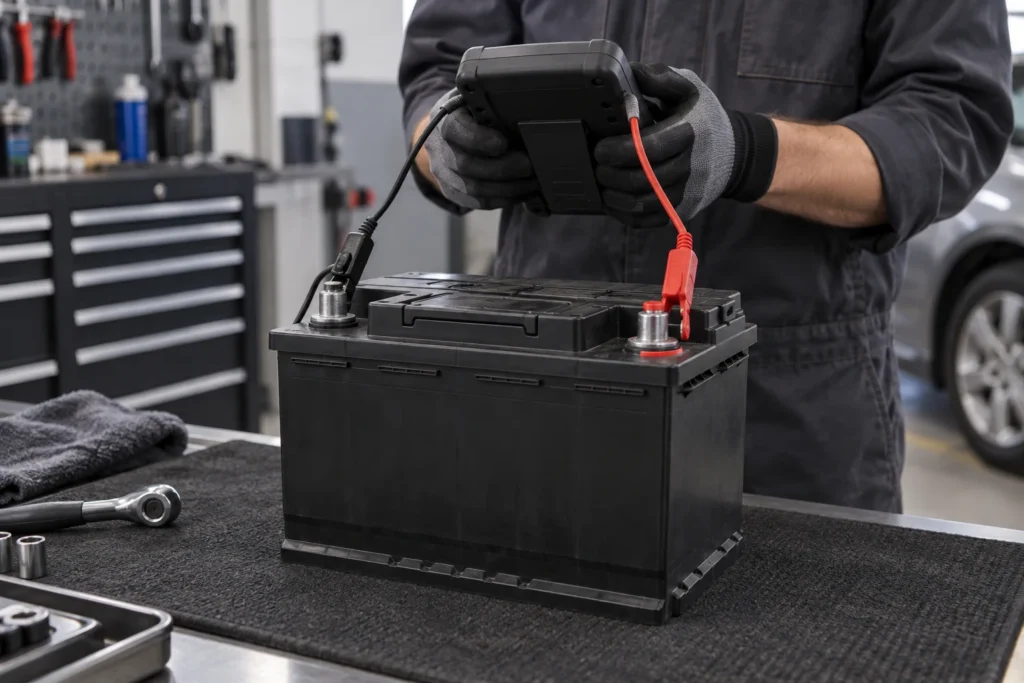
A weak battery can leave the car completely dead, produce rapid clicking, or crank the engine too slowly to start. Dubai heat can accelerate battery ageing, while long periods parked, repeated short journeys, an electrical drain or a charging-system problem can leave the battery discharged. Voltage by itself is not the full condition test, so a battery that was recently charged may still fail under starting load.
If testing confirms a faulty battery, Porsche battery replacement depends on the exact battery type, fitment and any registration requirement for that vehicle.
Battery connections, grounds and power supply
A healthy battery cannot crank the engine properly if high-current connections are loose, damaged or resistive. Cable condition, terminal security, chassis and engine grounds and the voltage drop while cranking can be more informative than replacing a battery solely because the car failed to start once.
Starter motor, solenoid and relay
A single solid click with no engine rotation can move the investigation toward the starter circuit, although battery supply still has to be proved first. Grinding, free-spinning or intermittent engagement also changes the test path. Repeatedly holding the start command on a stalled starter can overheat components without solving the fault.
Start-permission inputs can block cranking
On many modern Porsches, a valid start request also depends on the car recognizing the required selector and pedal inputs. Automatic and PDK models may require Park or Neutral and a valid brake-pedal signal, while some manual cars require the clutch input. A selector-position, pedal-switch, steering-lock or start-authorisation fault can therefore create a no-crank condition even when the battery and starter are healthy. Report the exact message instead of assuming the starter motor has failed.
Could the alternator be the reason?
An alternator usually causes a no-start indirectly. If charging output was inadequate while the engine was running, the 12V battery may later be too discharged to crank the car. Clues include a battery or charging warning while driving, repeated need for jump-starts, lights changing brightness or the car shutting down after the battery state falls too far.
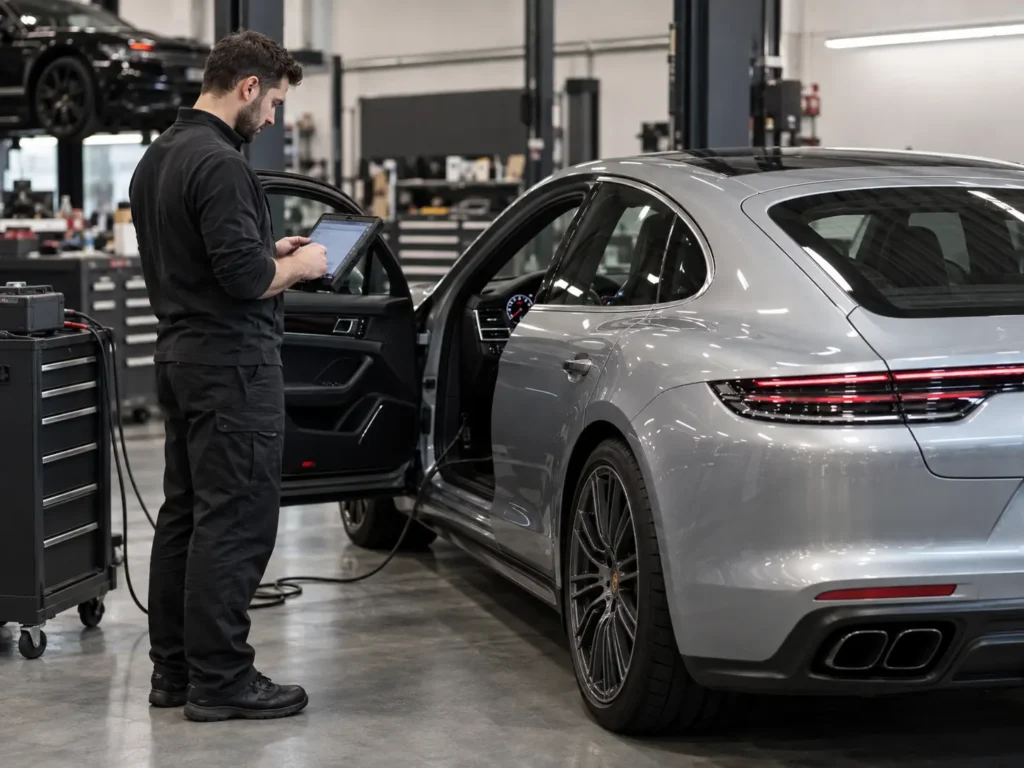
A newly fitted battery that goes flat again should trigger charging and parasitic-draw checks rather than another battery replacement. If a battery or charging warning appeared while driving before the no-start, the battery-warning guide addresses that separate question.
Engine cranks but will not start
When the engine turns at a normal speed but never fires, the starter has already done its main job. The investigation moves toward fuel, ignition, engine-speed signals, authorisation and mechanical condition. This is where replacing a battery or starter without evidence wastes time.
Fuel delivery and pressure
An empty tank, low-pressure supply fault, high-pressure pump problem, failed relay, wiring fault or pressure-control issue can all result in a crank-no-start. The correct test depends on the model. Listening for a pump sound is not enough to prove correct fuel pressure, and replacing a pump without testing its supply can leave a wiring or control fault untouched.
Ignition and engine-speed signals
Coils and spark plugs matter on petrol engines, but a complete no-start may also follow a missing crankshaft or camshaft signal. The engine control unit needs reliable rotational information to manage injection and ignition. Fault memory, live engine speed while cranking and model-specific tests help separate a sensor or wiring problem from an ignition component.
Mechanical timing and compression
Internal engine damage is possible, but it should not be the first assumption. If cranking sounds abnormal, timing-related faults are stored, or fuel and ignition checks do not explain the problem, mechanical timing and cylinder sealing may need assessment. Compression or leak-down testing is useful only when it answers a specific question raised by the earlier checks.
Key not recognised or start authorisation fails
Some no-start faults occur before the engine-management system is allowed to start the car. A flat key-fob battery, damaged key, receiver or antenna fault, control-module problem or immobilizer data issue can produce “key not recognised” or similar messages. The exact security architecture varies by generation, so a used module or second-hand key is not automatically plug-and-play.
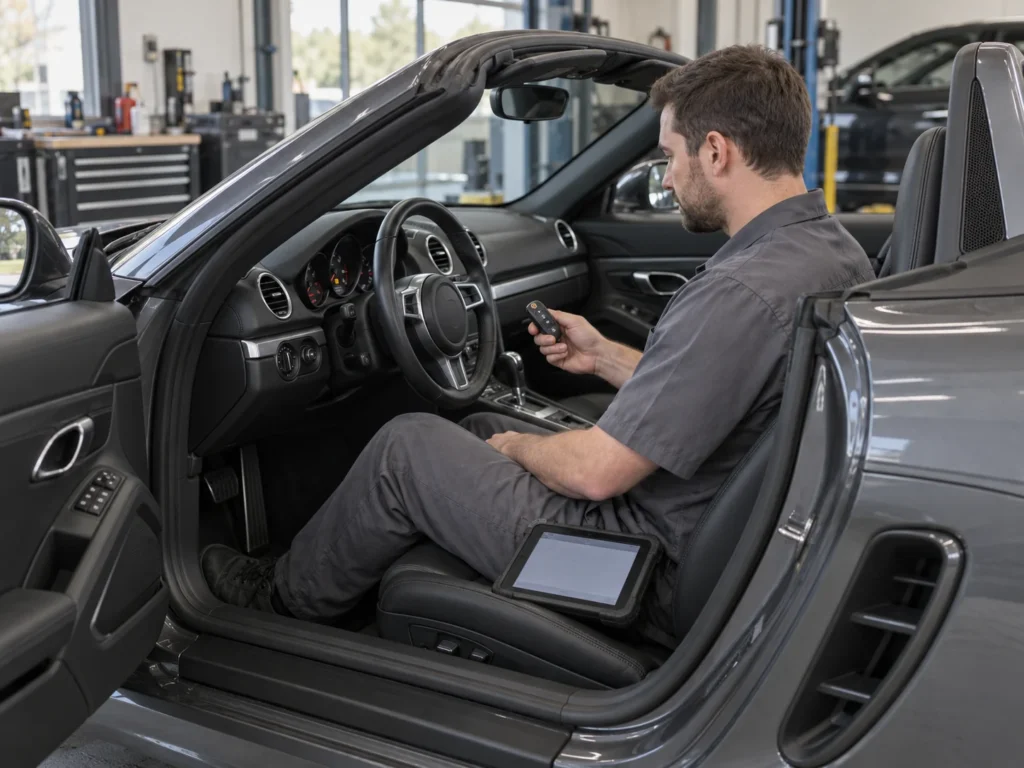
If you have the spare authorised key, noting whether it behaves differently is useful information. Do not repeatedly disconnect batteries or swap security modules in the hope of forcing a start. That can remove useful evidence or create additional coding work.
Electric and E-Hybrid starting faults
Taycan will not enter Ready mode
A Taycan does not have a petrol engine to crank. A “will not start” complaint means it may fail to power up or enter the ready-to-drive state. The 12V supply, key authorisation, charging state, high-voltage safety interlocks or a control-system fault may be involved. Porsche’s Taycan guidance for model year 2023 onward explains that a discharged 12V onboard battery needs a model-specific emergency power-supply procedure to open the bonnet. Check the exact model-year manual for earlier cars. This does not diagnose the cause of a no-Ready message. Follow the vehicle’s own manual and leave high-voltage work to qualified personnel. Petrol-engine starter, spark-plug and fuel-pump advice does not apply to the Taycan.
Cayenne and Panamera E-Hybrid no-starts
E-Hybrid models have both a combustion engine and a high-voltage hybrid system, so a no-start or no-ready complaint can involve the 12V supply, engine-management side, hybrid control system or high-voltage safety conditions. A conventional battery or starter diagnosis should not be applied to the hybrid system without the correct model-specific checks.
Safe checks before retrying
- Record the exact warning message or take a photo before switching the car off again.
- Check the displayed fuel level on a petrol model instead of assuming the gauge is irrelevant.
- If you have the spare authorised key, note whether the symptom is identical.
- Avoid repeatedly cranking the engine or clearing fault codes before diagnosis.
For model-specific warning wording and operating instructions, use Porsche’s Driver’s Manual portal. Avoid a jump-start procedure copied from another model, especially on an E-Hybrid or Taycan.
When to stop trying to start the car
Stop repeated attempts if there is smoke, a burning electrical smell, grinding, a strong fuel smell, visible leakage, unusual mechanical noise or a red warning that indicates a serious system problem. If the Porsche is stopped in an unsafe place, roadside assistance or recovery is more appropriate than continued testing beside traffic.
If a jump-start works but the car quickly dies again or the battery warning remains on, do not assume the problem is solved. The charging system still needs checking before normal use.
What a useful no-start diagnosis should check
The exact sequence changes with the symptom, but a useful diagnosis connects each test to what the car is doing. Battery state and cranking voltage matter for a slow crank. Starter command and current matter for a single click. Fuel pressure, ignition, engine speed, authorisation and mechanical condition matter more when the engine cranks normally without starting.
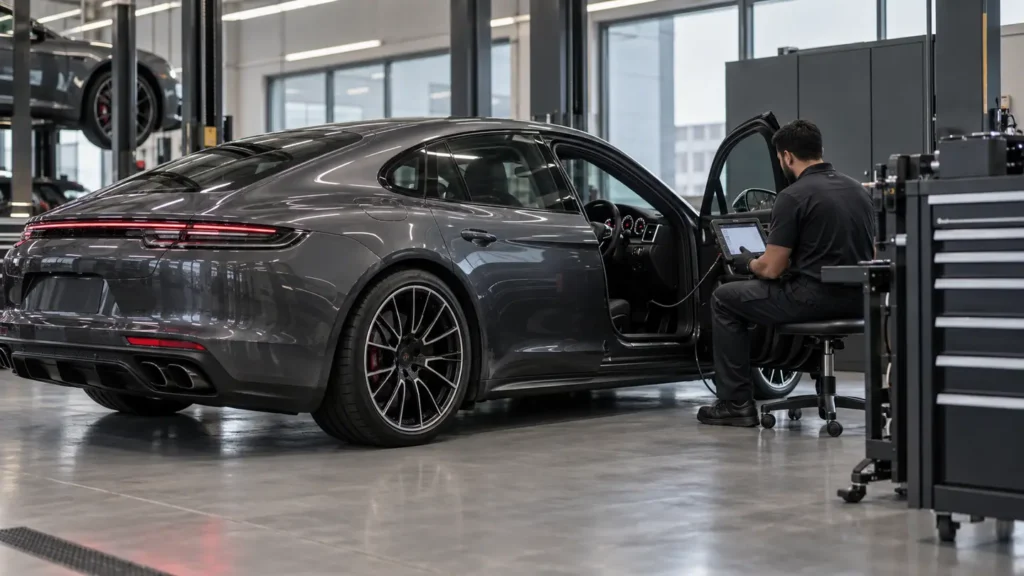
A diagnostic scan is a starting point, not an automatic parts list. A fault code tells you which system detected an abnormal condition. The workshop still has to prove whether the component, wiring, power supply or another condition caused it.
Arrange diagnosis or recovery
Tell PorscheGarage the model and year, whether the engine cranks or the Taycan enters Ready mode, the exact warning, and whether a spare key or jump-start changed anything. The workshop can begin with the initial review described above and explain any further testing before work. If the car is unsafe to drive or cannot be moved, request recovery and confirm the dispatch price before help is sent.
Porsche not starting FAQs
Why does my Porsche click but not start?
Rapid clicking often points toward insufficient 12V supply, while a single click can move attention toward the starter circuit. Battery condition, cable voltage drop and starter command should be checked before the starter is condemned.
Why does the engine crank but not fire?
Once cranking speed is normal, likely paths include fuel delivery, ignition, crank or cam signals, start authorisation and mechanical timing or compression. The exact Porsche generation determines which checks are most useful.
If a jump-start works, is the problem fixed?
Not necessarily. The battery may simply have been discharged. Its condition, charging output and possible parasitic drain should be considered if the problem returns.
Can a key-fob problem stop a Porsche from starting?
Yes, depending on the model and security system. If the car displays a key-recognition or start-authorisation message, the key, receiver, control modules and stored authorisation data may be relevant. Trying the correctly authorised spare key can provide useful evidence.
How much does a Porsche starter repair cost?
There is no single responsible price across all Porsche models because starter location, part specification and access vary. The starter should be priced only after battery supply and the start-control circuit are checked and the failed component is confirmed.
Should I tow the Porsche or keep trying?
Recover the car if repeated attempts produce smoke, burning smell, grinding, strong fuel odour, major warning messages or abnormal mechanical noise. A routine discharged battery may be suitable for a roadside jump-start and basic check instead.