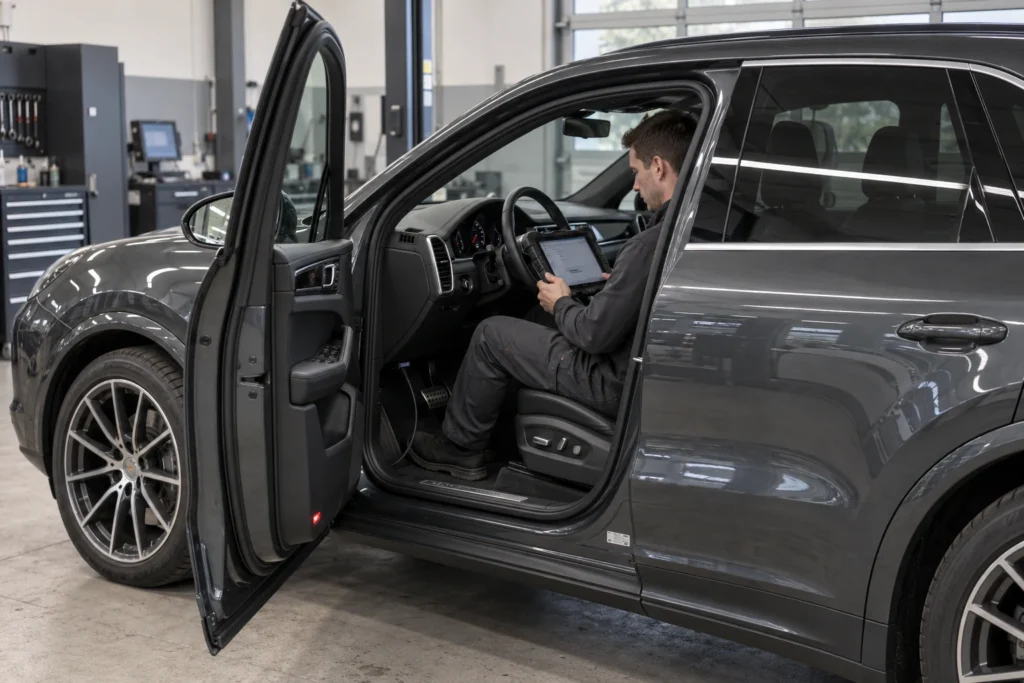

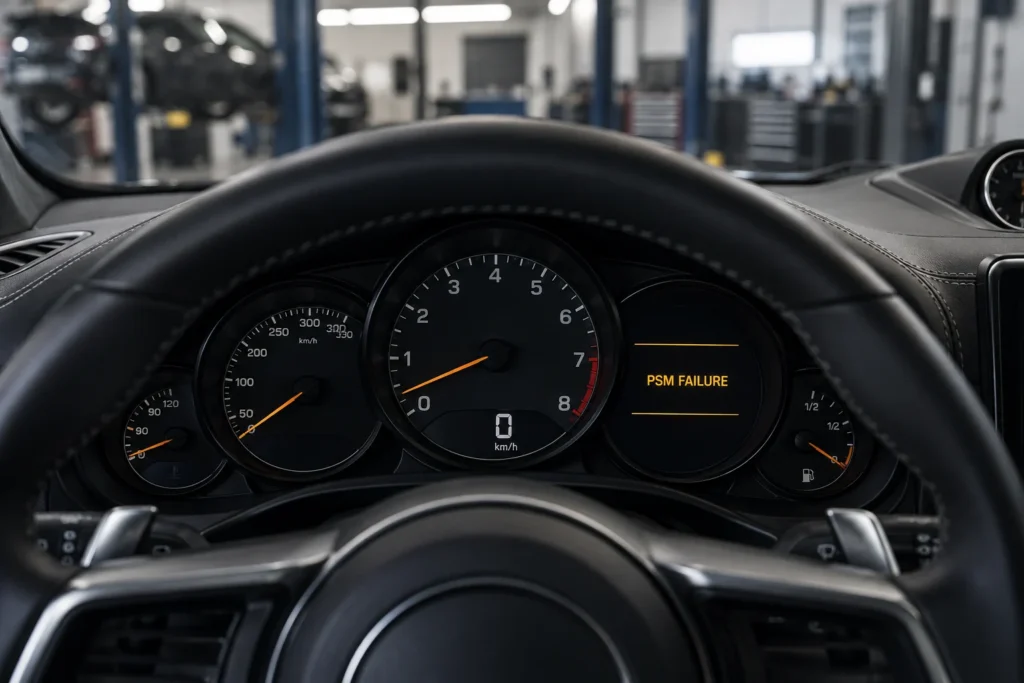
A Porsche PSM failure means the car cannot rely on Porsche Stability Management as intended. The message identifies a problem in the stability-control system or one of the signals it needs. It does not identify one failed part. Low 12-volt supply, a wheel-speed signal, a brake input, steering-angle data, wiring, software or a fault reported by another control unit can all change the diagnostic route.
Multiple warning lights do not automatically mean several systems have failed independently. PSM, ABS, drivetrain and driver-assistance functions share sensor data and communicate across the vehicle. One missing signal or voltage event can make more than one function unavailable. The exact message, warning colour, driving behaviour and stored fault data matter more than the number of lights.
What PSM controls
Porsche Stability Management compares the driver’s intended direction with the vehicle’s actual movement. Depending on the model, it uses information such as individual wheel speeds, steering angle, yaw rate, lateral acceleration, brake input and available drive torque. When intervention is needed, the system can brake individual wheels and coordinate with the powertrain to help stabilise the car.
Porsche Engineering’s explanation of PSM describes the system as combining anti-lock braking and vehicle control. This shared architecture explains why a PSM warning may appear with an ABS, brake, all-wheel-drive or powertrain message. It also explains why replacing a PSM control unit before testing its inputs can be an expensive mistake.
PSM is not PASM or PTM
| System | Main job | Why it can appear beside PSM |
|---|---|---|
| PSM | Stability and traction control using braking and powertrain coordination | This is the system named by the warning. |
| ABS | Prevents wheel lock during braking | PSM uses wheel-speed and brake-system information, so an ABS fault can also limit PSM. |
| PTM | Porsche Traction Management controls drive distribution on applicable all-wheel-drive models | A shared input or communication fault can affect both traction and stability functions. |
| PASM | Porsche Active Suspension Management controls damping | PASM is a separate chassis system. Similar timing does not prove the suspension caused the PSM warning. |
| TPMS | Monitors tyre pressure using model-specific hardware and logic | A tyre-pressure warning should be assessed on its own evidence, even when it appears at the same time. |
Which Porsche models this applies to
This guide applies to Porsche vehicles equipped with PSM, including the 911, 718, Cayenne, Macan, Panamera and Taycan model lines and many earlier generations. It does not assume that every generation uses the same sensors, software, warning wording or repair procedure. Engine codes are not a useful way to generalise this fault because the diagnostic evidence usually starts in the brake, chassis, electrical and network systems.
| Model group | Useful distinction | Diagnostic caution |
|---|---|---|
| 911 and 718 | PSM Off or PSM Sport selected by the driver is different from a failure message. | Do not treat a deliberate mode indication as a fault, or a permanent warning as a selected mode. |
| Cayenne and Macan | PSM works beside ABS and, where fitted, all-wheel-drive and other chassis functions. | A cluster of warnings may come from one shared speed signal or communication path. |
| Panamera | Brake, start-stop and stability functions can share pedal and control-unit information. | Use the exact model year and fault entries before applying a known fix from another generation. |
| Taycan | The low-voltage supply supports control units even though propulsion uses a high-voltage battery. | Multiple warnings are not proof that the 12-volt battery caused the original fault, or that the traction battery has failed. |
PSM warnings and what they suggest
A flashing stability indicator during an actual control intervention can be normal on many models. A warning that stays on, returns after startup or is accompanied by a failure message needs a different response. Exact symbols and instructions vary, so follow the message shown in the car’s instrument cluster and the correct owner’s manual.
| What you observe | What it can mean | What it does not prove |
|---|---|---|
| PSM indicator flashes briefly while traction is limited | The system may be intervening as designed. | That a fault exists. |
| PSM failure stays on with no driving change | A stored or current fault has limited the system. | That the vehicle is safe for normal-speed driving or that one named part has failed. |
| ABS and PSM warnings appear together | A shared brake-control function or wheel-speed input may be unavailable. | That the hydraulic unit or every wheel sensor needs replacement. |
| Several warnings appear at startup after a flat battery or jump-start | Low or unstable supply voltage may have affected several control units. | That the battery is the root cause, or that every warning can be ignored after charging. |
| PSM warning appears with a brake-light or start-stop concern | A brake-pedal input may be relevant on some model generations. | That a brake-light switch is the answer for every Porsche. |
| PSM warning follows wheel, tyre, alignment or steering work | A disturbed sensor, wiring route, tyre-size issue or calibration may need checking. | That calibration alone will correct damaged hardware or a bad signal. |
| Warning appears with reduced power or a drivetrain message | PSM may be missing torque information or another control unit may have requested protective operation. | That the PSM control unit caused the engine or transmission fault. |

When to stop driving
Stop in a safe place and arrange assistance if the PSM warning appears with a red brake warning, an unusually long or soft brake pedal, reduced braking, changed steering assistance, severe pulling, a damaged tyre, burning smell, smoke or a direct instruction to stop. Do not continue merely because the engine still runs.
If the car displays an amber warning, remains stable and explicitly permits adapted driving, reduce speed and avoid sharp acceleration, hard braking and high cornering loads. Leave more space in traffic and arrange diagnosis promptly. Stability assistance may be reduced when it is most valuable, especially on a wet, loose or uneven surface.
Do not test the car’s limits to find out whether PSM is working. A warning that disappears after a restart can still leave stored evidence, and an intermittent signal may return without notice.
Common causes of a Porsche PSM failure
The cause should be described as a tested fault, not a list of parts that commonly get blamed. These are the main diagnostic categories.
Low or unstable 12-volt supply
Control units can record several faults when voltage falls during startup, jump-starting, diagnosis or programming. The useful questions are whether low voltage was present when the warnings were stored and why the supply fell. A discharged or weak battery, charging problem, poor connection or parked electrical drain requires a different repair. If a battery or charging warning appeared first, the Porsche battery-warning guide explains the checks behind that message.
Voltage recovery does not prove that every warning was caused by the battery. The car should be rescanned after the supply is stabilised so persistent faults can be separated from consequences of the voltage event.
Wheel-speed sensor, encoder or wiring fault
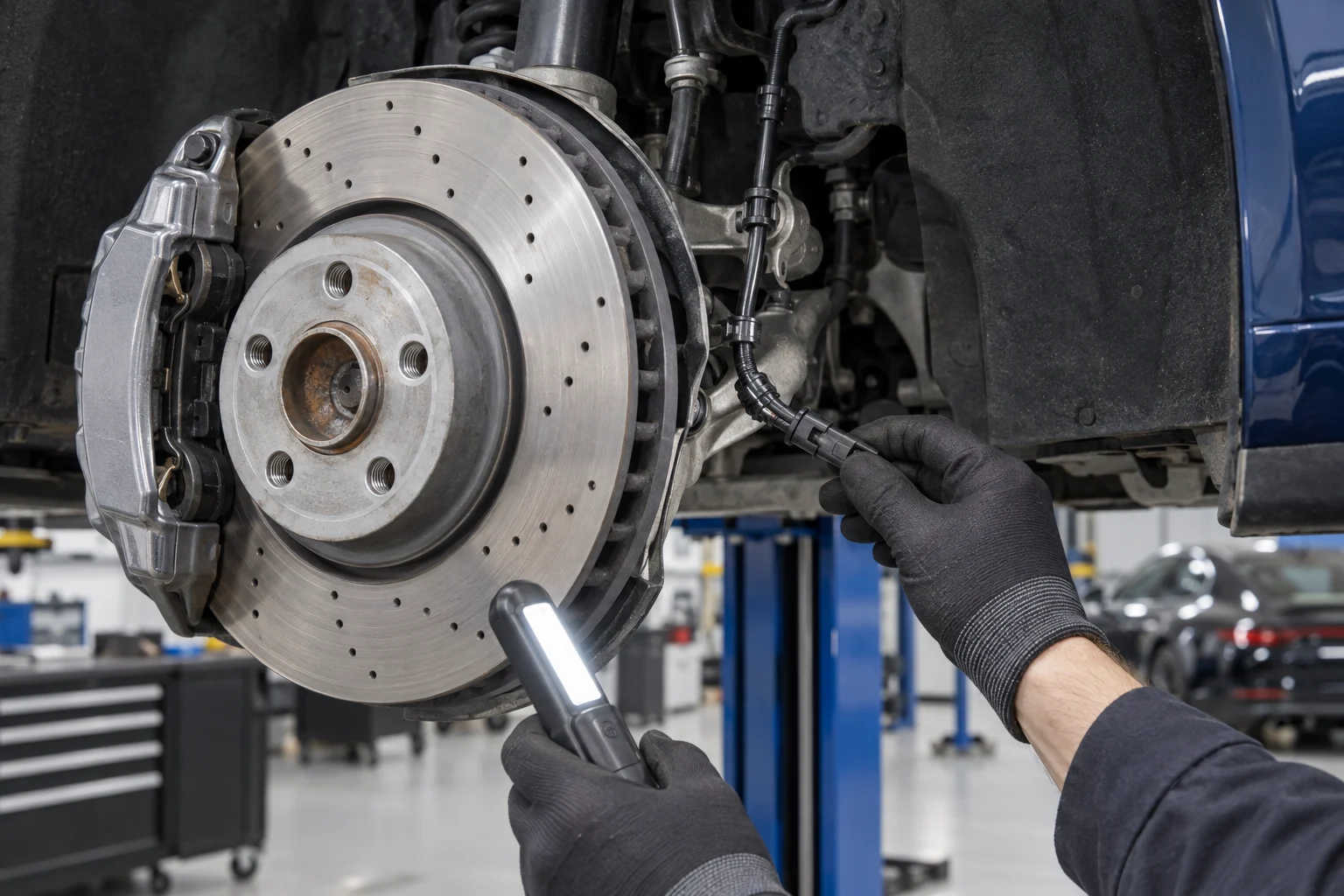
PSM needs credible speed information from each wheel. A missing or implausible signal may come from the sensor, its power or ground, damaged wiring, a connector, contamination, the encoder built into or associated with the wheel bearing, or physical damage near the hub. Live data that shows one wheel disagreeing with the others narrows the test area but does not identify which part in that signal path is defective.
A specific example is Porsche Technical Information 117/21 for the Cayenne (92A), model years 2015–2018. It describes an ABS/PSM warning where testing detects defective front or rear speed sensors linked to insufficient sealing, with tropical climates able to promote the fault. That bulletin applies to this defined model group and fault type, not every Cayenne or every PSM warning. Confirm the car’s VIN, installed part status and fault evidence before choosing a repair.
Steering-angle or motion-sensor data
PSM compares steering input with the way the car actually rotates and moves sideways. An implausible steering-angle, yaw-rate or lateral-acceleration signal can therefore limit the system. Calibration may be required after specific repairs, but only after mechanical alignment, mounting, wiring and relevant fault entries have been checked. Recalibrating a defective or incorrectly installed component does not repair it.
Brake-pedal, pressure or hydraulic information
The system needs to know when and how the brakes are being applied. Depending on the model, diagnosis may include brake-light switch status, pedal travel, pressure values, wiring and the hydraulic control unit. Porsche Technical Information 39/12 lists Panamera, 911 Carrera (991) and Boxster (981), with its model-year field stated as “as of 2010”. Confirm the vehicle’s VIN and generation before applying that bulletin. It links a brake light that stays on, PSM failure or fault code 4340 to a check of brake-light-switch adjustment before parts are replaced. It does not say every brake warning is caused by the switch. The exact generation, warning and fault entries must match.
Communication, software or another control-unit fault
A control unit can make PSM unavailable when a required message is missing or implausible. The root fault may sit in the brake electronics, engine management, transmission, steering, all-wheel-drive system, gateway or their wiring and network connections. Software updates and service campaigns are VIN-specific. A communication code is a direction for testing, not permission to replace whichever module is named first.
Checks an owner can make safely
- Photograph the exact warning messages only after the vehicle is safely parked.
- Record whether the warning appeared at startup, after driving, during rain, after a battery discharge or after recent wheel, tyre, brake, alignment or steering work.
- Note the warning colour and whether braking, steering, speedometer operation or power delivery changed.
- Check visible tyre damage and confirm that fitted tyre sizes match the approved combination for the vehicle. Do not crawl beneath the car.
- Observe whether the brake lights operate normally without dismantling the pedal switch or trim.
- Keep invoices for recent battery, sensor, bearing, brake or alignment work available for the technician.
Do not disconnect the battery as a reset, clear all control units before saving their faults, probe connectors with unsuitable tools or replace a wheel-speed sensor solely because a generic code description mentions one wheel. These actions can remove useful evidence or introduce another fault.
How professional diagnosis should work
- Confirm the vehicle and complaint. Record the VIN, model, model year, equipment, exact warning wording, recent work and the conditions in which it appears.
- Stabilise the electrical supply. Check the fitted 12-volt battery, connections and charging behaviour using the correct procedure for that powertrain. A Taycan or hybrid should not be treated as though its electrical architecture is identical to a conventional combustion model.
- Scan the complete vehicle. Save PSM, ABS, engine, transmission, steering, gateway and other relevant fault entries with status, priority, occurrence details and freeze-frame information before clearing anything.
- Inspect the basics. Confirm tyres, wheel fitment, visible sensor wiring, connectors, hub areas, brake-light operation and any components disturbed during recent work.
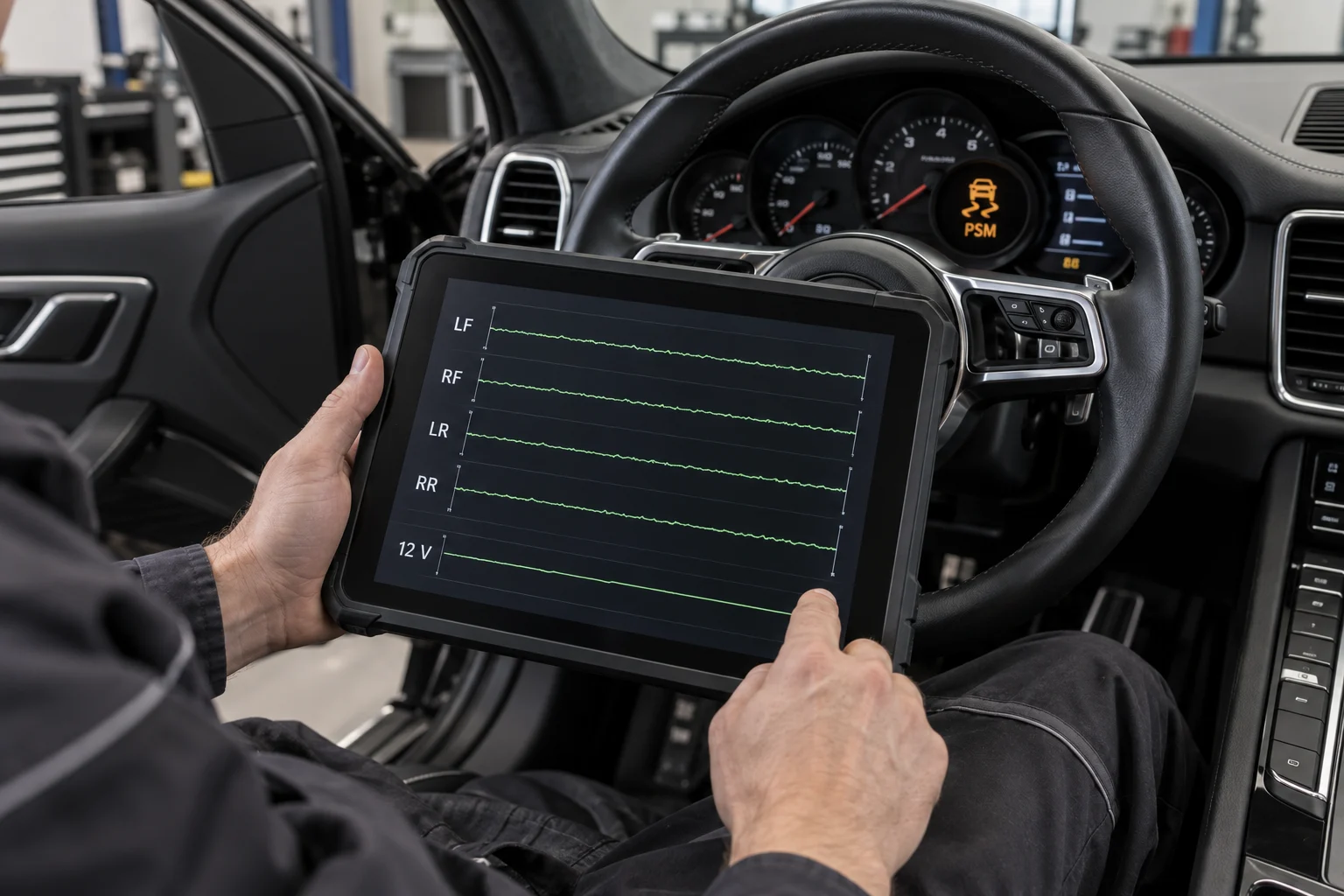
- Compare live values. Observe all four wheel speeds under controlled conditions, steering angle around straight ahead, brake inputs, yaw and acceleration data, supply voltage and network status. Normal ranges and test methods are model-specific.
- Test the suspect circuit. Use wiring information, electrical measurements and component checks to separate a sensor from its wiring, encoder, supply or control-unit input.
- Check model-specific information. Review applicable software levels, campaigns and technical instructions for the VIN and stored fault combination.
- Repair and initialise correctly. Complete any required calibration, programming, brake bleeding or steering setup only when the repair procedure calls for it.
- Verify the result. Repeat the conditions that produced the warning where safe, compare live data, confirm normal driving behaviour and rescan the vehicle.
What each test confirms
| Test or evidence | What it can confirm | What it cannot confirm alone |
|---|---|---|
| Battery and supply-voltage test | Whether the low-voltage system is charged, stable and capable under the tested conditions | That low voltage caused the original PSM warning |
| Full-system fault scan | Which control units reported faults, their status and available occurrence context | That the component named in a code must be replaced |
| Four-wheel live-speed comparison | Whether one signal drops out or disagrees under the test conditions | Whether the sensor, encoder, wiring or connection is responsible |
| Steering-angle and yaw data | Whether the readings are plausible and respond in the expected direction | That calibration will cure a hardware or alignment problem |
| Brake switch, travel and pressure values | Whether the brake inputs change plausibly and agree with the physical action | That the hydraulic unit has failed without the applicable functional tests |
| Visual inspection | Obvious damage, disturbed routing, corrosion, tyre mismatch or recent-work clues | Electrical integrity inside a sensor, wire or control unit |
| Warning clears after restart | Only that the fault is not currently commanding the same message | That the original cause has gone or the car is repaired |
Repair decisions after diagnosis
A good estimate names the confirmed fault, the supporting test result, the proposed repair and the verification required afterwards. A sensor can be replaced when its failure is established. Wiring or a connector may be repairable. A wheel bearing may be relevant when its encoder or mechanical condition is the actual problem. A software update, calibration or brake procedure should be tied to the correct model information rather than offered as a universal reset.
When several warnings followed a voltage event, stabilising the supply and rescanning may prevent unnecessary parts replacement. The opposite is also true. Fitting a new battery should not close the job if a wheel-speed, brake or communication fault returns. Ask for the post-repair scan and road-test result rather than only a cleared dashboard.
When workshop diagnosis is worth it
A warning that returns, appears with ABS or brake messages, changes the way the car drives or follows recent electrical or chassis work needs structured testing. Our Porsche computer diagnostics service in Al Quoz 4 can preserve the complete fault record, test the low-voltage supply and compare the relevant sensor and control-unit data before repair options are quoted.
Need a PSM fault diagnosed?
Tell us the Porsche model, model year, exact warning messages and whether braking, steering or power delivery changed. We can plan the right diagnostic starting point without guessing at parts.
Checks before buying a used Porsche
Watch the complete startup sequence and do not let a seller clear warnings before inspection. A pre-purchase scan should cover the complete vehicle, not only the engine controller. Ask for the status and occurrence information of stored PSM, ABS, steering and drivetrain faults, then compare it with invoices for battery, wheel bearing, sensor, brake, tyre, alignment or control-unit work.
Confirm that all four tyres are an approved size combination and inspect their condition and wear pattern. During a permitted road test, check for warning messages, unusual brake feel, pulling and speedometer irregularity without deliberately provoking stability intervention. A recently replaced battery or sensor is not proof that the original problem was diagnosed. The useful evidence is a credible repair record followed by a clean verification scan under normal supply voltage.
Porsche PSM failure questions
Can a weak battery cause a Porsche PSM failure?
Yes. Low or unstable 12-volt supply can create several warning messages and fault entries. It is not safe to assume the battery caused them all. Test the battery, charging or supply system and connections, then rescan after voltage is stable to see which faults return.
Can I drive with a PSM failure warning?
Follow the instruction displayed by the vehicle. Stop if there is a red brake warning, abnormal braking or steering, severe pulling, tyre damage or a stop-driving message. If adapted driving is explicitly permitted and the car behaves normally, reduce speed, avoid hard inputs and arrange prompt diagnosis.
Is PSM failure the same as traction control being switched off?
No. A driver-selected PSM Off or PSM Sport indication describes an operating mode on applicable models. A PSM failure message means the system has detected a fault or cannot use required information. The symbols and remaining assistance vary by model.
Does a wheel-speed sensor code prove the sensor is bad?
No. The code identifies a signal or circuit that needs testing. The sensor, connector, wiring, power or ground, wheel-bearing encoder and physical condition near the hub may all need inspection. Compare live wheel speeds and test the circuit before replacing the sensor.
Will turning the steering wheel from lock to lock reset PSM?
It is not a universal repair. Some models may perform specific initialisation steps after battery or steering work, but a lock-to-lock movement cannot repair damaged wiring, a failed sensor, incorrect alignment or a brake fault. Use the procedure for the exact model and investigate a warning that remains or returns.
Can a brake-light switch trigger a PSM warning?
It can on defined models and fault combinations because PSM uses brake-pedal information. Porsche service information has addressed brake-switch adjustment on particular Panamera, 911 and Boxster generations. That does not make the switch a universal fix. Check its status, adjustment and related fault data first.
Why did several warnings clear after restarting?
The triggering condition may no longer be present after the restart, or the control units may have completed a new plausibility check. This does not erase the cause. Stored and intermittent faults, occurrence details and supply-voltage history may still show what happened.