
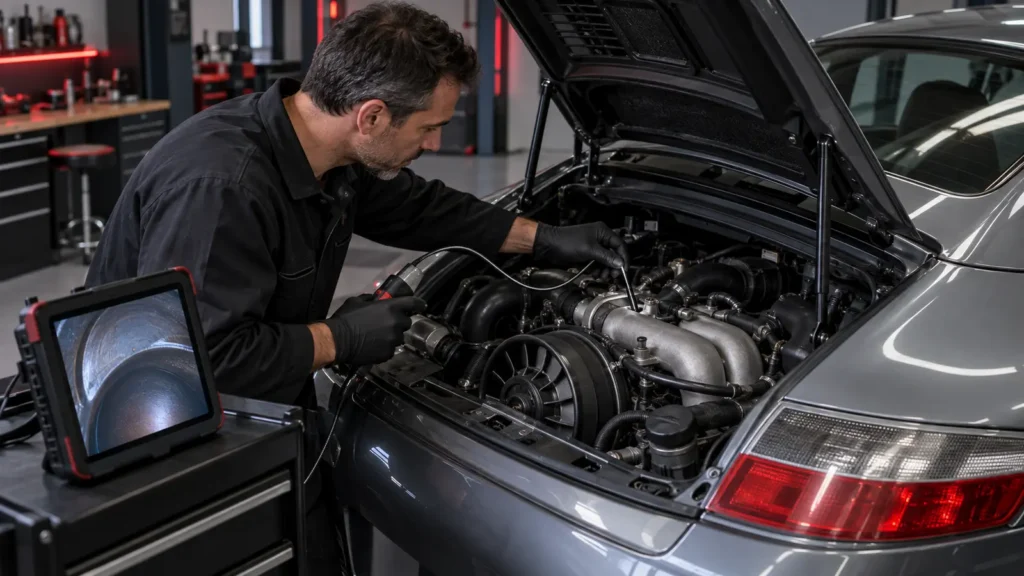
Porsche bore scoring symptoms can include rising oil consumption, a rhythmic tick or knock, uneven soot between exhaust outlets, smoke, misfires and oil-fouled spark plugs. None of those signs proves that a cylinder is scored. A reliable diagnosis depends on identifying the exact engine, checking other plausible causes and inspecting the cylinder walls with a borescope from the correct access point.
This distinction matters to owners and used-car buyers. Bore scoring is physical wear inside the engine, but many of its outward signs overlap with an air-oil separator fault, ignition problem, injector issue, exhaust leak or ordinary valvetrain noise. The aim is not to make every tick sound expensive. It is to know when a symptom deserves a deeper engine inspection and what that inspection should show.
What Porsche bore scoring means
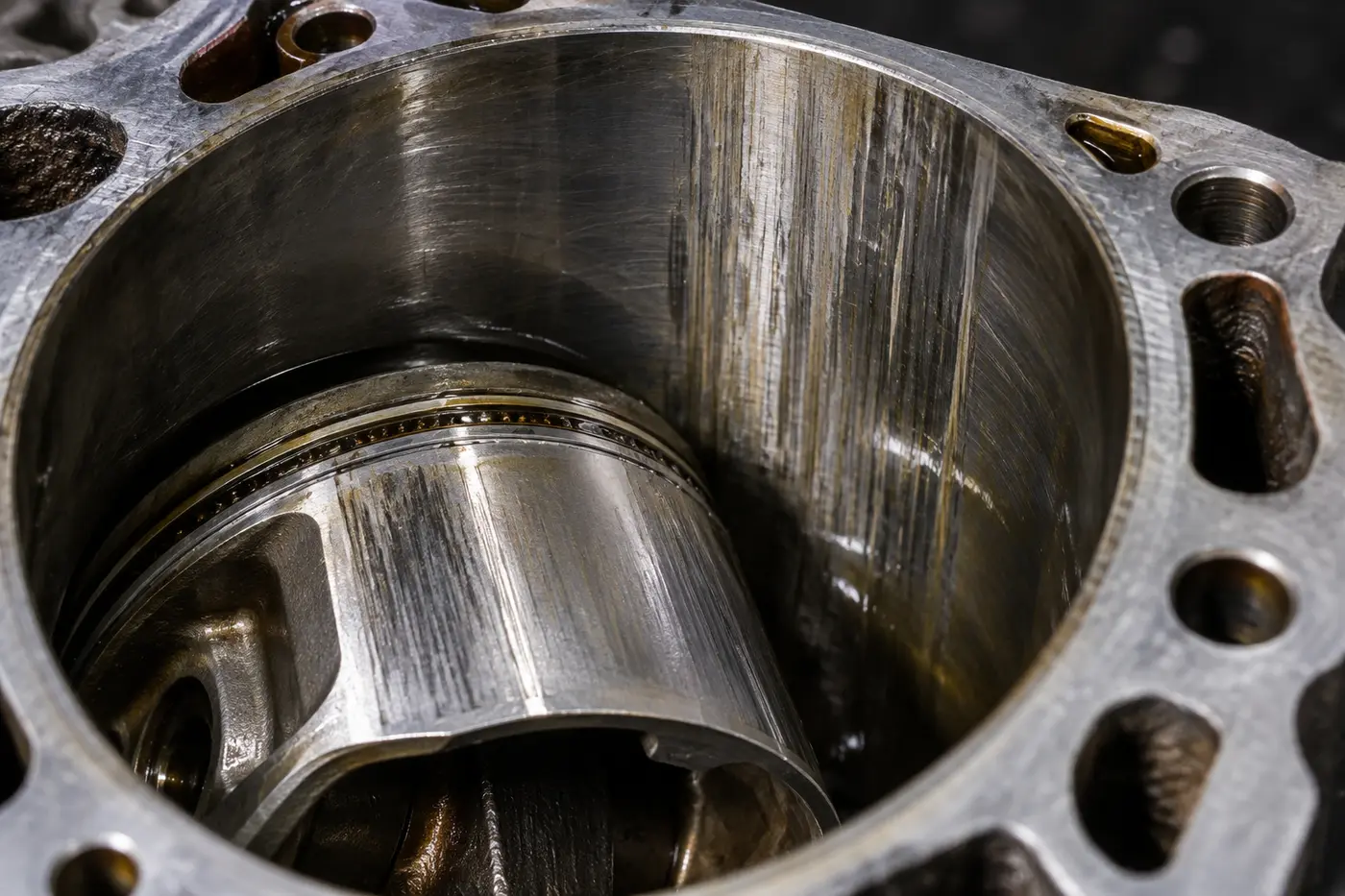
The cylinder wall guides the piston while the piston rings control compression and oil. A thin oil film separates the moving surfaces. Bore scoring describes abnormal vertical damage to the cylinder wall, usually accompanied by wear on the piston skirt. As clearance and surface damage increase, the piston can rock more in the bore, ring sealing can deteriorate and engine oil can enter the combustion chamber.
The result is not always an immediate breakdown. Early damage may produce little or no obvious change from the driver’s seat. More advanced damage can bring heavier oil use, piston slap, contaminated spark plugs, misfires, smoke and reduced compression. This is why the absence of a warning light does not prove clean cylinder walls, while the presence of a warning light does not identify bore scoring on its own.
Which Porsche engines need closer attention
Bore-scoring risk should be discussed by engine family, displacement and application, not by the Porsche badge alone. Independent engine rebuilders most often associate the problem with naturally aspirated water-cooled M96 and M97 flat-six engines. Even within that group, reported frequency is not equal.
| Engine group | Typical applications | Useful interpretation |
|---|---|---|
| M96 and M97 naturally aspirated flat-six | 986 Boxster, 996 911, 987.1 Boxster and Cayman, 997.1 911 | The main family discussed in relation to Lokasil bore scoring. Inspect by exact engine code rather than generation alone. |
| Frequently reported specialist examples | M96.03 and M96.05 3.6, M97.01 3.8, M97.21 and M97.22 3.4 | These include later 996, 997.1 Carrera, Cayman S and late 987.1 Boxster S applications that justify careful evidence-led inspection. |
| Lower reported frequency within M96 and M97 | Many 2.5 and 3.2 Boxster applications, and 2.7 Boxster/Cayman applications | Lower reported incidence does not mean that every engine is immune or that other engine faults can be ignored. |
| 9A1/MA1 naturally aspirated flat-six | 997.2 Carrera, 987.2 Boxster/Cayman, 991.1 Carrera and 981 Boxster/Cayman where this engine is fitted | A later sports-car engine family with different bore construction and inspection access. Specialist reports of scoring do not establish the same frequency or mechanism as M96/M97. |
| Separate Cayenne, Panamera and Macan engines | Selected earlier Alusil V6/V8 applications. Later coated V engines and some cast-iron inline-fours differ | These are not 9A1/MA1 flat-sixes. Confirm the engine code and actual bore construction before applying a scoring concern or choosing an inspection method. |
| Different 996 and 997 engine architecture | Turbo, GT2 and GT3 models using the Mezger-based engine family | Do not assign the naturally aspirated M96 or M97 risk profile solely because the body is a 996 or 997. |
LN Engineering’s engine-repair observations identify the M96.03, M96.05, M97.01, M97.21 and M97.22 among the engines they most commonly receive with scored bores. That is specialist repair-intake experience, not a failure rate for every car on the road. It should guide inspection priority, not be used to declare an uninspected engine faulty.
Porsche documents the 2008 997 Carrera engine update and the second-generation Boxster engine changes. The SUV and saloon bore-technology breakdown is specialist guidance, not a population failure rate. For a purchase or diagnosis, confirm the engine code and fitted construction from reliable vehicle information. Model year alone can mislead around generation changes, replacement engines and regional specifications.
Symptoms that justify an inspection
| Observation | Why it matters | What else can cause it |
|---|---|---|
| Oil use is increasing between services | Worn cylinder walls and ring sealing can allow engine oil into the combustion chamber. | External leaks, air-oil separator faults, turbocharger issues and other internal wear. |
| Rhythmic tick or knock, often clearer at idle | Increased piston-to-bore clearance can create piston slap. | Hydraulic lifters, injectors, exhaust leaks, timing components and accessory noise. |
| One exhaust outlet becomes much sootier | Uneven combustion or oil burning may be concentrated in one cylinder bank. | Rich fueling, injector imbalance, oxygen-sensor faults, exhaust layout and short-trip use. |
| Blue or grey exhaust smoke | Oil may be entering the combustion chamber. | Air-oil separator faults, valve-seal wear, turbocharger oil leakage and oil overfill. |
| Misfire or oil-fouled spark plug | Heavy oil entry can contaminate a plug and disturb combustion. | Ignition coils, plugs, injectors, intake leaks, wiring and compression faults from other causes. |
| Loss of compression or leak-down result outside tolerance | Advanced cylinder, piston or ring damage can reduce sealing. | Valve leakage, head-gasket problems, ring damage unrelated to scoring and test-condition errors. |
The tick is a clue, not a verdict
A scored engine may make a regular metallic tick or deeper knock as the piston changes direction in the bore. The sound can be more noticeable during a cold start or at idle, but owners should not diagnose piston slap from a phone recording. Injector operation, lifters and small exhaust leaks can create a similar rhythm. A useful workshop assessment records when the sound begins, whether it changes with temperature and engine speed, and where it is strongest before deciding on the next test.
Oil use needs a trend
An isolated low-oil message does not establish consumption. The level may have been set incorrectly, the car may have an external leak or the reading conditions may differ. Record the level using the vehicle’s correct procedure, the distance driven and how much oil was added. A rising rate over comparable use is more useful evidence than a single top-up.
Tailpipe soot needs context
A visible difference between exhaust outlets can support further investigation, particularly on layouts where each outlet reflects a cylinder bank. It still does not prove a scored bore. Photograph both outlets before cleaning them, note recent driving conditions and check whether an exhaust modification changes the bank-to-outlet relationship.
How Porsche bore scoring diagnosis works
- Identify the engine. Record the model, generation, engine code, displacement, mileage and any replacement-engine history. This determines the relevant risk and inspection method.
- Document the complaint. Measure oil use where possible, listen from cold and warm, compare exhaust outlets and note smoke, misfires or warning messages.
- Check plausible alternatives. Review fault data and misfire counts, inspect spark plugs and coils, assess fueling, look for external oil leaks and consider the air-oil separator and exhaust system.
- Inspect every cylinder. Use the access and piston position appropriate to the engine. Save labelled stills or video for each cylinder rather than relying on one unlabelled image.
- Add supporting tests. Compression, leak-down, crankcase-vacuum checks and used-oil analysis can add context. Their value depends on procedure, baseline and interpretation.
- Match the recommendation to the evidence. The report should separate no abnormal scoring seen, inconclusive access, marks requiring monitoring and confirmed damage that justifies repair planning.
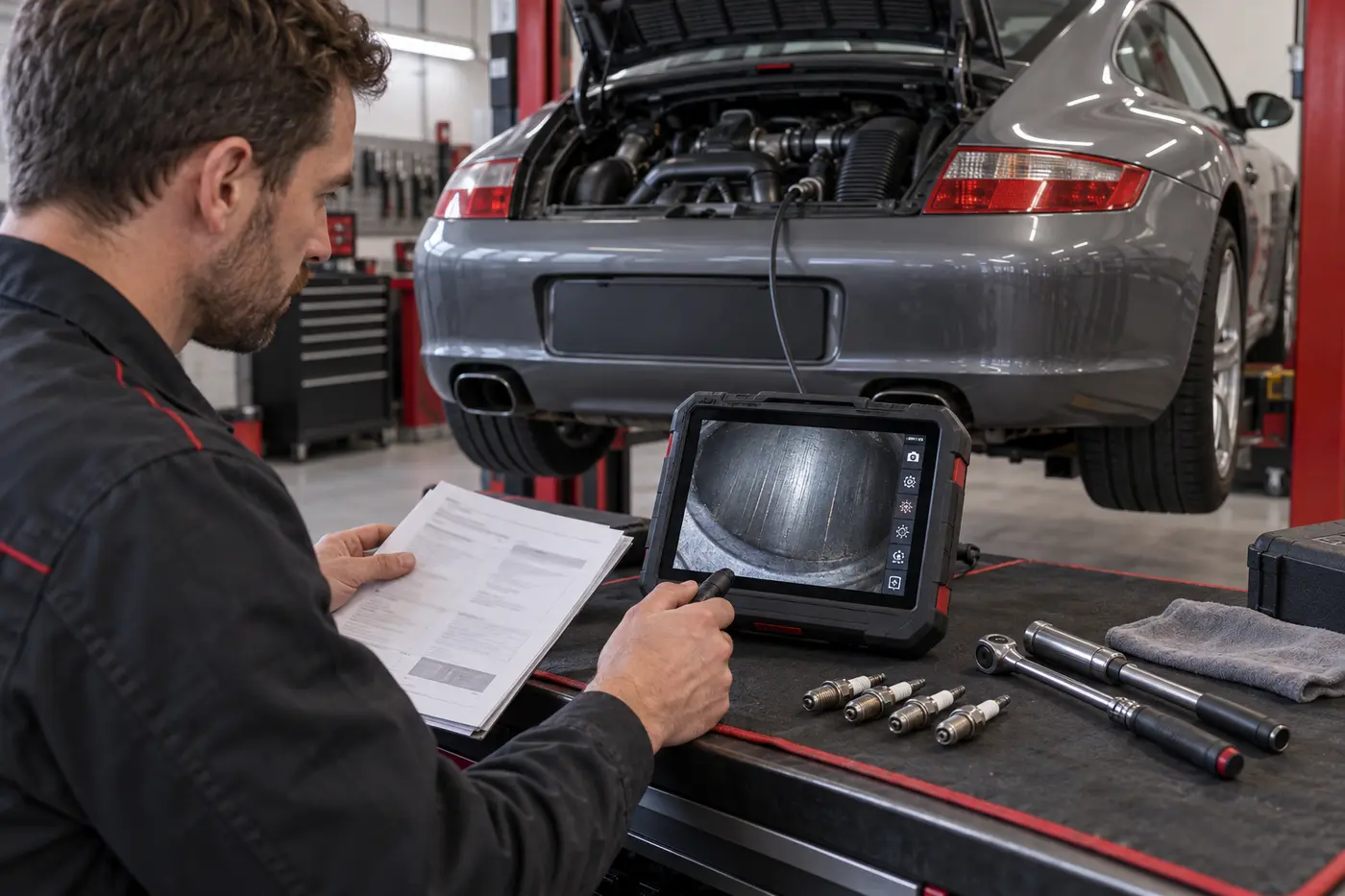
Why the borescope method matters
A borescope is a small camera used to view the cylinder wall without stripping the entire engine. The tool is only part of the job. Camera direction, piston position, lighting and access point decide which part of the bore can actually be seen.
M96 and M97 lower-bore inspection
On M96 and M97 engines, damage can begin low in the cylinder around the piston-skirt thrust area. A spark-plug-hole view with the piston at bottom dead centre may not expose the earliest lower-bore damage. Specialist guidance therefore recommends viewing the lower bore from the sump with the piston at top dead centre where the procedure and access allow it. Cylinders 4, 5 and 6 receive particular attention because they are frequently reported first, but a complete report should not ignore cylinders 1, 2 and 3.
LN Engineering’s cylinder-scoping guidance explains why lower-bore access matters on the 1997 to 2008 Lokasil M96 and M97 family. The method should be carried out by someone who understands the exact engine layout and can identify each recorded cylinder.
Other engines need their own method
For a 9A1/MA1 flat-six, a spark-plug-hole view with the piston positioned to expose the wall is a different procedure from the M96/M97 lower-bore check. Cayenne, Panamera and Macan engines also vary by V6, V8 or inline-four design and bore construction. Specialist scoping guidance above describes the distinction, but the actual engine and service information should determine access. The report should name the code, each cylinder viewed, the piston position and any area that remained hidden.
How bore images should be read
Not every vertical-looking mark carries the same meaning. Camera glare, oil tracks, deposits and surface marks can appear severe in a still image. Interpretation should consider the mark’s location and continuity, the piston skirt, the other cylinders, the engine family and the supporting symptoms. A grainy photo without a cylinder number, piston position or second viewing angle is weak evidence for authorising an engine rebuild.
Supporting tests and their limits
Compression testing compares how well each cylinder builds pressure. A low result can support an internal sealing concern, but an early scored bore can still produce an acceptable reading. A good compression test does not replace a complete visual inspection.
Leak-down testing introduces controlled air into a cylinder and measures leakage. Listening at the intake, exhaust and crankcase can help locate the leakage path. The result depends on piston position, equipment and procedure, and it does not show the cylinder wall directly.
Used-oil analysis can track wear metals over successive oil changes. A trend can justify further investigation, especially when it changes alongside oil use or other symptoms. One sample without a baseline can be affected by oil age, recent repairs, contamination and laboratory interpretation.
Fault-code and misfire data can identify which cylinder or operating condition needs attention. A code such as a cylinder-specific misfire remains a starting point. It does not distinguish a scored bore from a plug, coil, injector, wiring or intake problem without further tests. A scan can help select further checks but cannot show the cylinder wall.
What the result should change
If no abnormal scoring is visible and the inspection was complete, keep the labelled images with the vehicle history. They describe the engine at that inspection. They are not a lifetime guarantee.
If the view is incomplete or the images are ambiguous, the correct result is inconclusive. Repeat the inspection with better access or obtain a second technical interpretation before agreeing to major work. Replacing coils, lifters or the air-oil separator simply to see whether a suspected scoring noise disappears can waste money and remove useful evidence.
If scoring is confirmed, ask for a written severity assessment, the affected cylinders, evidence from the piston and bore, current oil use and the checks for contributing issues such as injector leakage or mixture faults. Physical scoring cannot be removed by an additive or routine oil change. An oil choice may alter noise or provide short-term management in a particular case, but it does not repair damaged cylinder walls.
Advanced damage with oil consumption, piston slap, misfires or poor sealing commonly leads to engine rebuild or replacement planning. The repair can involve block machining or cylinder treatment, pistons, rings, bearings, gaskets and checks of related oil, fuel and cooling systems. The final work depends on what is found after dismantling. A workshop should quote internal engine work only after the finding and repair options have been explained.
Used Porsche buyers should request evidence
A pre-purchase inspection should begin before the engine is warmed by the seller. Ask for a genuine cold start, service invoices, oil top-up history and details of previous engine work. If the engine family or symptoms justify a cylinder inspection, agree the borescope method and price before the appointment.
Request the images or video, cylinder labels and a plain-language conclusion. “Scoped and fine” is difficult to assess later if the report does not show which cylinders were viewed and whether the lower thrust areas were visible. A standard condition assessment and specialist tests such as borescope, compression and leak-down checks should be agreed separately.
Clean images reduce one important uncertainty, but a purchase decision still includes cooling, oil leaks, over-rev information where applicable, transmission condition, accident evidence and service history. Bore scoring should not become the only question asked about an older Porsche.
When to stop driving
Stop the engine and arrange advice or recovery if there is an oil-pressure warning, a loud new knock, heavy continuing smoke, a flashing engine warning with persistent misfire, a rapidly falling oil level or metal debris found during inspection. Continuing to drive can increase damage and complicate the repair.
A mild tick with a stable oil level does not provide a diagnosis, but it still deserves a timely check on a susceptible engine. Avoid repeated cold starts, hard acceleration and speculative parts replacement while the evidence is being gathered. Tell the workshop the model, year, engine code if known, oil-use history and exactly when the noise or smoke occurs.
Porsche bore scoring questions
What does Porsche bore scoring sound like?
It can sound like a regular metallic tick or a deeper rhythmic knock caused by piston movement in a worn bore. Lifters, injectors and exhaust leaks can sound similar, so the noise must be investigated rather than treated as confirmation.
Can a compression test confirm bore scoring?
No. Low or uneven compression can support an internal-engine concern, but early scoring may still return acceptable figures. A borescope inspection provides the direct visual evidence that a compression test cannot.
Does one sooty tailpipe mean scored cylinders?
No. Uneven soot can justify further checks, but fueling, sensors, exhaust layout and driving conditions can also create a difference. Treat it as one observation alongside oil use, plugs, fault data and cylinder images.
Is bore scoring the same as IMS bearing failure?
No. Bore scoring damages the cylinder wall and piston area. IMS bearing failure concerns the intermediate shaft bearing used in relevant M96 and M97 applications. They involve different components, evidence and repair decisions.
Can thicker oil or an additive fix scoring?
No oil or additive restores metal already removed from a cylinder wall or piston skirt. A specialist may recommend a particular oil while a repair is planned or a mild finding is monitored, but that is management, not a mechanical repair.
Should every used Porsche have a borescope inspection?
Not automatically. The decision should reflect the engine family, known risk, symptoms, purchase value, service history and what a standard inspection can establish. For higher-risk M96 and M97 applications, agreeing a correctly performed cylinder inspection before purchase can remove a major uncertainty.
Arrange an engine inspection
If an M96/M97 symptom pattern or purchase decision justifies a borescope check, send the model, year, engine code if known, oil-use history and any existing images. Ask which cylinders and bore areas will be visible, what the written report includes and the price before booking. A Porsche pre-purchase inspection can address the wider vehicle. Engine repair becomes relevant only after internal damage is established. PorscheGarage can discuss the appropriate starting check and a vehicle-specific quotation.