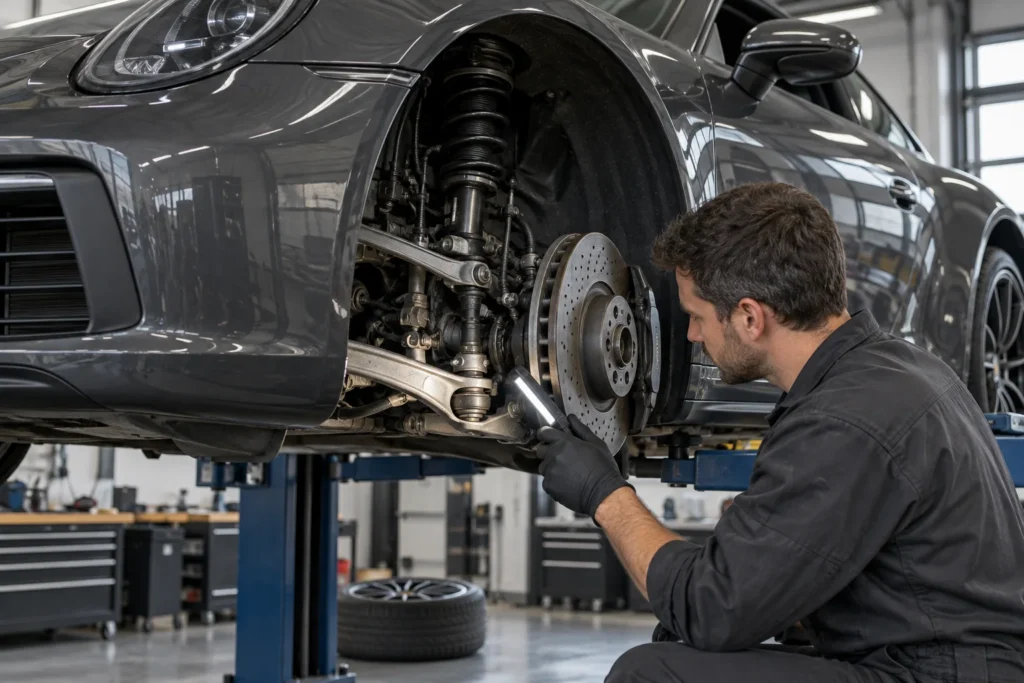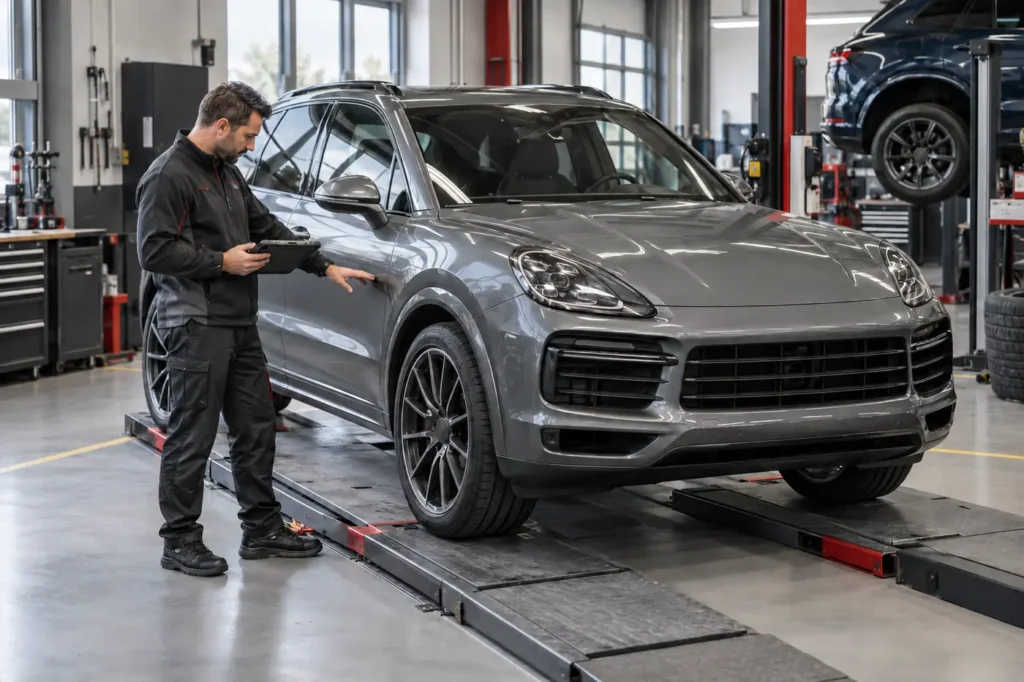

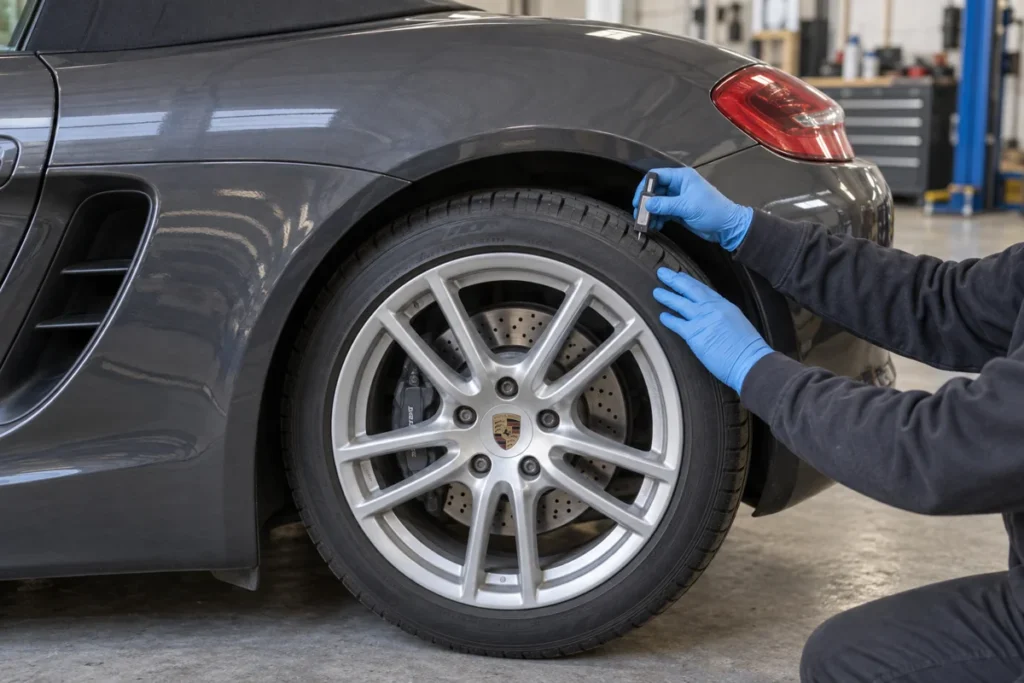
The best tyres for your Porsche are the ones approved for its exact model, model year, wheel and axle, with the specified size, load index and speed rating. A familiar brand or a tyre fitted to a different 911, Macan, Cayenne, Panamera, Boxster or Taycan is not enough to establish fitment. Start with the vehicle’s approved wheel and tyre combinations, then choose a suitable tyre for the roads you actually use.
This guide helps you narrow the choice before buying. It does not supply a universal size chart because wheel options, front and rear fitment, and approval markings vary by vehicle. Use your car’s Porsche owner’s manual and its tyre information label, and have any non-standard wheel or tyre combination checked against Porsche’s vehicle-specific information.
Check the exact Porsche fitment first
Give the tyre supplier the model, generation or model year, variant, wheel diameter and the front and rear tyre markings. The VIN helps resolve equipment and wheel-option differences. Read the current sidewalls as a starting point, but do not assume tyres already on the car are correct—especially on a used car or one with changed wheels.
- Size on each axle the width, aspect ratio and rim diameter must match an approved combination for those wheels. Some Porsche configurations use different front and rear sizes.
- Load index and speed symbol check the complete service description for each axle, including any Porsche-specified construction or additional marking. Do not select a lower specification merely because the width and rim diameter match.
- Tyre approval and model confirm the relevant Porsche N-marked version, where specified, for the exact application and both axle sizes. The same product name can be sold in several specifications.
- Condition and date inspect tread, sidewalls and the manufacture date on each tyre. A matching model name cannot make an old or damaged tyre suitable.
Porsche’s tyre guidance explains its N-marking and the sidewall information for size, load and speed. Continental’s tyre-size guide explains why the vehicle label or manual, rather than an isolated sidewall number, is the starting specification.
What Porsche N-marking tells you
An N-marked tyre is a tyre specification tested and approved for Porsche applications. The approval is attached to the particular tyre specification. It is not a blanket endorsement of every size or version carrying the same range name. The N code also has versions, so ask the supplier to identify the complete marking on the proposed front and rear tyres and check it against the vehicle’s approved fitment.
Porsche recommends its approved tyres because the vehicle and tyre are considered together for handling and other characteristics. If warranty coverage matters to your decision, check the terms that apply to your car and ask the warranty provider about the proposed fitment. A general tyre guide cannot decide an individual claim.
Choose for Dubai roads and your actual use
For a Porsche used chiefly on Dubai roads, the choice should account for everyday road driving, heat, occasional wet conditions, ride and noise preferences, and the approved specification. A tyre marketed for circuit use is not automatically the best road tyre. If the car also travels to a cold or snowy climate, check Porsche-approved seasonal options and the relevant local requirements before that trip. Porsche describes the different roles of summer and winter tyres. The right seasonal choice depends on where the car will be driven.
A 911, Boxster or Cayman with different axle sizes needs its own front and rear fitment. A Macan or Cayenne may have wheel and load specifications that differ by variant and equipment. A Taycan also requires its exact load, size and Porsche-approved tyre specification to be checked. Those model names do not establish a universal tyre size or justify choosing any product labelled “SUV”, “performance” or “EV”.
Can staggered Porsche tyres be rotated?
If front and rear tyre dimensions differ, do not move a front tyre to the rear axle or the reverse. A blanket rotation interval does not account for staggered fitments. Even side-to-side movement depends on identical dimensions, tread direction or asymmetric mounting rules, tyre condition and the vehicle’s instructions. Ask for the specific permitted pattern before moving tyres. Michelin’s rotation guidance also distinguishes different axle dimensions and directional tyres.
Uneven wear deserves a cause check, not a promised percentage improvement from rotation. Check cold pressures to the vehicle label, measure tread at the inner, centre and outer areas, and inspect alignment and suspension if the pattern warrants it. A new tyre fitted without addressing a pressure or alignment problem may wear unevenly again.
When to inspect or stop using a tyre
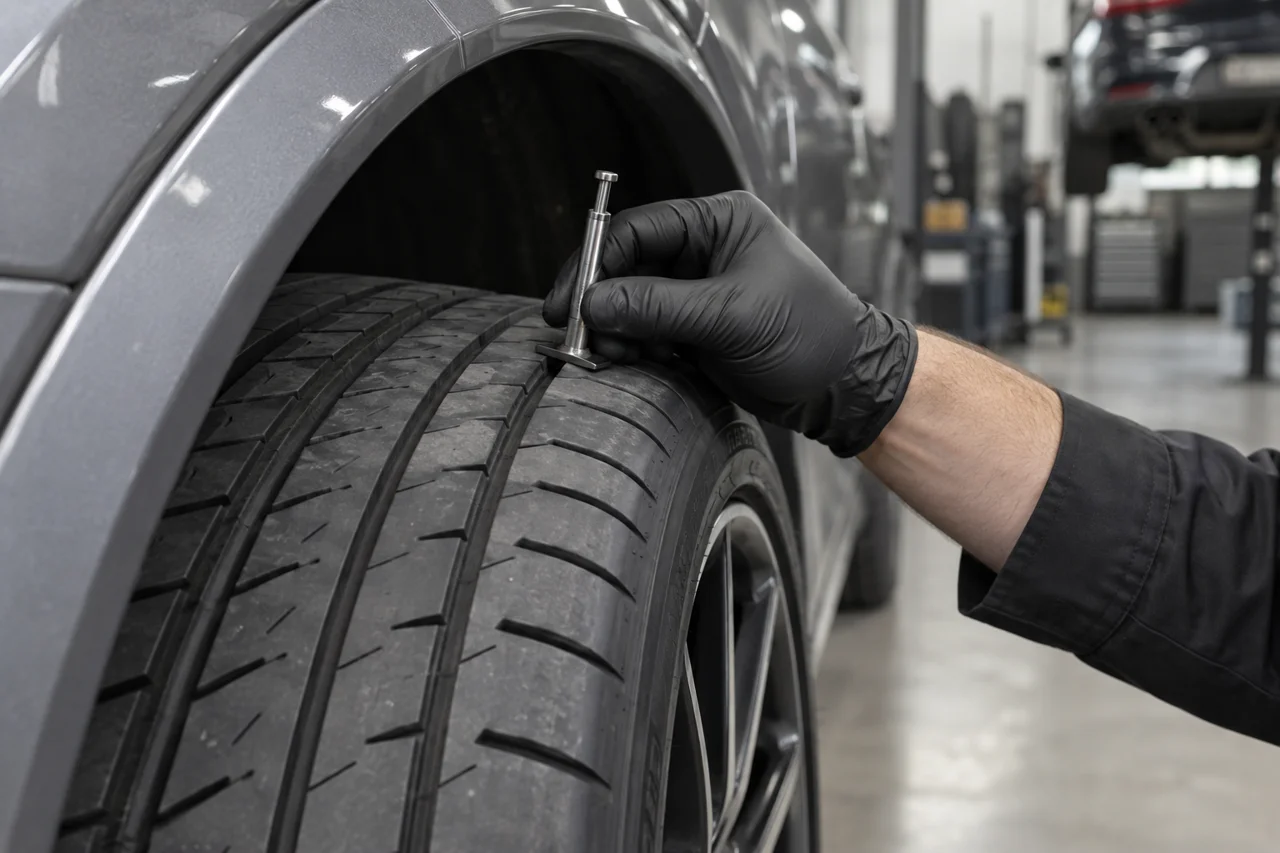
Arrange an inspection if pressure repeatedly falls, a tyre has a cut, bulge or exposed cord, vibration appears after a road impact, or tread wear is uneven. A visible bulge, exposed cord, severe damage or rapid pressure loss is a reason to stop in a safe place and arrange professional help rather than continuing on a suspect tyre. Do not judge safety by tread depth at one point alone. Measure across the tyre and consider age, damage and the vehicle’s guidance.
The date code identifies manufacture week and year, but age by itself is not a complete condition assessment. Michelin’s sidewall guide covers the date and service-description markings. Inflation pressure should come from the vehicle information, not the maximum pressure moulded into a tyre sidewall.
What to confirm before accepting a tyre quote
- The exact front and rear sizes, full load and speed service descriptions, Porsche approval markings and tyre product specification proposed for your car.
- Whether the quotation is for one tyre, an axle pair or a full set, and which fitting, balancing, valves or tyre-pressure-monitoring work is included.
- The manufacture dates of the tyres that will be supplied, and whether an inspection or alignment check is needed for existing uneven wear.
- The total price and VAT treatment in the written quote. This guide gives no generic tyre price because the exact specification and stock must be confirmed.
Replacing only one or two tyres requires an assessment of the remaining tyres, matching requirements and the car’s drivetrain guidance. A new tyre of the same nominal size may not match an older tyre of another specification. If the wheel is bent, cracked or the wrong fitment, the Porsche wheel replacement guide addresses that separate decision.
Ask the workshop about your tyre fitment
If the specification is uncertain or the tyres show damage or uneven wear, PorscheGarage’s tyre replacement service can check the vehicle and discuss suitable options before a written quote. Send the model and year, wheel size, and clear photos of the front and rear sidewall markings. Mention any warning, pressure loss or unusual wear.