
The best 2026 Porsche Cayenne for you depends less on the highest power figure than on three practical choices, including whether you can charge regularly, whether you want a V6 or V8, and which equipment you will actually use. Compare the exact vehicle, not just its badge. Two Cayennes with similar asking prices can differ substantially in chassis specification, seats, driver assistance, brake system, and ownership costs.
This is a research-based buying guide, not a claimed road test. It focuses on the model-year 2026 petrol and plug-in hybrid Cayenne and explains how the newer Cayenne Electric fits into the shopping decision. Manufacturer and Dubai model information was checked on September 26, 2026. Regional availability, connected features, prices, and individual vehicle specifications must be confirmed with the seller.
What changed for 2026
Porsche’s model-year 2026 announcement for the 911, Taycan, Panamera and Cayenne identifies revised Porsche Communication Management (PCM) hardware, access to the Porsche App Center, and expanded connected functions. It also describes Amazon Alexa and Dolby Atmos with compatible Bose or Burmester equipment and suitable content. This global model-year announcement supports the digital update, but it does not establish which apps, subscriptions or audio options a Dubai car has. Porsche’s model-year PCM announcement
For a Dubai car, ask the seller to demonstrate the apps, voice functions and audio features that matter to you. Availability can depend on market, equipment and active services. A launch announcement does not guarantee an identical local specification or a future software upgrade.
The current combustion-engine Cayenne’s major revision predates model year 2026. Porsche introduced the extensively revised range in 2023 and added the newer GTS versions in 2024. The 2026 car should therefore not be presented as an entirely new petrol-generation launch. Porsche’s Cayenne press kit
Model year, build date, and registration date are different
A car first registered in 2026 is not automatically a model-year 2026 vehicle. An unsold earlier car, a late delivery, or an imported vehicle may be advertised using the registration year. Request the build and model-year information in the vehicle documentation and confirm it against the actual specification.
This is particularly useful when comparing the infotainment update. A screen photograph is not enough to establish all the hardware and service entitlements. Ask the seller to demonstrate the installed functions and provide the relevant vehicle details in writing.
Petrol, E-Hybrid, or Electric
Porsche’s Dubai model overview now separates Cayenne Electric and Cayenne Coupe Electric from the gasoline and hybrid Cayenne body styles. Do not mix their batteries, charging speeds, power figures, or cabin layouts into one specification table. Porsche Dubai Cayenne model overview
| Choice | The question to answer first | A reason to pause |
|---|---|---|
| Petrol Cayenne | Do you prefer conventional refueling and the particular V6 or V8 character? | You are paying for performance or equipment you do not expect to use. |
| Cayenne E-Hybrid | Can you charge conveniently and regularly enough to use the plug-in capability? | You are assuming laboratory consumption figures describe uncharged daily use. |
| Cayenne Electric | Does your charging access and journey pattern suit a fully electric SUV? | You are relying only on a peak charging figure or an optimistic range headline. |
The Cayenne Electric is a distinct vehicle family. Porsche Dubai currently lists Electric, petrol and hybrid body styles, while its individual configurator entries may carry different model-year labels. If you are considering an Electric listing, verify its derivative, model year and delivery specification separately.
The practical first step is to define your use, including typical daily distance, occasional long trips, available parking and charging, passenger requirements, and the features you refuse to compromise on. That produces a more useful shortlist than starting with the fastest acceleration claim.
Understand the petrol and hybrid trim names
The following table provides reference points from Porsche’s technical descriptions of the revised combustion and plug-in hybrid family. Outputs are shown consistently in kW and metric horsepower, PS. These are not SAE horsepower figures, and the table is not a guarantee that every derivative is available as a new 2026 order in Dubai.
| Derivative | Powertrain reference | Published output | What makes it a different buying decision |
|---|---|---|---|
| Cayenne | 3.0-liter turbo V6 | 260 kW / 353 PS | Start here if the main appeal is the Cayenne package rather than a V8. |
| Cayenne S | 4.0-liter twin-turbo V8 | 349 kW / 474 PS | Compare the V8 experience and total ownership budget. |
| Cayenne GTS | 4.0-liter twin-turbo V8 | 368 kW / 500 PS | Evaluate the more performance-focused specification in person. |
| Cayenne S E-Hybrid | V6 plus electric motor | 382 kW / 519 PS system output | A plug-in decision, not simply an S with a different badge. |
| Cayenne Turbo E-Hybrid | V8 plus electric motor | 544 kW / 739 PS system output | High combined output with a more complex ownership proposition. |
The base and S figures come from Porsche’s engine and gearbox technical description. The GTS figure comes from the GTS launch specification. Hybrid system outputs come from Porsche’s E-Performance technical explanation. Check the exact 2026 vehicle’s local specification before purchase.
The family also includes the Cayenne E-Hybrid below the S E-Hybrid in positioning. Do not confuse the two or copy an S E-Hybrid output into a base E-Hybrid advertisement. Special derivatives and market-specific versions, including Turbo GT-related listings, deserve their own specification check rather than being treated as directly equivalent to a Turbo E-Hybrid.
Why horsepower figures differ between websites
PS and SAE horsepower are different units. A discrepancy can therefore result from unit choice, not an engine change. Before deciding that one advertised Cayenne is more powerful, compare the unit, model year, derivative, and whether the number refers to the combustion engine or combined hybrid system.
Hybrid system output also should not be reconstructed by casually adding headline engine and motor peaks. Use Porsche’s published system figure for the exact derivative. The components do not necessarily reach their individual peaks under identical operating conditions.
The Cayenne transmission is not a universal Porsche PDK assumption
Porsche’s technical description specifies an eight-speed Tiptronic S for this revised Cayenne family. Do not import a 911 PDK specification or service claim simply because both cars are Porsches. For maintenance and inspection, identify the actual installed drivetrain and use its applicable service information.
Which version deserves your first test drive
Start with the base Cayenne if you want to establish whether the overall car suits you. It provides a useful reference for evaluating whether a higher trim genuinely improves your daily experience. Compare similarly equipped examples, since an option-rich base car can answer different needs from a sparsely specified higher trim.
Consider the S when a V8 is a deliberate preference. The question is not whether the power figure is larger, but whether the sound, response, specification, and running budget justify the difference for you. Make that judgment through a suitable test drive and an itemized ownership estimate rather than a specification-sheet comparison alone.
Consider the GTS when its particular chassis and equipment package appeal to you. Porsche’s GTS description includes a more performance-focused setup and standard adaptive air suspension for that launch specification. Check the actual car and evaluate comfort on the roads you use. A sports-oriented badge is not a guarantee that you will prefer its ride.
Shortlist an E-Hybrid when charging is a workable habit. Home or workplace charging can change how useful the plug-in capability is. If charging involves a substantial detour every day, model your real routine before accepting an economy argument based on regular charging.
Treat the Turbo E-Hybrid as a specific preference, not the automatic best choice. Its output is impressive, but a purchase should still account for specification, condition, charging routine, consumables, and budget. The most powerful derivative is not necessarily the most satisfying answer to a commuting or family requirement.
What hybrid charging figures actually tell you
Porsche’s technical description of the revised E-Hybrid family gives a 25.9 kWh high-voltage battery capacity and an 11 kW onboard AC charger. The published charging time depends on an appropriate supply and the stated conditions. Battery capacity, usable energy, electric range, and charging time are different quantities and should not be treated as interchangeable. Porsche’s hybrid technology explanation
Do not assume that connecting to a charger with a much higher advertised rating means the car can accept that power. The vehicle’s onboard capability, supply, cable, and conditions matter. Ask for a demonstration of the actual charging process on a used car and confirm that the supplied equipment is compatible with your intended installation.
An electric-range headline needs its test cycle, derivative, body style, and conditions. A city-cycle maximum is not a promise for sustained highway driving with passengers and climate control. It is also not directly comparable with a figure measured under another certification system.
A practical charging checklist
- Confirm whether you have permission and a suitable installation route at your parking location.
- Obtain an installation assessment from an appropriately qualified provider rather than relying on an extension lead or improvised arrangement.
- Check which charging equipment and cables are supplied with the vehicle.
- Consider your actual daily journeys, not just the longest theoretical range figure.
- Ask about battery-related inspection evidence and the warranty terms applicable to the exact car.
Do not open high-voltage housings or attempt to assess battery health by dismantling components. A displayed charge percentage is not a comprehensive traction-battery condition report.
The Cayenne Electric is a separate comparison
The newer electric family uses a different technical platform and charging proposition. Porsche Middle East’s April 2026 Cayenne Coupé Electric announcement describes 800-volt technology and up to 390 kW DC charging at a suitable charger under stated conditions. That is an Electric claim, not an E-Hybrid charging specification. The announcement date alone does not establish the UAE model year of a particular vehicle. Porsche Middle East’s Cayenne Coupé Electric announcement
If you are deciding between Electric and E-Hybrid, compare the journeys each needs to cover, your regular charging access, and the fallback plan when a preferred charger is unavailable. A plug-in hybrid still has a combustion engine. A pure EV requires a different approach to a long trip when charge is low.
For the Electric, request the exact model’s range and charging documentation and consider the conditions attached to both. For the E-Hybrid, evaluate fuel use when not regularly charged as well as the potential electric portion of your usual travel. One combined “Cayenne economy” figure cannot answer both questions.
Cabin equipment that matters after the first week
The revised combustion Cayenne introduced Porsche’s digital Driver Experience, including a digital instrument display and a central touchscreen, with equipment such as a passenger display depending on specification. Do not assume every screen or feature shown in a launch photograph is standard on the vehicle you are viewing. Porsche’s Cayenne interior description
Spend time on the seats before evaluating cosmetic trim. Check the adjustment range, support, entry and exit, driving position, and rear-passenger comfort. If you need child seats or regularly transport adults in the rear, assess the actual installation and seating arrangement rather than relying on a generic cabin-size claim.
Try the controls you use frequently while stationary, including climate settings, navigation entry, phone pairing, camera views, and audio. Confirm the language and regional functionality you need. A dealer demonstration using a different account or vehicle does not prove your purchased car will have the same active services.
For a used example, ask how account ownership and connected services will be transferred. Remove the previous owner’s personal access through the approved process and verify your own setup at handover. Do not share account credentials with a seller as a shortcut.
SUV or Coupe
Choose between the body styles by testing access, rear headroom, luggage shape, visibility, and the items you actually carry. A published cargo volume is useful only when the measurement basis and seating arrangement match. The shape of the opening can matter more than the headline number for a stroller, equipment case, or bulky luggage.
Bring measurements or representative items with the seller’s agreement. Check the installed seating configuration instead of assuming every Coupe has the same rear-seat arrangement. Inspect roof equipment and any option-specific compromises on the actual car.
Chassis options should earn their place in your budget
PASM and air suspension are not synonyms. Porsche’s revised Cayenne technical material describes steel-spring suspension with PASM and an optional air arrangement for the relevant launch models. Higher derivatives can have different standard equipment. Verify the specification rather than declaring every Cayenne air-sprung. Porsche’s chassis and brake description
When comparing cars, note wheel and tire specification as well as the suspension system. Do not attribute the entire ride difference to one option when the test cars have different wheels, tires, loads, or settings. A fair comparison keeps as many of those factors consistent as practical.
Rear-axle steering, roll-control systems, and other chassis equipment can affect both the driving proposition and future repair considerations. Ask which systems are fitted and confirm that they operate without unresolved faults. More options are not automatically a better purchase if their condition or operation is uncertain.
Check the installed brake system before estimating consumable costs. Different disc materials and brake options can change parts requirements substantially. A generic “Cayenne brake price” is not a reliable ownership allowance for every derivative.
Porsche Cayenne 2026 price in Dubai
There is no single AED price for a 2026 Cayenne. The answer depends on derivative, body style, options, new or used status, mileage, condition, vehicle origin, and the terms included in the offer. A launch price, a current configurator starting price, and a used-car asking price describe different things.
For a new car, check the current Porsche Dubai model overview and obtain a dated quotation for the exact derivative, body style and options. Its configurator is showing 2027 labels on several petrol and hybrid entries as of September 2026. Those starting prices should not be presented as 2026 prices. For a used 2026 example, compare its documented model year and condition with comparable local listings.
Ask for the total to separate the vehicle, factory and dealer additions, registration-related charges, insurance if offered, and VAT treatment. Confirm whether a quoted amount is conditional on finance, trade-in, or another arrangement. The monthly payment alone does not explain the total purchase commitment.
For used vehicles, compare similar examples before drawing a conclusion about value. A lower-mileage car is not automatically better maintained, and a higher asking price is not evidence of a cleaner history. Verified condition and documentation should influence the shortlist before negotiation.
Build a realistic ownership budget
Obtain vehicle-specific estimates for scheduled maintenance, tires in the installed sizes, brake consumables for the fitted system, insurance, and any immediately due work. For a hybrid or EV, include charging installation if needed and use your actual tariff and usage assumptions when estimating energy costs.
Keep routine running costs separate from an allowance for unexpected repairs. Neither a warranty label nor a recent service eliminates every potential expense. Read the actual coverage, exclusions, duration, and transfer conditions rather than assigning an assumed value to “warranty included.”
Avoid comparing a fully charged hybrid’s short trip with a petrol car’s unrepresentative traffic-heavy journey. Use comparable routes and a realistic mixture of charged and uncharged use. The goal is a budget that fits your life, not the smallest consumption number in an advertisement.
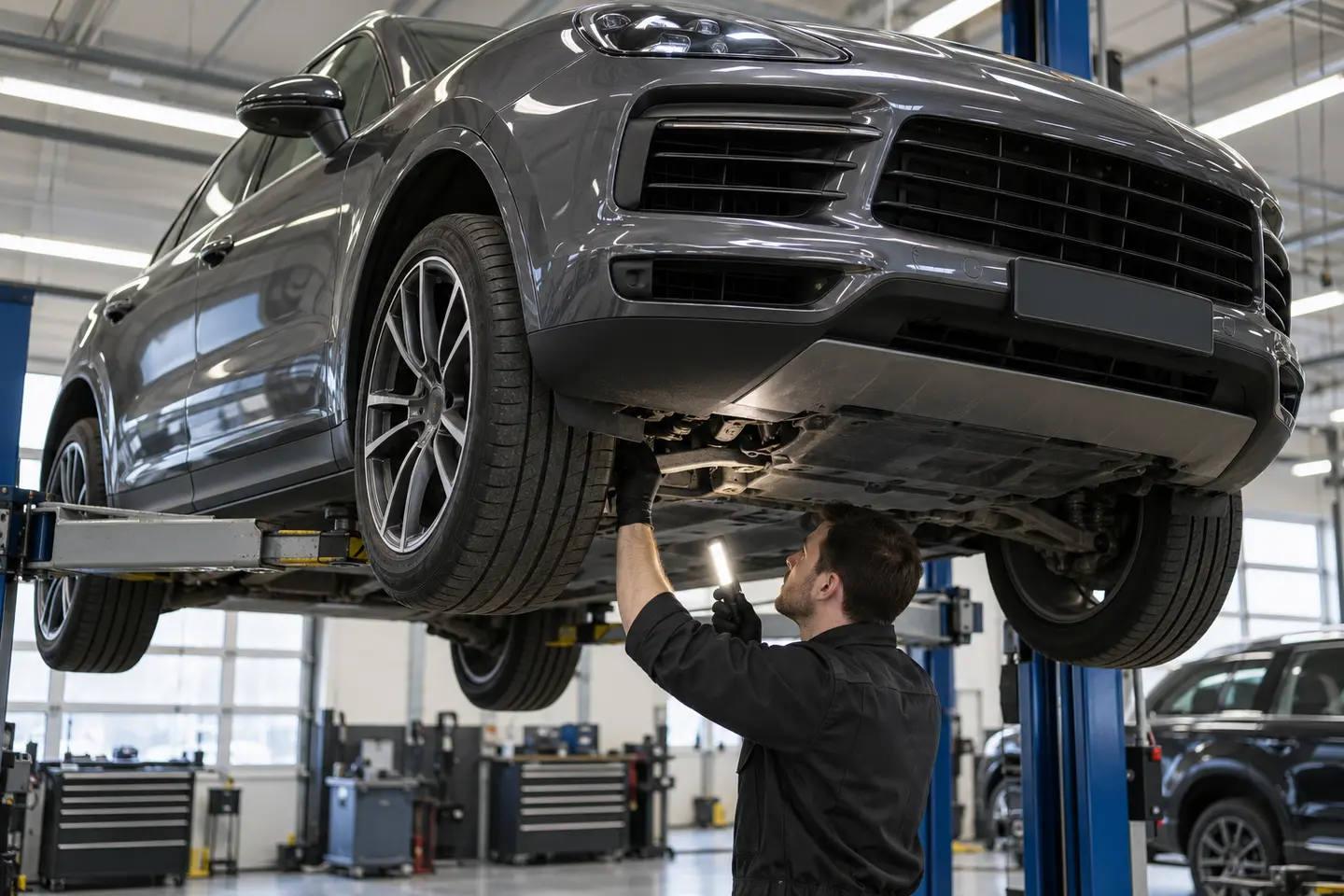
A used 2026 Cayenne inspection should answer these questions
Does the vehicle match its description? Check the documented model year, derivative, body style, major options, mileage history, and origin. Ask for clarification of inconsistencies before treating a seller’s description as established fact.
Is the maintenance record specific and coherent? Read the invoices, dates, and mileages. Look for what was actually performed, not only a claim of “full service history.” Confirm outstanding scheduled work against the applicable service information.
Are there unresolved warnings or stored concerns? An appropriate diagnostic assessment can support the inspection, but it should be interpreted with mechanical findings and the reported history. A cleared display does not prove every system is healthy.
What do the tires, brakes, and chassis show? Request condition findings, relevant measurements, and an explanation of any uneven wear, leaks, noises, or abnormal height behavior. Avoid relying on a short test drive alone.
Does the hybrid or electric equipment function as represented? Ask for appropriate charging checks and relevant battery or system reports where available. Do not infer traction-battery condition solely from a displayed range estimate.
What does the inspection exclude? A pre-purchase inspection is not an absolute guarantee against hidden or future faults. Define access, diagnostic coverage, road-assessment conditions, and any limitations before commissioning it.
For a car you are seriously considering, request a Porsche pre-purchase inspection with the seller’s permission and agree the scope for its powertrain and equipment. Have important findings and estimated immediate work documented before committing to the purchase.
How to compare an X5, GLE, or SQ8 fairly
Use the exact rival derivative, model year, market, and equipment, not just the family name. An entry-level BMW X5, a high-output Mercedes-AMG GLE, and an Audi SQ8 are not automatically equivalent performance or price comparisons.
Build the comparison around the decisions that matter, such as seating and luggage needs, charging access, ride preference, controls, driver-assistance equipment, brake and tire costs, warranty terms, and verified vehicle condition. Check manufacturer documentation for any numbers you intend to compare.
Test similarly specified cars on representative roads under safe conditions. A claim that one is universally more comfortable or reliable needs evidence beyond a badge, one favorable drive, or an internet anecdote. This guide does not invent test results to declare a winner.
Should you choose a 2025 or 2026 example
The confirmed model-year 2026 digital update gives you something specific to compare. It does not automatically outweigh a stronger condition report, more suitable equipment, or a materially different purchase price on a 2025 car.
Check what each vehicle actually has, including the software and hardware features important to you. Do not assume that every earlier car can receive the same functions through a free update. Obtain confirmation for the particular vehicle if an upgrade is part of the seller’s argument.
Make the final decision using a short written list of required equipment, acceptable history and condition, realistic ownership budget, and the price difference you are willing to pay for the features that matter. That keeps an annual model label from replacing a proper assessment.
Which Cayenne makes sense for you?
Shortlist the powertrain around your charging and travel pattern, then choose the derivative around the experience and equipment you actually want. Verify the model year and regional specification, obtain a dated AED quote, and inspect a used car before treating its advertisement as fact.
If you already own a Cayenne and are deciding whether to keep it or change cars, establish its condition and upcoming maintenance first. When it needs attention, Cayenne service and repair can address the reported concern and provide a vehicle-specific estimate. Use those findings when weighing the cost of keeping the car against changing it.
The right 2026 Cayenne is the one whose specification, condition, and costs make sense together. Updated infotainment, a V8, or a charging socket can be valuable features, but none removes the need to check the actual vehicle.