
Porsche brake pads should be replaced when inspection shows that they have reached the applicable wear limit, are damaged or contaminated, or otherwise require replacement under the correct service procedure. A pad-wear warning needs prompt attention, but squeaking, vibration, or a soft pedal does not by itself prove that new pads are the complete repair.
The most useful estimate connects each recommended part to an inspection finding. It identifies your brake system, records pad and disc condition, and explains any work on sensors, hardware, or the parking brake. This guide helps you read that estimate and recognize situations that require stopping rather than booking a routine pad change.
Decide whether this is routine wear or an urgent brake concern
Stop safely and arrange assistance if braking performance changes significantly, the pedal becomes unusually soft or sinks, there is an apparent fluid leak, severe grinding, smoke, or the vehicle displays an instruction to stop. Do not drive to a workshop simply to find out whether the problem gets worse. An online description cannot certify that the brakes are safe.
A pad-wear message and a hydraulic brake warning are not interchangeable. Nor does an ABS or stability-control message automatically mean the friction pads are worn out. The correct response depends on the exact message and the condition of the vehicle. Check the relevant warning in Porsche’s driver’s manual.
If there is only a wear notification and no obvious change in braking, arrange a prompt inspection and ask for model-specific guidance before further use. Do not assume the sensor guarantees a fixed number of kilometers remaining. It is not a promise that every pad is wearing evenly or that the discs are serviceable.
Identify the brake system before comparing prices
“Pads for a Cayenne” is not a complete parts specification. Model year, trim, axle, fitted brake option, and prior modifications can change the required parts. A workshop should verify fitment against the vehicle, not select a kit from an exterior badge alone.
Porsche vehicles can have different friction systems, including conventional iron discs, Porsche Surface Coated Brake systems on applicable models, and Porsche Ceramic Composite Brakes. The correct inspection procedure and compatible friction materials depend on what is installed. Do not apply an iron-disc repair recommendation to a ceramic disc without the appropriate technical procedure.
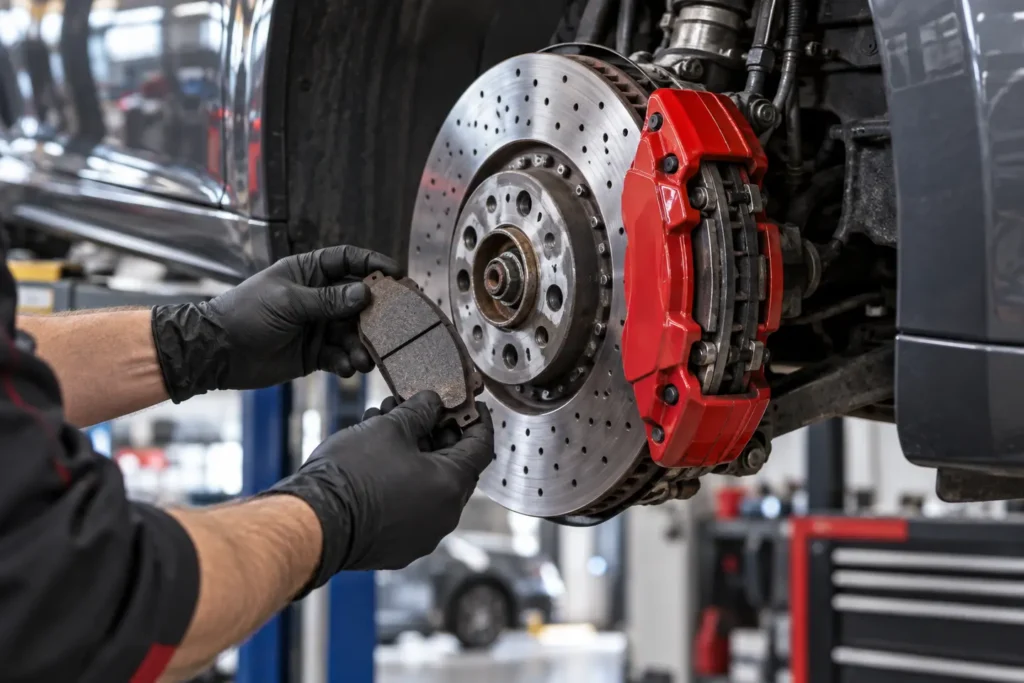
Caliper color can be a useful clue, but it is not conclusive evidence of original equipment. Calipers can be refinished, and components can be changed. The vehicle specification and part identification are more reliable than a seller’s photograph or a color chart.
Front and rear are separate inspection decisions
Front and rear pads do not necessarily reach their service limits together. Both axles should be assessed, while the estimate distinguishes the work actually needed on each. A recommendation for all four corners should be explained, not treated as automatic.
Within an axle, pad replacement is a matched job. Brembo’s car brake-pad instructions specify replacement across the axle. That does not establish that the other axle is due at the same time.
What the inspection should tell you
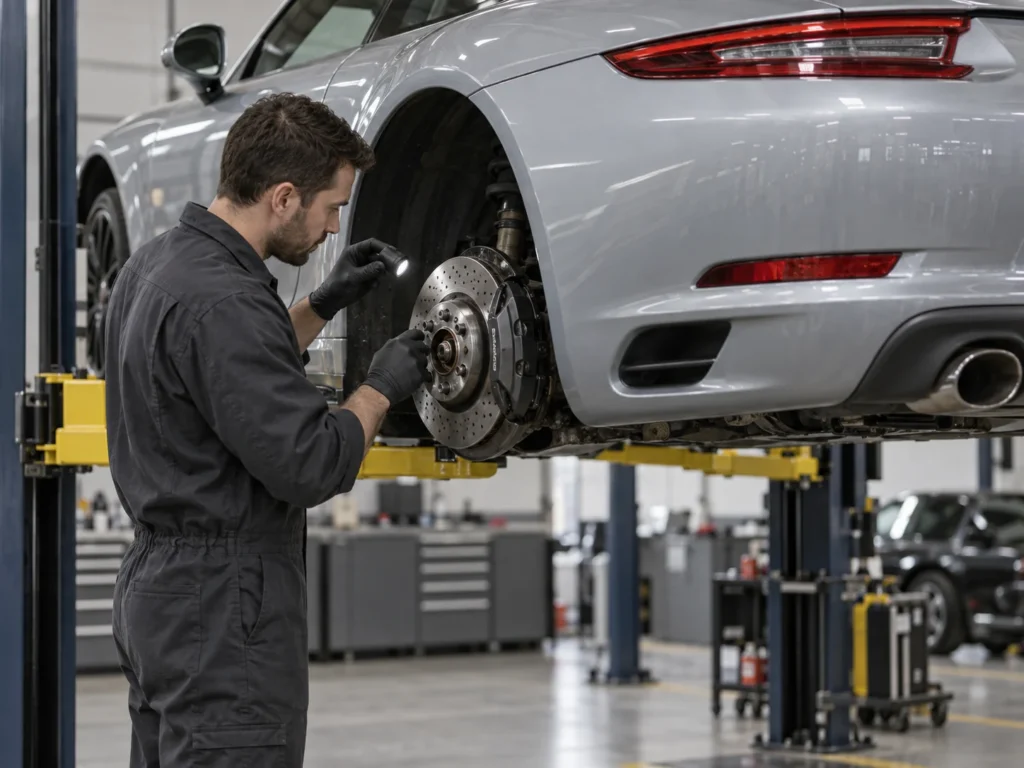
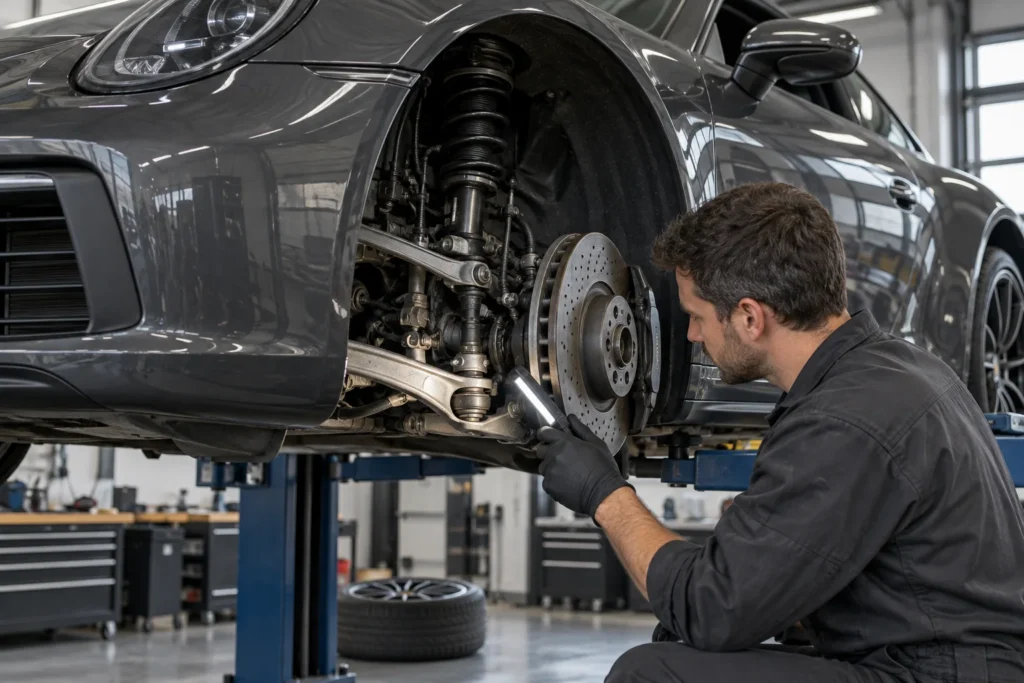
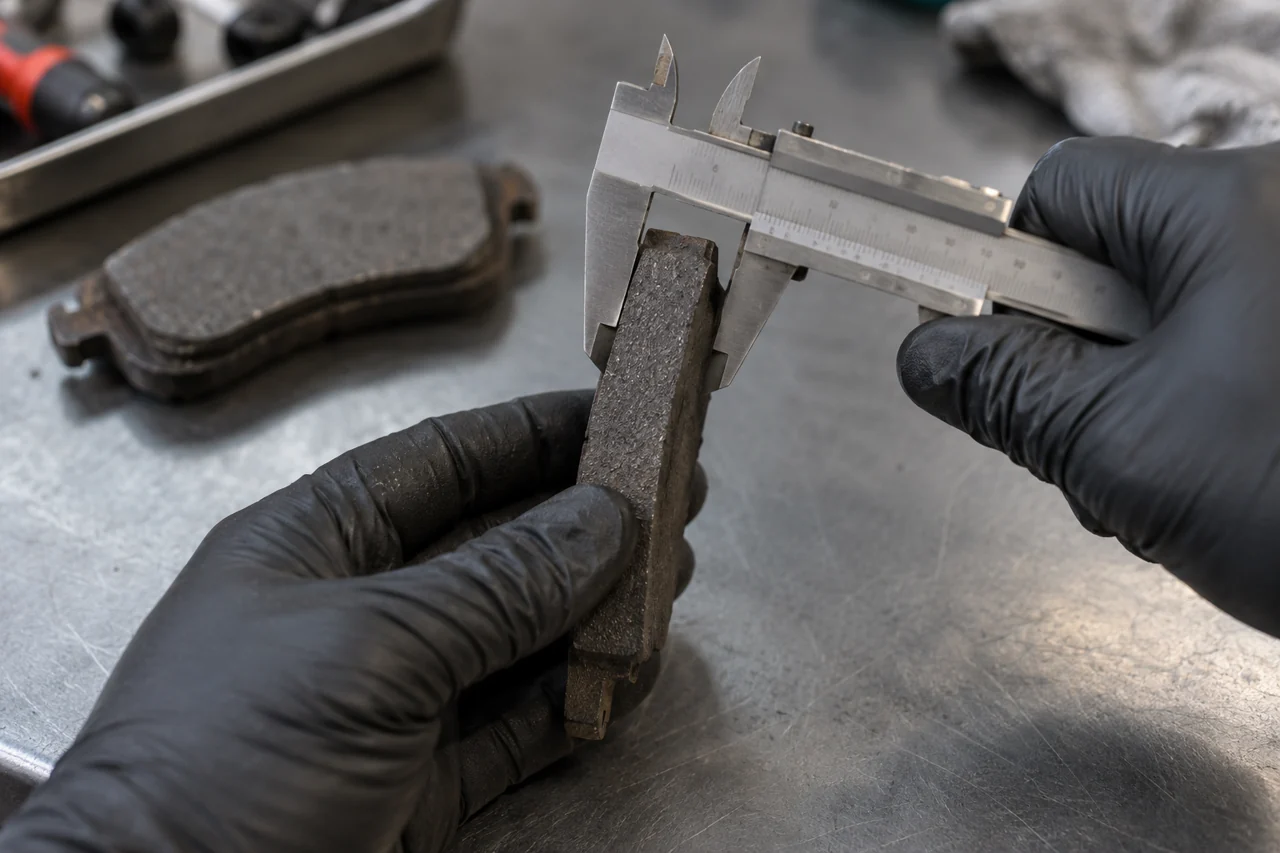
Ask for measurements and condition notes rather than a single photograph of the easiest outer pad to see. The report should make clear which axle and which wheel each finding concerns.
| Finding to request | Why it changes the decision | What an incomplete answer looks like |
|---|---|---|
| Remaining friction material on relevant inner and outer pads | Uneven wear can conceal a more worn pad and may need investigation | “The visible pad looks fine.” |
| Correct pad limit or replacement criterion for the installed system | A general number may not reflect the applicable procedure | “Every Porsche uses the same limit.” |
| Disc measurements and condition under the correct inspection method | Pads alone may be unsuitable if the discs are outside specification or damaged | “There is a lip, so everything must be replaced.” |
| Wear-sensor and wiring condition | A warning may involve sensor damage as well as pad wear | “We will just clear the light.” |
| Caliper operation and associated hardware | Uneven wear or drag may continue after new pads | “New pads will fix any pull.” |
| Explanation of symptoms that remain unexplained | Noise, vibration, and pedal changes can need separate tests | “All brake symptoms are pad symptoms.” |
Ask whether a photograph shows the measurement itself or only the surface condition. Pictures can help explain a result but do not replace the relevant measurements, checks, or model-specific limits.
Why common symptoms do not identify one failed part
Squealing needs context
A noise report should include whether it occurs when cold, at low speed, after parking, or during repeated braking. A squeal can relate to the pad and disc interface, installation details, contamination, or other conditions. It is not reliable proof of a built-in metal wear tab on every Porsche pad.
Do not spray lubricant toward the brakes or try to silence the symptom before inspection. That can introduce contamination and obscure what the technician needs to investigate. If the noise is accompanied by reduced braking, severe grinding, or another urgent symptom, treat the combination as a safety issue.
Vibration is not an automatic pad diagnosis
Report whether vibration appears only while braking, through the steering wheel, through the seat, or also at a steady speed without brake application. That distinction helps separate a brake-related investigation from wheel, tire, or mechanical suspension concerns.
Where the brakes are implicated, a technician may need to examine disc condition, thickness variation, runout, and the relevant mounting surfaces according to the service procedure. Replacing pads without understanding the source of vibration can leave the original complaint unchanged.
A soft pedal belongs in a different urgency category
Normal pad wear should not be used as a blanket explanation for a sudden soft or sinking pedal. A change in hydraulic performance needs appropriate assessment. Likewise, a low-fluid warning is not permission to top up the reservoir and continue without understanding the cause.
If pedal feel or stopping performance changes, stop safely and seek assistance. This guide does not provide bleeding instructions, a roadside hydraulic test, or advice to keep driving until a pad appointment.
Grinding deserves prompt action, not a noise experiment
Severe grinding can indicate a condition in which continued use risks further damage and compromised braking. Do not deliberately repeat hard stops to reproduce it. Give the workshop the circumstances and arrange safe transport when needed.
Avoid diagnosing the affected corner solely from where you hear the sound inside the cabin. Noise travels through a vehicle, and the inspection should establish the source.
When pads alone may be reasonable
A pads-only job can be appropriate when the existing discs meet the applicable requirements, the calipers and hardware are serviceable, and the new pads are compatible with the installed brake system. It still requires proper preparation, installation, and verification.
Ask the technician to explain the disc assessment and whether the remaining condition is suitable for the proposed pad replacement. “We always replace discs” is not an inspection finding, but neither is “the discs look shiny.” The correct service criteria take priority over a blanket sales rule.
For conventional discs, relevant factors may include measured thickness, damage, corrosion, and the conditions associated with the complaint. Ceramic and coated systems require their own assessment. A machining proposal should identify the disc type, permitted procedure, and resulting service limits before it is considered.
When discs require replacement, pad replacement and axle consistency must also be addressed. Brembo’s disc-replacement instructions specify replacing both discs on the axle and fitting new pads. The vehicle and installed product instructions remain essential to the actual job.
Parts quality is more than a logo on the box
The appropriate choice is a traceable, correctly specified product for the installed system and intended use. A genuine Porsche part and a correctly cataloged aftermarket part should be compared on verified fitment, product documentation, supply source, and the workshop’s written terms.
“OEM quality” alone is not a part number or evidence of suitability. Ask who makes the proposed product, which brake option it fits, and whether the quote covers the correct sensors and installation hardware. Do not accept an unspecified substitution just because it is described as an upgrade.
Similarly, a track-oriented pad is not automatically the best road-car choice. Intended operating conditions and product characteristics matter. If the vehicle is used on track, tell the workshop so that road and track requirements can be discussed explicitly. Do not choose a friction compound solely to reduce dust without considering the whole application.
What a complete replacement appointment includes
This is a description of work to discuss with a qualified workshop, not a DIY procedure. Brake work involves vehicle support, safety-critical fasteners, hydraulic components, and model-specific setup.
Before fitting: identify the installed system, document wear and relevant symptoms, inspect related components, and confirm the approved parts and scope. If additional damage appears during dismantling, the workshop should explain it before expanding the job.
During fitting: follow the Porsche and component instructions for the specific application. Pad orientation, contact surfaces, retaining parts, and caliper condition can matter. Brembo’s directional-pad guidance illustrates why superficially similar pads cannot simply be treated as interchangeable pieces.
For the parking brake and sensors: establish whether the installed system needs a service mode, adjustment, replacement wear sensor, or other prescribed operation. Not every Porsche rear-brake arrangement is identical. Clearing a dashboard notification is not a substitute for correcting its cause.
Before handover: verify the repair using the appropriate checks and explain the bedding-in instructions for the actual parts. If a controlled road assessment is appropriate, it belongs with qualified personnel after the necessary static checks, not with an owner trying to diagnose unsafe brakes on public roads.
How to compare two Dubai brake estimates
A lower total can be a valid better offer, or it can describe a different job. Ask both providers to quote the same axle, brake system, product specification, and inspection findings before comparing totals in AED.
Your written estimate should separate pad sets, discs if justified, wear sensors, hardware, labor, and any additional diagnosed repair. It should state whether inspection charges, VAT, and post-repair checks are included. Request the warranty terms actually offered instead of relying on an unspecified “guarantee.”
Brake fluid service is a separate maintenance question. It may be due under the vehicle’s schedule, but that should be stated rather than hidden inside a pad package. A hydraulic fault is also a separate diagnosis, not an optional add-on to ignore because pads were the original booking request.
For a system with expensive specialty discs, ask for the inspection evidence before approving a large parts bill. Conversely, do not pressure a workshop to fit pads onto discs it has correctly identified as unserviceable just to meet a price target.
No fixed price range is given here because the relevant Porsche specification and approved workshop pricing have not been established for your vehicle. A written, vehicle-specific estimate is more useful than an attractive number that excludes the parts you actually need.
Pad life depends on use and condition
There is no single reliable mileage interval for every Porsche owner. Driving pattern, vehicle specification, friction material, load, and use all affect wear. An estimated remaining distance should never override a warning, inspection result, or the applicable replacement criterion.
Ask for pad measurements to be recorded during suitable service inspections. Comparing documented readings over time is more informative than assuming a highway-driven car must reach a particular kilometer figure. A change in wear pattern can also be more important than the total distance covered.
Electrified vehicles still require friction-brake inspection. The presence of regenerative braking does not make pad and disc condition irrelevant. Long periods with limited use can create a different inspection context from frequent heavy braking, so describe how the car is actually used.
After replacement, know what should and should not happen
Follow the specific bedding-in guidance supplied for the installed parts. Do not substitute an internet sequence of aggressive stops. Brembo’s maintenance guidance emphasizes checking the brake behavior after replacement. The exact instructions for your application should be provided at handover.
A warning that remains illuminated, a marked pull, worsening vibration, severe noise, smoke, or abnormal pedal behavior should not be dismissed as “new pads settling.” Contact the workshop, and stop safely if braking is affected. Record when the symptom occurs instead of repeatedly trying to reproduce it.
Keep the invoice, part details, and measurements. Those records help establish what was changed and provide a useful reference at the next service or if the car is sold.
Three questions owners often ask
Can I replace just the pad that looks worn?
Pad replacement is handled across the affected axle under the applicable procedure, not as a single-pad patch. Uneven wear should also be investigated so that the underlying issue does not immediately affect the replacements.
Does the wear warning mean the discs must be replaced?
No. Disc replacement needs its own inspection evidence. The warning should trigger assessment of the relevant pads and system, not an automatic decision about every brake component.
Can a photo confirm that my brakes are safe?
No. A photograph can document a concern, but it cannot establish hydraulic integrity, inspect every friction surface, or replace the required measurements. Use photos to support a booking discussion, not to obtain remote permission to continue driving.
If you need a Porsche brake inspection and service, provide the model, year, exact warning, symptoms, and whether you are asking about the front axle, rear axle, or an existing estimate. Ask for the findings before authorizing parts. The aim is a justified, complete brake repair, not merely a reset warning and a new set of pads.