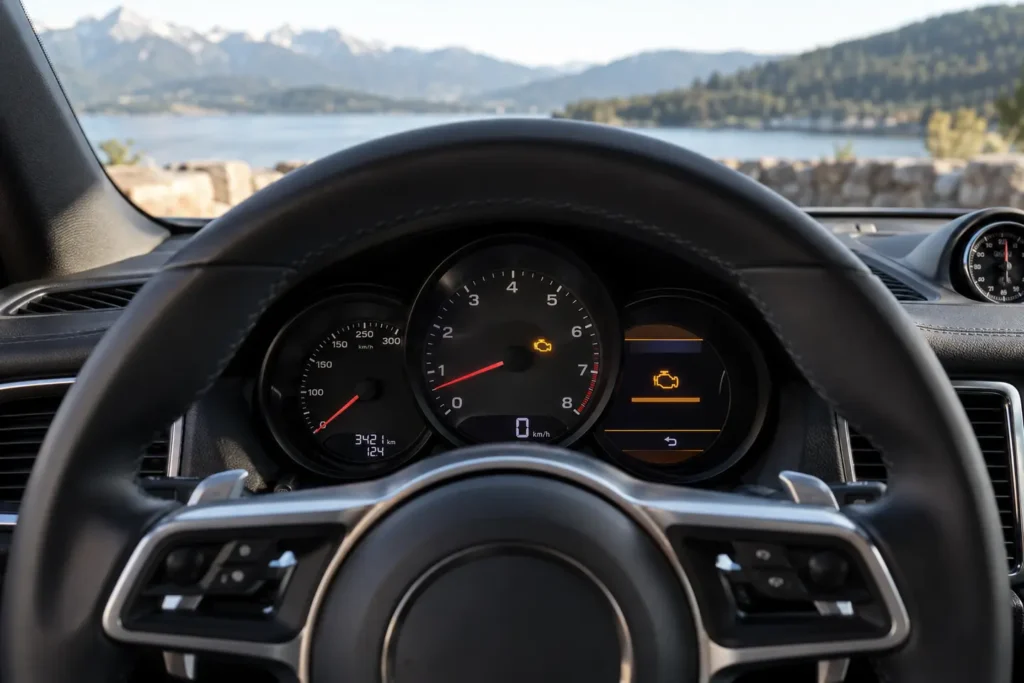
A Porsche engine warning or reduced-power message is a reason to read the exact display, not to assume that every car has an “EPC” lamp. Move to a safe place, note whether the engine symbol is steady or flashing, and photograph the message once parked. A flashing Check Engine light, severe misfire, smoke, fuel smell, overheating or an oil-pressure warning calls for stopping safely, switching off and arranging help. If the warning is steady and the car runs normally, reduce engine load and follow the instructions for your exact model and year before arranging an inspection.
This guide concerns combustion-engine warnings. Hybrid and electric drive-system messages can have different meanings and instructions. Use the vehicle-specific manual. Porsche provides digital owner’s manuals by model and year, and its owner-manual help explains where to find the manual in the car or app.
Identify the symbol and message first
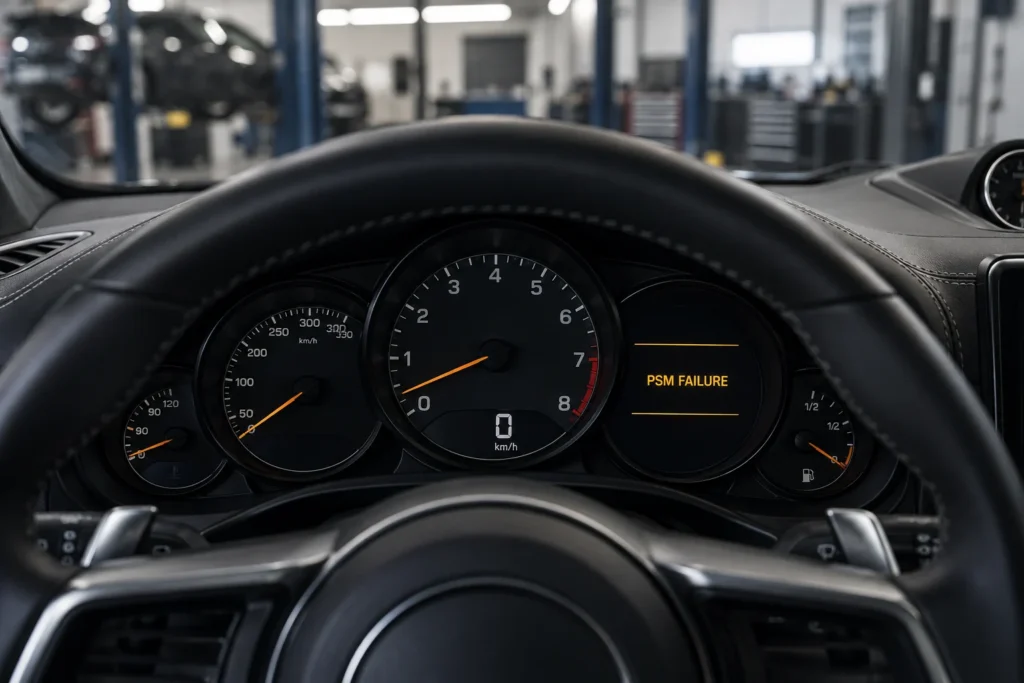
“EPC” is sometimes used as shorthand online for engine power control, but it is not a verified universal Porsche dashboard label for 991, 992, 718, Macan, Cayenne or Panamera. Record what your cluster actually shows. The engine-shaped warning symbol may be identified as Check Engine or an emission-control warning. A reduced-power text message is a separate clue, and red oil-pressure or coolant-temperature warnings demand their own response.
For a deliberately narrow example, Porsche AfterSales bulletin 59/15 lists 911 GT3 (991), model year “as of 2014”, for a specific high-RPM misfire complaint. It describes a yellow reduced-power message alongside the Check Engine symbol. That bulletin does not establish the same wording or an EPC lamp on other 911s or 718s. The model, year, warning colour and accompanying text matter more than a search term.
Should you stop driving?
| What you notice | Practical next step |
|---|---|
| Flashing Check Engine light, pronounced shaking or severe loss of power | Find a safe stopping place. Switch off, avoid repeated restarts and arrange recovery or professional advice. Porsche’s warning guidance says not to continue with a flashing Check Engine warning. |
| Red oil-pressure or high coolant-temperature warning, smoke, burning or fuel smell | Stop safely and switch off. Do not leave the engine idling to “see if it clears.” Keep clear of traffic and hot components. Arrange recovery. Follow any more specific instruction in your own car’s display or manual. |
| Steady yellow engine warning, normal running, no other urgent signs | Reduce speed and load, read the exact manual entry and arrange a timely check. A steady light is not proof that a long drive is safe. New symptoms change the decision. |
| Reduced-power message with limited acceleration | Follow the message’s stated driving restriction. If the car cannot keep pace with traffic safely, pull over and request recovery. Do not try to reproduce the fault with hard acceleration. |
Porsche’s warning-light guidance separates a flashing Check Engine warning from a steady one and directs drivers to stop and switch off for excessive coolant temperature. If you cannot identify the warning, treat the situation conservatively and consult the manual or a qualified workshop before driving further.
What a fault code tells the workshop
A diagnostic code records what a control unit detected. It does not name a failed part with certainty. A misfire entry, for example, can lead to checks of ignition, fuel delivery and mechanical condition. Porsche’s 991 GT3 bulletin uses fault memory together with a staged test path rather than ordering a replacement from the code alone. A warning that disappears after restarting may still leave useful stored information, so avoid repeatedly clearing it before assessment.
The useful intake details are the exact warning photo, model and year, when it appeared, whether the light flashed, how the engine behaved and any other warning shown at the same time. The workshop can then review relevant fault information and live readings, check voltage and connections where indicated, and select physical tests for the affected system. A normal scan on one visit cannot guarantee that an intermittent fault is solved.
Repair and follow-up depend on the finding
Possible causes include an ignition or fuel fault, intake or boost leak, sensor or wiring problem, low supply voltage, or a mechanical issue. These are possibilities, not a frequency ranking across Porsche models. The repair should follow evidence from the specific car. After approved work, the affected function and relevant warning information should be checked again. Adaptation, coding or software programming is needed only when that particular component and the applicable Porsche procedure require it. It is not a mandatory step after every engine-warning repair. If fuel quality is relevant to the complaint, check the specification for the exact car and test the suspected fault.
Arrange an appropriate diagnostic check
If the car is safe to bring in, PorscheGarage’s diagnostics service offers these distinct steps.
- Free initial check a review of your complaint and accessible fault information. It does not include an open-ended investigation.
- Paid targeted diagnostics an agreed system scan with relevant readings or checks. The estimate is AED 250–450 before VAT (AED 262.50–472.50 including 5% VAT), matching the published price guide.
The workshop confirms the specific tests and price before paid work. Extended or intermittent tracing, parts and repairs are separate. If driving is unsafe, ask about recovery instead of attempting the journey.
Call +971 56 464 6081 WhatsApp the warning photo. Include the model, year, exact display message and whether the engine runs normally.