
A Porsche brake disc needs replacement when its measured thickness reaches the limit for that disc, when significant cracks or damage are found, or when a measured fault cannot be corrected within the manufacturer’s procedure. A vibration or brake warning is a reason to inspect the system, not proof that the discs are worn. There is no single replacement mileage for every Porsche.
The decision starts with the exact model, year, axle and fitted brake system. A steel disc, Porsche Surface Coated Brake (PSCB) disc and Porsche Ceramic Composite Brake (PCCB) disc have different materials and assessment procedures. The vehicle’s VIN-specific Porsche owner’s manual and current parts and workshop instructions take priority over a generic mileage figure.
When a disc must go
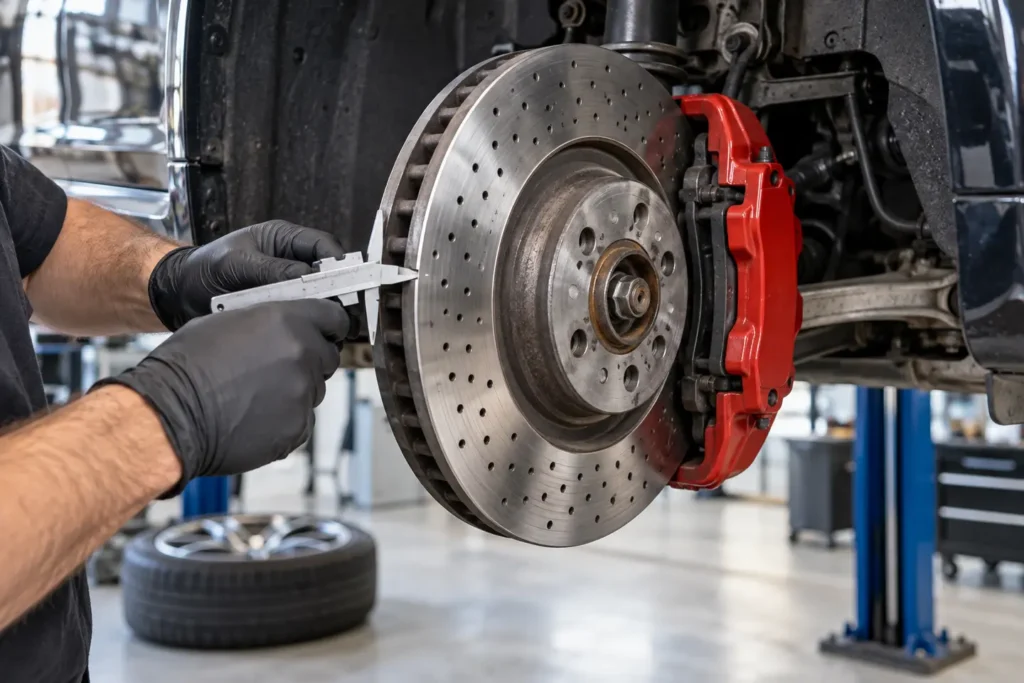
A technician measures the friction surface at several points with the appropriate gauge, away from the unworn outer lip, and compares the lowest reading with the minimum thickness marked for that disc or specified by the manufacturer. Brembo’s minimum-thickness guidance describes measurements at at least four points and replacing both discs on an axle if one has reached its limit. An apparent lip or a photograph does not supply that measurement.
- Below the applicable limit: Replace the affected axle’s matched discs with compatible parts and assess the pads and hardware. Do not machine a disc thinner to reuse it.
- Cracks or substantial damage: Inspect the exact type of disc. Significant cracking, deep scoring or damage may require replacement even when a simple thickness reading seems acceptable.
- Noise, a wear alert or a light surface film: These alone do not establish that a disc must be changed. Check the pads, sensors, calipers and disc condition. A pad-wear alert is not a direct disc-thickness gauge.
For a soft or sinking pedal, a red brake warning, severe loss of braking, grinding that suggests metal contact, or a wheel that becomes unusually hot, stop safely and arrange an inspection or recovery. Do not use another high-speed stop to “test” it.
What vibration can mean
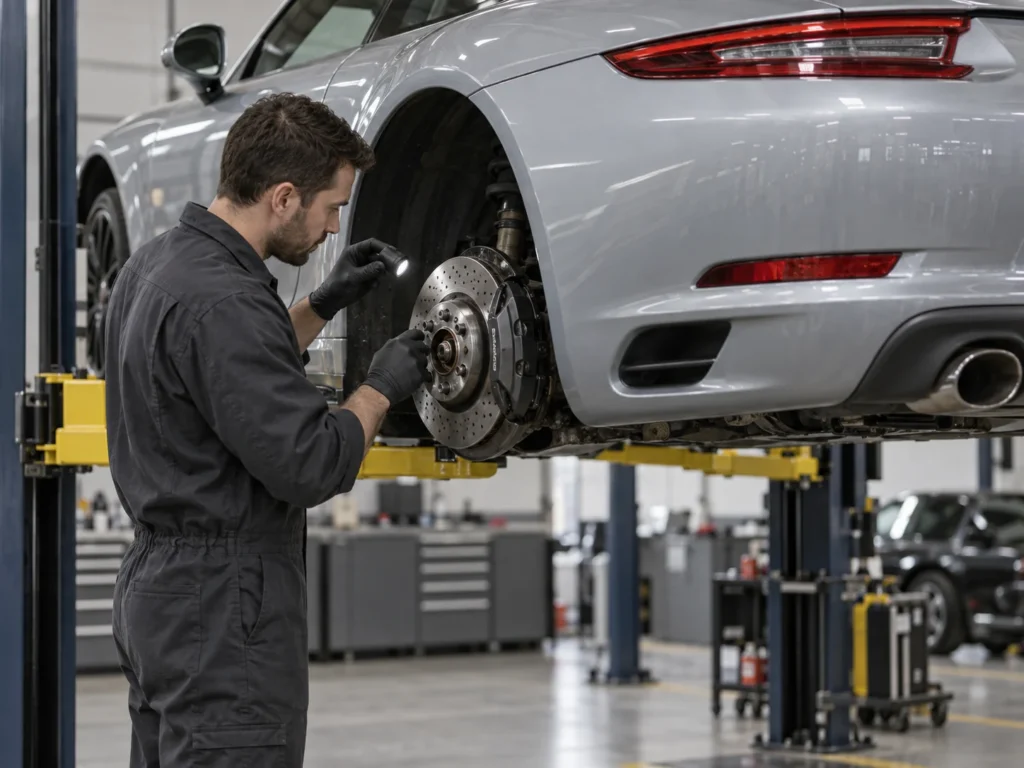
A shake while braking can arise from disc thickness variation, lateral runout, pad material deposits, a mounting face that is not clean, a hub or bearing problem, or another brake or chassis fault. It cannot be diagnosed by feel alone. A workshop should check the pattern, measure the disc, inspect pads and calipers, and measure mounted-disc runout with a dial gauge when indicated.
Brembo’s disc fitting instructions call for cleaning deposits and rust from the hub mounting face, checking bearings, then measuring disc runout after fitment. If runout is outside the applicable specification, the hub face is investigated. This is a cleanliness, measurement and fault-finding step. The result calls for the approved remedy to the measured fault, rather than a default machining or press procedure.
If a newly fitted disc still produces vibration, ask for the measurements and the underlying cause before approving another set. Correctly tightening and seating parts matters, but no workshop can guarantee a particular percentage improvement in stopping distance or disc life.
Steel, PSCB and PCCB differ
Conventional steel discs
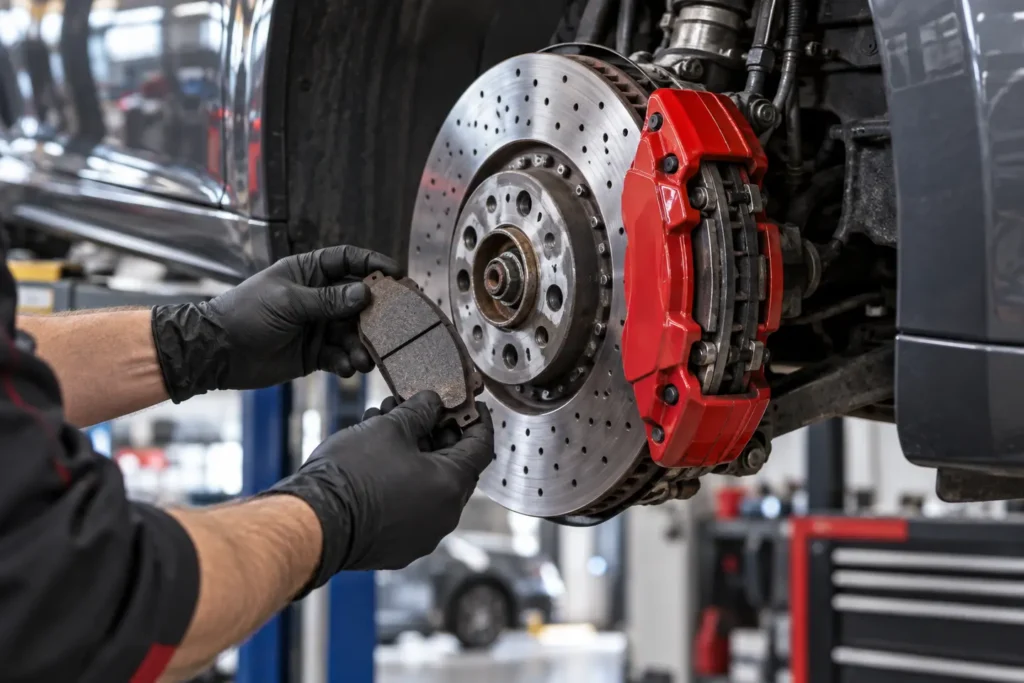
Grey cast-iron discs are inspected for thickness, surface condition, damage and runout against the specified limit. Matching the disc, pads and hardware to the VIN and axle matters. Replacement is normally an axle-pair decision, with the pads assessed at the same time. A serviceable disc is not automatically replaced simply because the pads are due. Our brake-pad guide explains how to assess the whole brake job.
Porsche Surface Coated Brake
PSCB uses a tungsten-carbide-coated grey cast-iron disc, described by Porsche’s Taycan technical information. The coating and matched friction components make a generic steel-disc machining or wear rule inappropriate. Identify the option on the actual car and use its Porsche parts and service instructions to decide whether a marked or worn PSCB disc can remain.
Porsche Ceramic Composite Brake
PCCB has a ceramic-composite disc rather than a conventional iron friction surface. Porsche describes a dedicated PCCB disc tester for assessing ceramic-disc wear. Chipping, damage or wear calls for the procedure and criteria specified for that car. A standard iron-disc thickness rule or casual resurfacing advice should not be applied. Confirm the exact fitted option before ordering parts or accepting a quote.
Equipment varies within the 911, 718, Macan, Cayenne, Panamera and Taycan ranges. Caliper colour or model name alone is not a complete parts identification. The VIN, build specification and current service information resolve it.
Mileage and Dubai use
City traffic, repeated heavy braking, track use, storage and exposure can change what an inspection finds, but none yields one fixed disc-replacement interval. Surface rust after parking may clear in normal use, while persistent corrosion, pitting, damage or rough braking deserves a measured check. On the Taycan, recuperation can reduce use of the friction brakes. Porsche explains that it periodically uses the hydraulic brakes to help keep the discs clean. That does not mean a Taycan disc automatically needs replacement after a set mileage.
Before approving replacement
- Ask for the measured thickness of each disc and the exact limit used. For a vibration complaint, ask what runout, hub, bearing or pad findings support the recommendation.
- Confirm the fitted brake type and axle, part numbers, pad and sensor needs, and whether the quotation covers both sides of that axle.
- Ask which model-specific fitting and post-service checks apply. Bedding-in advice should follow the selected parts and vehicle instructions.
A diagnostic scan can help with a related warning or parking-brake fault, but it does not measure friction-ring thickness. Likewise, a brief road test cannot certify disc life or guarantee stopping distance.
Ask for a brake assessment
If a brake disc is at its limit, damaged or suspected in a braking vibration, contact PorscheGarage with the model, year, VIN, fitted brake option if known, and what you feel or hear. The workshop can discuss an inspection and provide a quotation after the disc and surrounding parts are checked. See the Porsche brake service page for the workshop enquiry path.