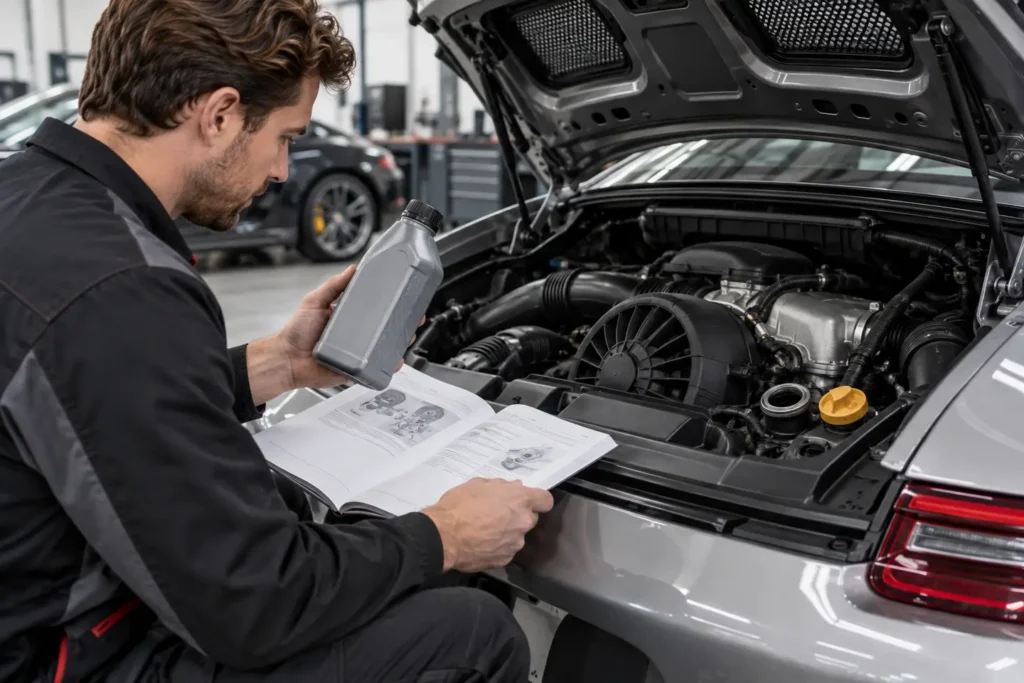

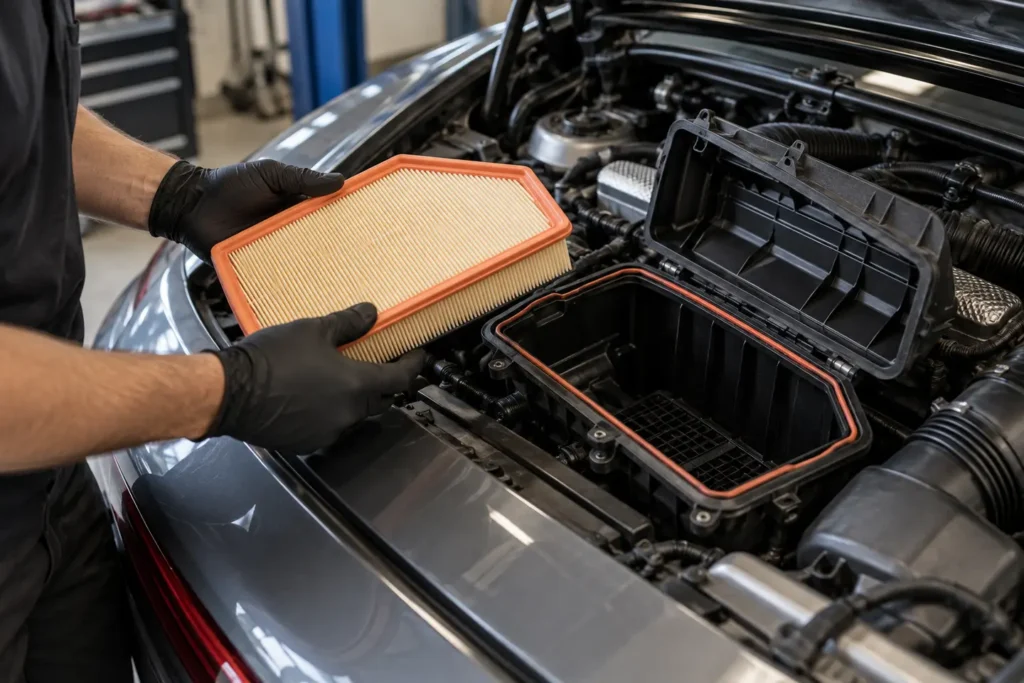
Before booking Porsche air filter replacement, identify which filter you mean. The engine air filter protects the combustion engine’s intake air. The cabin filter serves the ventilation system and the air entering the passenger compartment. Replacing one does not service the other, and they may have different schedules, access requirements, and part numbers.
For a Porsche used in Dubai, the sensible plan is to follow the correct vehicle maintenance schedule and assess actual filter condition and dust exposure. A universal replacement interval for every Porsche would ignore the model, engine, filter design, and driving environment. Likewise, a dirty-looking filter does not prove the cause of every performance or air-conditioning complaint.
Two filters, two different jobs
| Question | Engine air filter | Cabin air filter |
|---|---|---|
| Where does the filtered air go? | Into the combustion engine’s intake system | Through the vehicle’s ventilation system |
| What is its main purpose? | Limit contaminants entering the engine while allowing the required airflow | Filter incoming cabin air according to the product’s design |
| What should a service quote identify? | Engine, part number, number of elements, and access work | Cabin-filter specification, quantity, and access work |
| Does a pure EV need this engine filter? | Not a combustion-engine intake filter | Cabin filtration remains relevant |
| Will changing it solve the other system’s problem? | It will not repair weak cabin ventilation | It will not repair an engine performance fault |
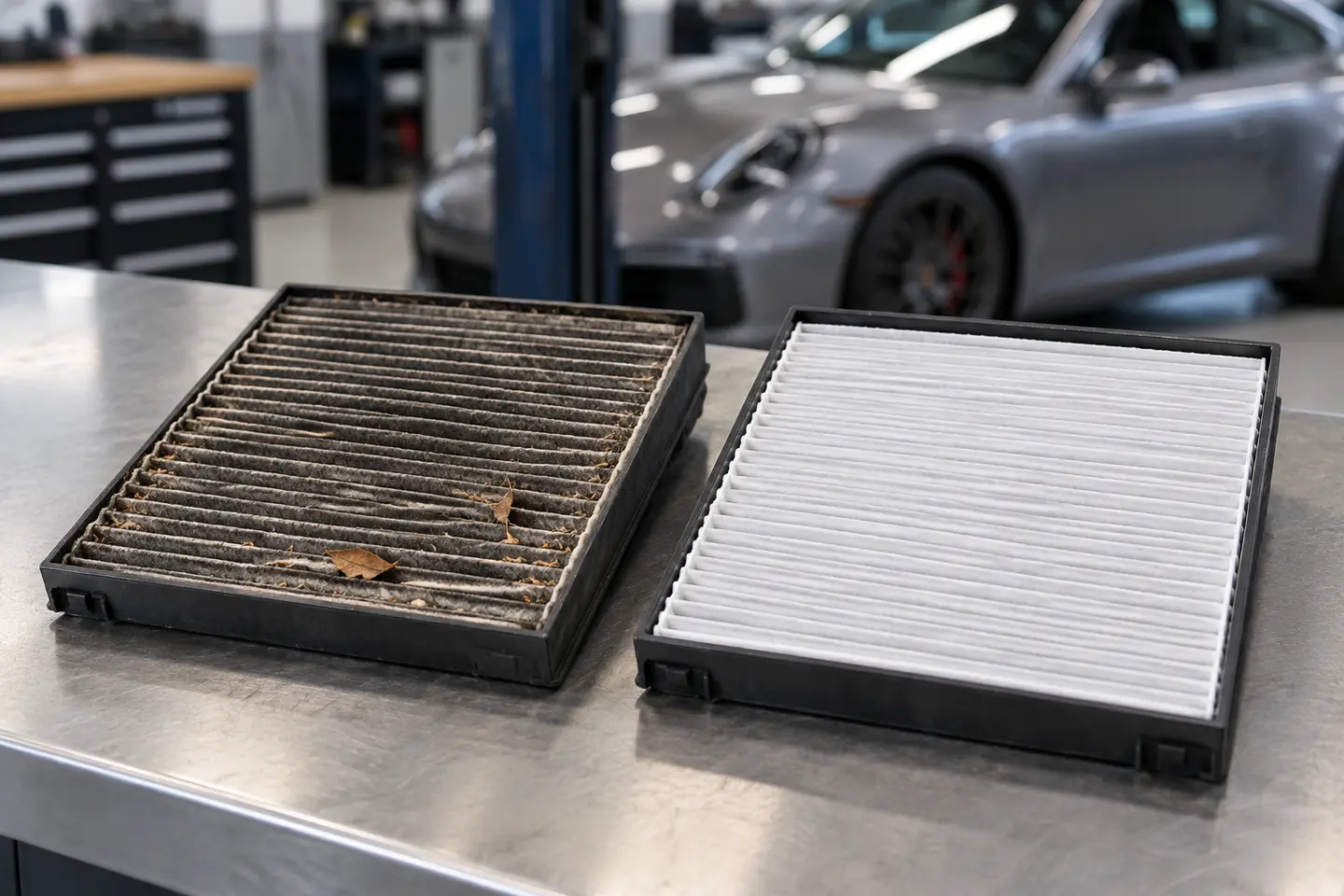
MANN-FILTER’s engine-filter information explains the relationship between contamination protection and airflow resistance. Its cabin-filter guidance addresses ventilation filtration separately. These are general product explanations, not a Porsche-specific maintenance schedule.
This distinction matters on an invoice. “Air filters replaced” is ambiguous unless the document identifies which filters, how many, and which part numbers were fitted. If you asked about weak airflow from the dashboard vents, confirm that the estimate has not been prepared only for an engine filter.
Find the right schedule before choosing a kilometer interval
Start with the service information for your exact model year, engine, and market. Confirm whether the relevant item has a distance interval, a time interval, condition-based guidance, or a combination. Use Porsche’s driver’s manual portal for vehicle information and ask the workshop for the applicable maintenance schedule where the owner’s manual does not contain the full service requirement.
A schedule from another Porsche is not automatically transferable. An older 911, a turbocharged Cayenne, and a plug-in hybrid can differ in layout and service requirements. The Taycan and an electric Macan do not have a combustion engine whose intake filter can be included in a generic petrol-car service package.
Dust exposure should trigger a discussion, not a fabricated interval
Tell the workshop whether the vehicle regularly encounters dusty access roads, construction areas, or sand-heavy conditions. That is useful context for inspection. It does not establish that every Dubai car must have an engine filter changed at 10,000 km or that all highway-driven cars can wait twice as long.
An earlier inspection may show that replacement is justified, or that the filter remains serviceable under the applicable criteria. Ask what was observed and how that finding changes the next service recommendation. A measured, documented decision is more useful than a one-size-fits-all “desert schedule.”
Service history is evidence, not just a stamped booklet
Look for the last replacement date, mileage, exact filter description, and part number on previous invoices. A general service stamp may not tell you whether engine filtration, cabin filtration, or neither was included.
If the history is missing, say so. The workshop can inspect and establish a baseline instead of assuming that an unknown filter is new. Record the resulting work clearly so the next maintenance decision is not based on the same uncertainty.
What an engine-filter inspection should establish
A useful inspection looks beyond whether the visible surface appears dusty. The relevant questions include whether the element is suitable for the vehicle, whether it is damaged or excessively loaded, and whether the housing and seal are doing their job.
Correct fitment the filter should match the exact application, including dimensions and sealing arrangement. A part that can be pushed into the housing is not necessarily the correct part.
Media condition torn, distorted, wet, or otherwise compromised material needs assessment under the appropriate product and vehicle guidance. A photograph can document obvious damage, but it cannot reliably quantify airflow restriction by itself.
Sealing and housing a damaged seal, incorrectly seated element, or unsecured housing can undermine filtration even when the filter is new. Ask the technician to check the relevant sealing surfaces and retaining features.
Unexpected contamination oil, moisture, debris, or evidence of dirt on the clean side should be investigated rather than simply hidden by a fresh filter. The source and significance depend on the vehicle and the finding.
These checks make replacement part of a proper intake inspection. They also explain why a parts-only price does not describe the same job as an installed service with a documented condition assessment.
Match the symptom to the right investigation
Reduced engine performance
A heavily restricted intake filter is one possible consideration in a performance complaint, but hesitation or reduced power does not diagnose the filter on its own. Intake leaks, ignition, fuel delivery, sensors, boost control, and other systems may need attention depending on the symptoms and vehicle.
Tell the workshop whether the change occurred suddenly or gradually, whether a warning appeared, and whether it began after service. A filter replacement should not be advertised as a guaranteed cure for poor acceleration without relevant evidence.
If a performance problem continues after a correctly fitted service filter, ask for the next diagnostic step. Replacing additional filters or ordering a software remap is not a substitute for establishing the fault.
Increased fuel use
Fuel consumption varies with routes, traffic, idling, temperature control, driving pattern, and vehicle condition. A change can be worth investigating, but a fuel receipt alone does not identify an intake restriction.
For a useful comparison, keep conditions reasonably similar and use a meaningful period instead of one trip. Explain the change to the workshop alongside any engine symptoms. Do not expect a fixed percentage fuel saving from replacement when the previous filter may not have been the cause.
Weak ventilation or an unpleasant cabin smell
These complaints belong first with the cabin-air and climate-control system, not the engine intake. A cabin filter can be part of the inspection, but blower operation, air distribution, moisture, and other HVAC conditions can also matter.
Separate weak airflow from air that flows normally but is not cool enough. Those are different observations. A new cabin filter cannot be promised to repair a refrigerant, control, or mechanical air-conditioning fault.
Warning light or rough running after a filter service
Report the timing and return for inspection. A connector, duct, or housing disturbed during access may need checking, although timing alone does not prove responsibility or the cause. Preserve any fault information before it is cleared.
If the car has a significant loss of power, abnormal running, smoke, or an instruction to stop, follow the warning and seek assistance. Do not continue a test drive simply to see whether a new filter “settles in.”
Paper, reusable, and performance filters
The best starting point is the approved specification for the car and its intended use. Product claims should be supported by the manufacturer’s documentation and correct fitment, not by a universal ranking of filter materials.
A specified replacement element
A traceable replacement with the correct application listing gives you an identifiable part and maintenance requirement. Ask for the brand and part number instead of accepting “premium filter” as the complete description. Genuine Porsche packaging and aftermarket branding are not interchangeable terms. The quote should accurately name what is supplied.
Fit and sealing are as important as the label. A high-quality product installed incorrectly can fail to provide the intended protection. Conversely, choosing the correct product is not an excuse to ignore a damaged housing.
A reusable element
Only treat a filter as washable or reusable if its manufacturer explicitly describes it that way. Obtain the cleaning materials, drying requirements, service interval, and any oiling instructions for that exact product. A reusable design is a maintenance commitment, not a permanently maintenance-free filter.
Do not assume an ordinary disposable element can be converted into a reusable one. This guide does not recommend washing, oiling, tapping, or blowing out an unidentified filter to postpone replacement. The wrong method can damage the media or leave contamination behind.
A performance claim
Ask what the claimed improvement was measured against, on which engine, and under which conditions. More intake sound is not itself evidence of more usable power. A marketing graph does not establish compatibility with your particular vehicle or its other modifications.
Replacing a standard service filter with the correct equivalent does not, by itself, establish a need for an ECU remap. If a workshop recommends calibration work, ask which modification or diagnosed condition makes it necessary. Keep ordinary maintenance and performance modification as separate decisions.
What owners can check without dismantling the intake
You can gather useful information without opening an unfamiliar airbox. Read the service invoices, identify the model and engine, record when symptoms occur, and describe the environment in which the car is driven.
Ask for photographs and part details during the workshop inspection. If you are considering owner maintenance, consult the model-specific instructions first. Access can be complicated on some Porsche layouts, and a generic internet instruction to “open the engine cover and unclip the box” may not apply.
Do not run the engine with the intake filter removed as a performance test. Avoid placing tools or loose objects near open intake components, disturbing sensors, or introducing cleaning fluid without an approved procedure. Where access is not clearly covered by an appropriate owner instruction, leave it to the workshop.
The fact that a filter is inexpensive does not make every access procedure simple. Labor can reasonably vary between layouts, but the estimate should explain the required access rather than using the Porsche badge alone to justify the cost.
A service sequence worth asking for
- Confirm the application. Identify the vehicle, engine, filter type, quantity, and relevant service requirement.
- Inspect before discarding evidence. Record the old filter’s condition and check the housing, seal, and any unusual contamination.
- Explain additional findings. If a damaged housing, duct, or connector needs attention, seek approval for that separate work.
- Fit the correct replacement. Use the applicable procedure and verify seating, closure, and anything disturbed during access.
- Check the result. Confirm normal operation and investigate any warning or symptom that remains.
- Document the next decision. Record the date, mileage, part numbers, and schedule or condition-based reason for the next service recommendation.
This sequence is an owner-facing quality checklist. It does not replace the technician’s service procedure, specify fastener settings, or authorize DIY work on a layout you have not identified.
What affects replacement cost in Dubai
Ask for a written AED estimate that identifies engine filters and cabin filters on separate lines. Confirm the number of elements, the proposed products, access labor, and whether any related inspection is included.
A package may cover only an engine filter, even if its title says “air filter service.” Another quote may include a cabin filter with an activated-carbon layer, while the first uses a different specified product. Compare the actual scope and suitability before comparing the total.
Where maintenance tasks share access, ask whether combining them changes the labor, but do not assume a discount or authorize unrelated work. If you are arranging a Porsche oil service, request confirmation of which filters are included rather than assuming all of them are automatically replaced.
The estimate should state VAT treatment, any diagnostic charge, and the warranty terms actually offered. No generic price range is supplied here because approved pricing and the exact vehicle requirements are needed for a meaningful figure.
If poor running is the reason for booking, separate filter maintenance from fault diagnosis. A diagnostic check may help investigate an engine warning, but a scan alone cannot reveal the physical condition of every filter seal or intake connection.
Keep the next visit simpler
Save a clear invoice and, if supplied, a photograph of the condition that justified replacement. Record whether the work addressed routine maintenance or a separate complaint. This prevents a later technician from assuming the symptom was resolved merely because a filter was changed.
When your driving environment changes, mention it at the next service. Frequent dusty routes are relevant to inspection planning, while a low-mileage car still needs the time-based items in its applicable schedule considered.
Do not add aftermarket screens, wraps, or extra filtration materials to the intake without an approved application. An improvised dust barrier can change airflow or fit without providing validated protection. Maintain the designed system and investigate any evidence that dirt is bypassing it.
Questions that prevent the wrong booking
Should the engine and cabin filters always be changed together?
Not automatically. Each has its own schedule, condition, and purpose. They can be serviced during the same appointment when both are due, but the invoice should identify them separately.
Does a hybrid still need an engine air filter?
A plug-in hybrid with a combustion engine has engine-intake maintenance to consider. Electric-only driving does not justify ignoring the vehicle’s maintenance schedule. A pure EV is a different application and should not be sold a combustion-engine filter service.
Is a dark filter always finished?
Color alone is an incomplete assessment. The product’s original appearance, contamination, media condition, sealing, and relevant service guidance matter. Activated-carbon cabin filters can also look different from plain particle filters before use.
Will a fresh filter restore lost horsepower?
It may address a restriction if that was genuinely present, but it cannot be promised to restore power when another fault is responsible. Ask what evidence connects the filter condition to the complaint.
Ask about the right filter service
Share the model, year and service history, then ask for the engine and cabin filter items to be identified separately in the written quote. If poor running or weak ventilation is the concern, describe the symptom so the workshop can advise whether a filter inspection or further diagnosis makes sense.