
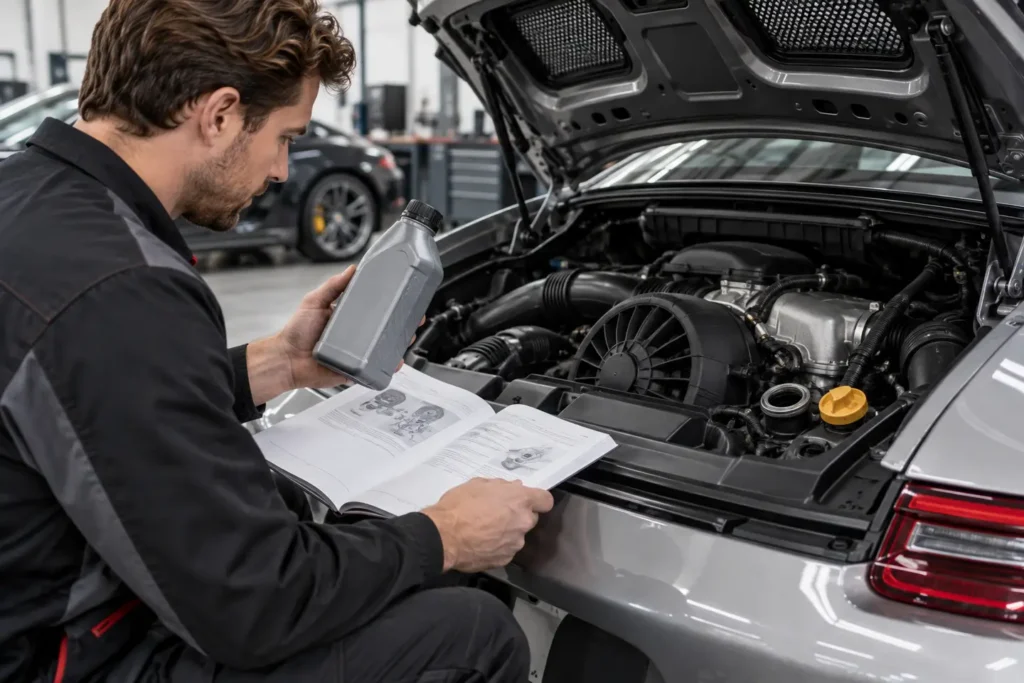
The right engine oil for a Porsche is the product that carries the Porsche approval required for that car’s exact engine and model year, in a viscosity Porsche permits for it. Start with the vehicle identification number (VIN), engine variant and applicable owner or service information. Then check the product against Porsche’s current approved-oil list. A familiar brand name or a 0W-40 label alone cannot establish compatibility.
Porsche’s owner-manual search lets owners select their model and year or enter a VIN. The Porsche oil-approval and model allocation bulletin for model year 2026 illustrates why this matters. Different variants in the same family can require different approvals. That bulletin applies to the vehicles it lists. It is not a substitute for the matching information for an older or different regional vehicle.
Find the approval before choosing the brand
- Identify the vehicle precisely. Record the VIN, model year, engine variant and any relevant emissions equipment. Registration year can differ from model year.
- Read the applicable Porsche requirement. Check the owner’s manual and current model-specific service information for the oil specification, permitted viscosity and service procedure. Classic engines may have a separate approval list.
- Check the exact oil product. Confirm that the product and grade have the required Porsche approval on Porsche’s current list, rather than relying on a seller’s “recommended for” wording.
- Confirm the quantity and service record. The fill amount and level-check method also depend on the engine. Keep the product name, approval, viscosity, filter and date on the invoice.
Approvals such as A40, C20, C30, C40 and C40 GT are not interchangeable. For example, Porsche’s 2026 allocation assigns the Panamera base engine C30 and the Panamera GTS C40. The point is to check the exact variant, not to copy either approval to every Panamera. Oil information can also change with a later Porsche bulletin, so use the current list when servicing the car.
What does 0W-20 or 0W-40 tell you?
The first part of an SAE multigrade label describes low-temperature flow performance. The number after W describes a viscosity class at operating temperature. Neither number is a standalone measure of oil quality, engine protection or Porsche approval. A higher second number is not automatically a safer choice for an older engine, a turbocharged model or summer driving.
Dubai heat and stop-start traffic make correct maintenance and monitoring sensible, but they do not override Porsche’s approved grade for the engine. Porsche’s 2026 allocation includes approved 0W-20 applications. Calling all “thin” oil unsuitable for the UAE would contradict those model-specific requirements. If the manual gives alternatives for a particular vehicle, follow its conditions. Do not extrapolate from another Porsche.
Does it have to be Porsche-branded oil?
The approval matters more than the branding on the bottle. Porsche publishes named approved products, so a non-Porsche-branded oil that is listed with the required approval can be a valid choice. “Fully synthetic,” “European formula” or “high performance” on its own is insufficient evidence. Check the exact product and grade, because products within one brand can carry different approvals.
Changing brand does not, by itself, cause sludge. Porsche’s 2026 bulletin permits mixing oils approved to the same Porsche specification and advises using the same brand and type for top-ups where possible. It does not recommend a flush simply because the approved brand changes. If the previous oil is unknown or unapproved, the sensible step is to verify the vehicle’s requirement and assess the service history, not to promise that a chemical flush will solve a problem.
When is the oil and filter service due?
Use the manufacturer’s time and distance requirements for the specific model year and engine, and service at whichever limit arrives first. The in-car reminder and documented history help identify what has been completed, but a reset alone does not prove an oil change took place. A 911, Cayenne, Macan and Panamera cannot all be assigned a reliable interval from their model names. Engines, years and schedules differ. Check the VIN-specific schedule before setting a date or mileage.
Dust, repeated short trips, track use or a heavy operating pattern may warrant a condition discussion or additional checks under the applicable guidance. Dubai location alone does not justify inventing a universal half-interval. A fully electric Taycan has no combustion-engine oil service. An E-Hybrid’s combustion engine does. Other drivetrain fluids are separate maintenance items.
Symptoms need diagnosis
New engine noise, smoke, rough running, loss of power or a rising temperature needs a diagnosis. Oil level or an overdue service may be relevant, but so may a leak, ignition or cooling fault, crankcase ventilation issue, or an internal engine problem. Note when the symptom occurs and any warning message. A routine oil change should not be sold as the confirmed cure before checking the cause.
A burning smell can come from oil leaking onto a hot surface, but it is not proof that the oil grade is wrong. If there is visible smoke, a leak near hot exhaust parts, or an active warning, arrange an appropriate inspection rather than continuing ordinary driving.
Red oil-pressure warning pull over safely, switch the engine off and do not continue driving or repeatedly restart it. Follow the vehicle’s warning instructions and arrange recovery or professional advice. Low oil pressure can damage the engine quickly. Topping up is not proof that the pressure fault has cleared. Porsche’s warning-light guidance likewise directs drivers to stop safely and shut off the engine for a red oil-pressure warning.
What should an oil service record show?
A useful invoice identifies the engine-specific Porsche approval and actual oil product, viscosity and quantity, together with the filter and sealing items fitted. It should record a final level check using the vehicle’s procedure, a check around the serviced area, the relevant service reset and any separate concerns found. A generic statement that “premium oil” was used tells the owner too little to verify the choice later.
Ask about the right oil service
For a scheduled change, send PorscheGarage the model, model year, engine or VIN and any service history you have. If there is an oil-pressure warning, arrange safe transport instead of driving to an appointment. For routine oil-and-filter work, Porsche oil service should use the exact approved product for the car. Ask what is included and request a written quote with VAT before authorising it.